
Vase with Flowers and Thistles: Story, Meaning & Brushwork
By May 1890, Vincent van Gogh had left the asylum at Saint-Remy and settled in Auvers-sur-Oise, a village north-west of Paris where he would live for barely ten weeks before his death in July. He was painting at a furious rate, often finishing a canvas a day, driven by a mixture of urgency and the relief of working again without supervision. Vase with flowers and thistles belongs to this last burst of activity, one of several still lifes he set down between sessions of landscape work in the fields around the village.
A Bouquet Cut From the Verge, Not the Garden
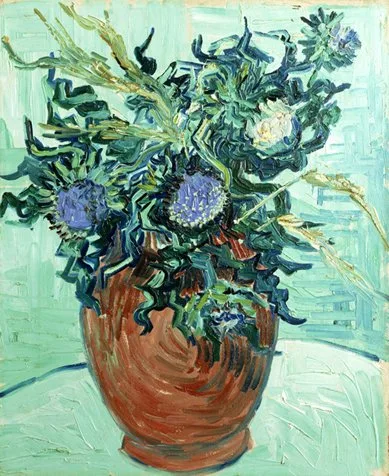
The flowers in this vase were not bought or cultivated. They are the kind that grow wild along a roadside or at the edge of a wheat field: thistles with their spiked, silver-green leaves, a scatter of wheat-coloured ears, and a few pale blooms mixed in among them.
Van Gogh had painted thistles before, in Arles and Saint-Remy, drawn to their aggressive silhouette and the violet crowns that sit oddly at odds with their armoured stems. Here three or four flowerheads, painted in blue-violet, press together at the centre of the bouquet, flanked by looser white blooms and the dry gold curls of grass.
The vase itself is a plain earthenware jug, rendered in warm rust and burnt sienna, its surface built from loose vertical strokes that leave the clay looking almost unglazed. It sits on a pale green-white surface that could be a table or a sheet, painted so thinly in places that the priming shows through.
Green Against Violet, Rust Against Both
Van Gogh set the whole composition against a background of mint and turquoise green, broken by darker jade strokes that suggest a wall or a piece of furniture without describing either in any detail. This green is the loudest colour in the painting, louder even than the flowers it surrounds, and it pushes the bouquet forward rather than letting it recede.
Against that field of green, the vase’s terracotta reads as the only warm note in the picture, a wedge of red-brown anchoring the lower third of the canvas. The blue-violet of the thistle heads sits between the two, close enough to the green in tone that the eye has to work to separate flower from background in places, which is part of what keeps the bouquet from looking static.
Dabs of white, in the petals and in the stray highlights on the leaves, are the only real pause in an otherwise saturated palette. There is almost no black in the picture; the darkest passages are made from deep blue-green mixed wet into wet, which is typical of the way Van Gogh built shadow in his Auvers still lifes.
Leaves Drawn Like Handwriting
The thistle leaves are the most graphic element on the canvas, each one drawn rather than blended, with a dark outline laid down first and then filled or left bare where the ground shows through. Some curl back on themselves in a single unbroken stroke, others fork into two or three points, giving the whole cluster a jagged, almost electric outline against the calm green behind it.
This is brushwork at speed. Van Gogh does not soften the thistle’s threat into something purely decorative; he keeps the plant’s spikes sharp and slightly hostile, even as he sets them in a domestic vase on a domestic table. The wheat ears, by contrast, are laid in with a lighter, more fluid touch, single curved strokes of pale gold that droop away from the mass of the bouquet.
Up close, the paint on the vase and background is thick enough to hold the ridges of individual brush passes, catching real light across the surface in a way a flat image cannot fully carry. It is worth remembering that this is a small picture, painted at 33.6 by 40.8 centimetres, worked at close range and at speed rather than built up over days.
What Stays on the Wall
The painting is held today by the Pola Museum of Art, its record listed in the public collection data at Wikidata under the identifier Q26221166 for anyone who wants to trace it further. It is a modest still life by the standards of Van Gogh’s Auvers output, without the drama of the wheat field paintings from the same weeks, but it carries the same restless hand.
Hung in a room with changing daylight, the picture behaves differently by the hour. Morning light picks out the cool greens and lets the violet thistle heads recede; by evening, under warmer artificial light, the terracotta vase and the gold wheat ears come forward and the green background cools further into shadow.
It rewards being looked at twice: once from across a room, where the shapes read as a simple bouquet in a jug, and once from close in, where the thistles resolve into the quick, deliberate marks of a painter working against time.
Sizes and materials for Vase with flowers and thistles are listed on its product page.
More from this collection
Bring this painting home
Choose a hand-painted oil reproduction for real brushwork, or an archival canvas print for a crisp museum-image edition. Every size preserves the original proportions.
View this work & options
Further reading
Verify the original in the Pola Museum of Art collection record and continue through related works in the catalogue.