
Still Life with Bottles and Earthenware: Story
A studio in his parents’ house, Nuenen, 1884
In December 1883 Vincent van Gogh moved back into his parents’ parsonage at Nuenen, a village in the Dutch province of North Brabant, and turned a room there into a makeshift studio. He was thirty years old, largely self-taught, and convinced that painting was a craft to be earned through repetition rather than waited for as inspiration.
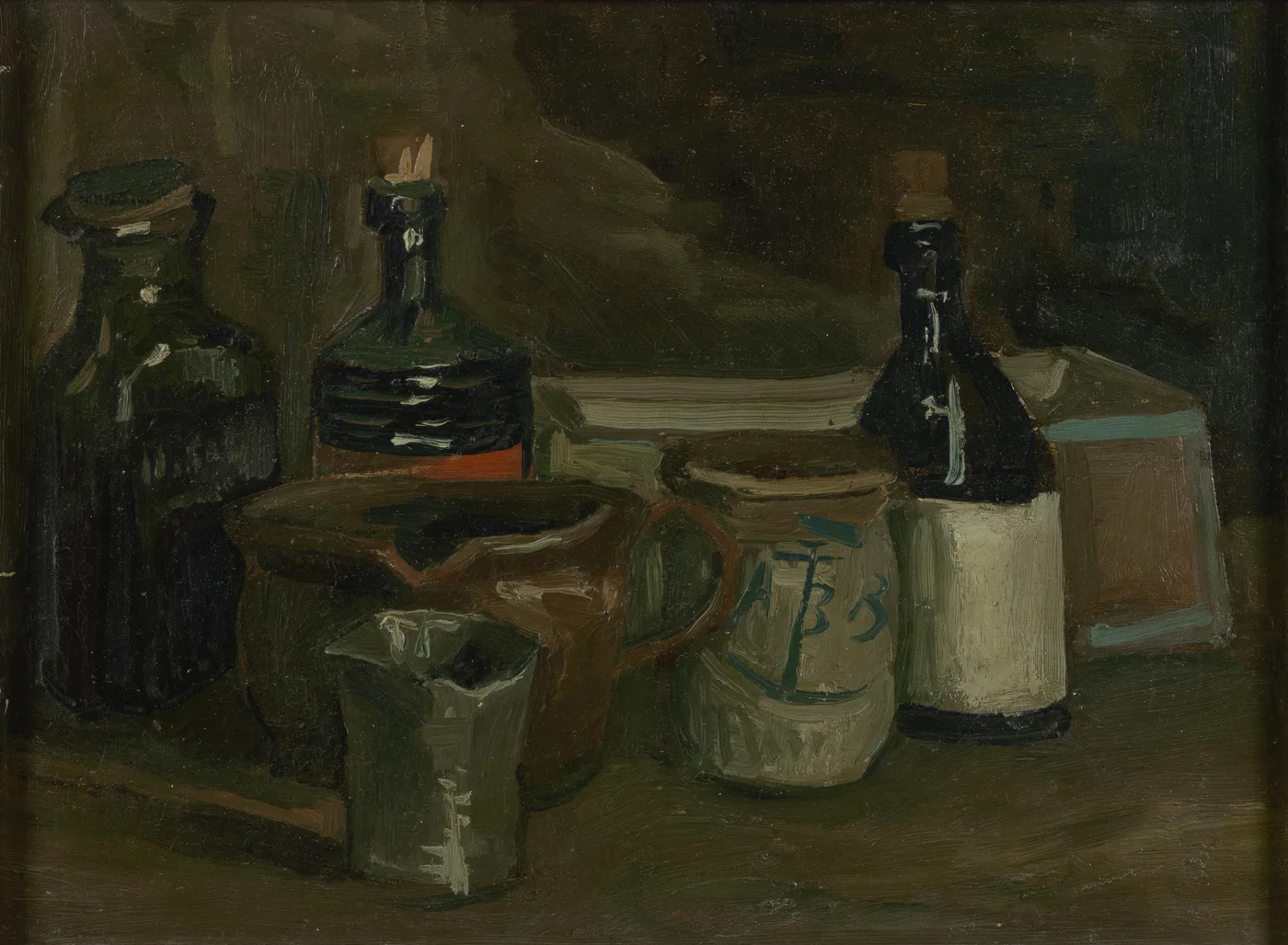
Through 1884 he worked his way from drawing into paint, setting himself modest, close subjects: peasant heads, hands at work, and the ordinary containers that stood about the house and the weaving sheds nearby. Still Life with Bottles and Earthenware belongs to this year of practice, made at a point when Van Gogh was still teaching himself to see in terms of tone before he trusted himself with colour.
The picture is small, 41.8 by 31.5 centimetres, closer to a study than a display piece, and that scale suits its purpose. It was made to be looked at from close, the distance at which the weight of paint on a bottle’s shoulder or the worn handle of a jug becomes visible.
What Van Gogh set out on the table
Two dark glass bottles anchor the left side of the composition, corked and so deeply green that the glass reads almost as black, broken only by a few strokes of grey-white where the light catches a rim or a shoulder. Set slightly forward of them, a stoneware jug with a broad, worn handle tilts against a low grey beaker, its clay the colour of rust and its lip left rough and uneven.
At the centre of the group stands a pale earthenware jar, its surface interrupted by a few loose strokes of blue that read as the ghost of a stencilled label, the kind of household lettering that told vinegar from oil, or salt from sugar, in a nineteenth-century Dutch kitchen. It is the one note of colour outside the brown-green range, and the eye keeps returning to it.
To the right, a third bottle rises taller and darker than the rest, its neck stoppered with a pale cork, its lower half wrapped in a band of cream that catches more light than anything else on the table. Behind the group, the corner of a box or parcel, its exposed side painted a dull pink-brown, closes off the composition and stops the eye running off the edge of the canvas.
Nothing here is fine china or good glass. These are working vessels, the kind that stood in a scullery rather than on a dining table, and Van Gogh painted them without any attempt to flatter them.
Working within a narrow band of colour
The palette Van Gogh chose is narrow by design: bitumen browns, olive greens, the near-black of old bottle glass, with a single passage of dull red-brown in the wall behind the jug. It is the earthy range art historians associate with his Dutch period, the one he set aside within two years once Paris and the Impressionists reached him, but here it does exactly what he wanted it to do.
The paint itself is laid on thickly in places, dragged and reworked around the handle of the jug and the shoulders of the bottles, so the surface carries a real, uneven relief. He was not smoothing his way to a likeness; he was building each form with separate, visible strokes, correcting as he went rather than covering his tracks afterwards.
That directness gives the objects their weight. The jug in particular looks heavy, its handle looks worn by an actual hand, because Van Gogh let the brush register the effort of finding its shape rather than disguising that effort once the shape was found.
Where the light lands
Light enters from the upper left and falls unevenly across the group, catching the shoulder of the nearest bottle, the rim of the beaker and the pale wrapping on the bottle at right, while the space behind the table dissolves into a loosely brushed, undefined brown. There is no clean background, no wall rendered as a flat plane; it reads instead as shadow that has been pushed around with a dry brush.
The table itself is barely distinguished from the wall behind it, both painted in the same dark, warm register, so the objects appear to rise out of the gloom rather than sit on a clearly lit surface. That compression is deliberate. It keeps the attention on the vessels themselves, and on the small, hard-won points where light actually lands.
On a wall, through the day
A painting this dark rewards a room where it can be looked at up close and in changing light, rather than one lit flat and evenly all day. In the low light of morning or evening, the browns deepen further and the few pale highlights, the cork, the jar’s rim, the wrapped base of the bottle, become the only points the eye can rest on.
Under a stronger lamp, or later in the day, the greens in the glass separate out from the blacks and the picture opens up a little, showing brushwork that stayed hidden in flatter light. It is a painting that asks to be returned to rather than glanced at once.
The original Still Life with Bottles and Earthenware is held by the Van Gogh Museum, part of the record of a young painter working, day after day in Nuenen, to earn the confidence he would need before he ever picked up the brighter palette for which he is now known.
Sizes and materials for Still Life with Bottles and Earthenware are listed on its product page.
More from this collection
Bring this painting home
Choose a hand-painted oil reproduction for real brushwork, or an archival canvas print for a crisp museum-image edition. Every size preserves the original proportions.
View this work & options
Further reading
Verify the original in the Van Gogh Museum collection record and continue through related works in the catalogue.