
Blossoming Almond Branch in a Glass with a Book: Story
Arles, and the First Sign of Spring
Vincent van Gogh reached Arles in February 1888, worn down by two years in Paris and chasing a harder, clearer light than the city could give him. He wanted colour that did not need explaining, the kind he had seen in Japanese prints, and he believed the south of France would show it to him.
He did not have to wait long. Within weeks of his arrival the almond trees came into flower, the first trees in Provence to blossom each year, ahead of the peach and apricot orchards he would soon paint standing in open fields under the Arles sky.
This small picture belongs to that same charged early season, but it never left the table. Rather than setting up outdoors among the trees, Van Gogh appears to have brought a single cut branch inside, stood it in an ordinary drinking glass, and painted it beside a book he had close at hand.
A Branch, a Glass, a Book
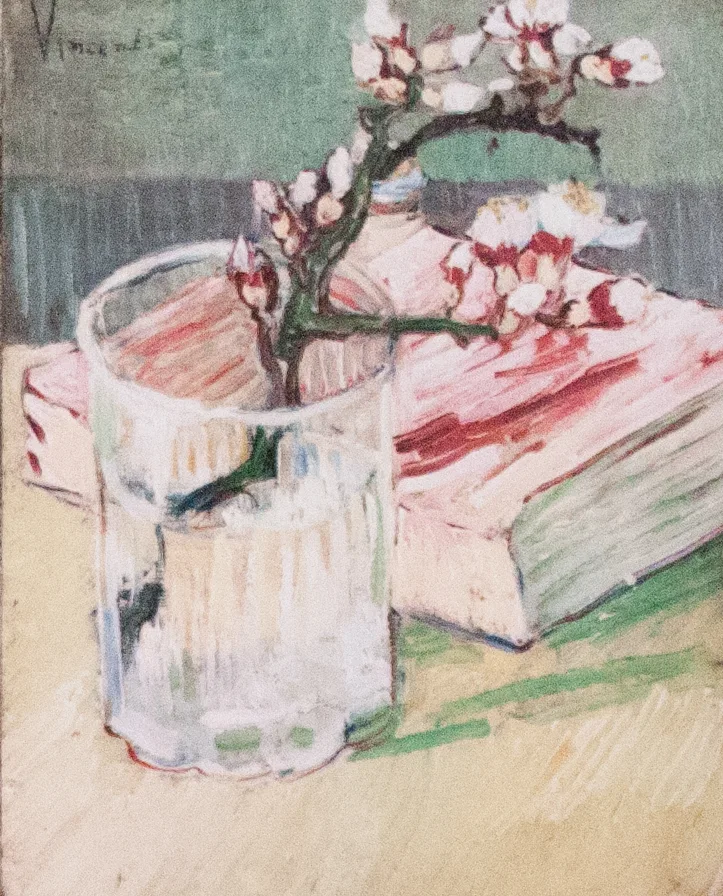
The branch arches up out of the glass, dark and angular, carrying clusters of white blossom flushed with pink and touched here and there with deeper red at the base of the petals. Some flowers are fully open, others still tight buds, so the whole spray reads as a moment caught mid-opening rather than a finished bouquet.
The glass itself is painted almost transparent, a few vertical strokes of white and grey standing in for the light passing through water and glass, with the dark green stem visible where it disappears below the rim. Beside it lies a closed book, its cover a warm rose pink, its fanned pages picked out in a thin band of yellow-green along the edge.
Both objects sit on a plain cream tablecloth, and the wall behind is laid in two broad, flat bands, a soft green above and a cooler grey-blue below, like a dado rail dividing a room. Van Gogh has signed the work “Vincent” in green paint at the upper left, letting the signature sink almost into the background tone rather than stand apart from it.
The Colour Arrangement
The picture turns on one contrast: the cool green of the wall against the warm pink-red of the book’s cover, with the white blossom caught between them, catching light from both sides. It is a small, deliberate exercise in the complementary colour pairings Van Gogh was working through that spring, tried here on a single closed volume rather than a whole orchard.
The cream of the tablecloth keeps the two stronger colours from fighting each other, giving the eye somewhere neutral to rest before it returns to the blossom at the top, which is where the picture’s real business lies.
At 19 by 24 centimetres, painted in 1888, this is one of the smallest studies from that Arles spring, closer in scale to a page turned over on a table than to a picture meant to be seen from across a room. The size asks for the kind of close, unhurried looking a reader gives a book, which suits the object placed beside the flowers.
How the Paint Sits
Van Gogh handled each material differently. The twigs are laid down in a few quick, dark, almost calligraphic strokes, the blossom in loaded dabs of white and pink applied wet, so that petal and highlight sit together on the surface rather than being blended smooth.
The book is built from flatter, more deliberate strokes, its cover given weight and edge with directional hatching that suggests the fanned pages without describing any single one of them. The glass, by contrast, is barely painted at all: a scaffold of pale lines and a shadowed rim doing the work of something the eye reads as clear.
Nothing here is laboured. The picture has the pace of something painted in one sitting, each part judged quickly and left alone once it held its place, which is part of why the blossom still looks freshly cut rather than posed.
On a Wall, Through the Day
Hung at eye level in a room that gets changing daylight, the picture shifts with it. Morning light draws out the cool green of the wall behind the branch; evening light warms the pink of the book and the blush in the petals, so the same small canvas reads slightly differently depending on the hour.
What stays constant is the quiet of the arrangement itself, a cut branch, a glass of water, a closed book, set down together and looked at hard for as long as it took to paint them. It is a small domestic pause held still in the middle of a season Van Gogh spent mostly working outdoors, and it rewards the same close, unhurried attention it was given when it was made.
Sizes and materials for Blossoming Almond Branch in a Glass with a Book are listed on its product page.
More from this collection
Bring this painting home
Choose a hand-painted oil reproduction for real brushwork, or an archival canvas print for a crisp museum-image edition. Every size preserves the original proportions.
View this work & options
Further reading
Verify the original in the collection record and continue through related works in the catalogue.