
Flowering Peach Tree: Story, Meaning & Brushwork
A memorial in blossom
Van Gogh had left Paris in February 1888, worn down by two years among the Impressionists and hungry for a light he associated with Japanese prints. He arrived in Arles to find the town still cold, orchards bare, and settled into rooms above a restaurant while he waited for spring.
In those same weeks came news from the Netherlands: Anton Mauve had died. Mauve, a leading painter of the Hague School, was married to Van Gogh’s cousin Jet and had given him his first proper lessons in oil painting back in 1881, before the two men fell out.
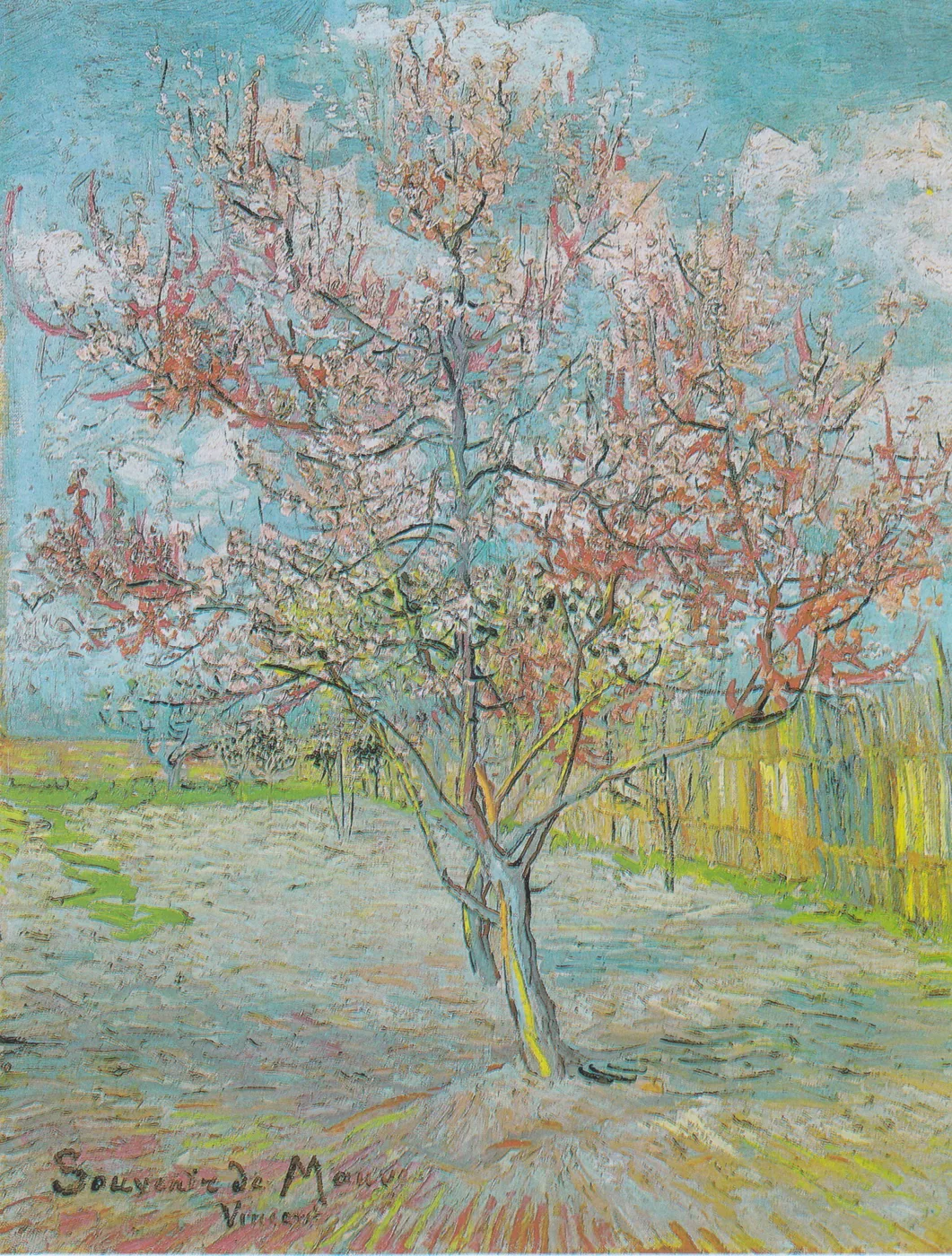
Van Gogh answered the news with a picture rather than a letter. He chose a young peach tree just breaking into flower, and in the lower left corner of the canvas he inscribed, in his own hand, “Souvenir de Mauve, Vincent”; a memento, offered in paint, to a man who had once believed in him.
Reading the canvas
The tree fills most of the frame, its trunk splitting low and leaning slightly left of centre before opening into a fan of branches. Pink and white blossom crowds the upper two thirds of the canvas, thicker on the right where the branches reach furthest into the light.
Behind it the sky is a pale, restless blue, broken by loosely brushed white cloud that echoes the shape of the blossom below. Van Gogh has kept the horizon low, a strip of green and ochre ground running back to a low garden wall or fence painted in strokes of yellow and olive green on the right-hand side.
The foreground is bare cultivated earth, raked in short diagonal touches of ochre, pink and pale green that fan out from the base of the trunk like sunlight. It is here, half hidden in that loose brushwork, that the dedication to Mauve sits, easy to miss and clearly not meant to dominate the picture.
One tree among fourteen
Flowering peach tree was painted in the spring of 1888, one of around fourteen orchard pictures Van Gogh made in Arles within a few short weeks. Blossom does not wait, and he worked fast, moving between trees and canvases as each variety came into flower in turn.
He wrote to his brother Theo at the time describing the intensity of the campaign, aware that peach, apricot and pear blossom would last only days once opened. The orchard paintings, taken together, record that single compressed season more precisely than any date alone could.
Most of the series simply describes the blossom Van Gogh saw around him. This canvas is the exception: the only orchard picture from that spring carrying a dedication, which sets it apart from its companions even though it shares their scale, palette and quick handling.
The hand that painted it
The blossom is built from short, loaded strokes of pink, white and touches of coral red, applied close together so the individual dabs read, from a normal viewing distance, as a mass of flower rather than as separate petals. Up close the paint sits proud of the canvas in ridges where the brush was heavily charged.
The trunk and branches are drawn rather than modelled, dark contour lines laid over pale underpainting, a habit Van Gogh was borrowing from the Japanese woodblock prints he collected. Blue and grey-green shadow runs along one side of the trunk, giving it a sense of roundness without any real gradation of tone.
Colour throughout is kept high and clean: blue against pink, green against ochre, with almost nothing muddied or greyed down. It is a fast, confident kind of painting, made by someone who had worked out, after years of drawing, exactly how few marks a form actually needs.
On a wall, in changing light
At 59.5 by 73 centimetres, the original is a modest, intimate object, closer in scale to a window than to a mural. Its size suits a wall that is seen up close, day after day, rather than one glimpsed from across a room.
Morning light draws out the cool blue-greens of the sky and shadow; by lamplight in the evening the pinks and ochres warm and come forward, and the tree seems to stand further out from its background. Few paintings reward that kind of daily attention as generously as a canvas built almost entirely from touches of raw colour.
The original Flowering peach tree is held by the Kröller-Müller Museum. It remains one of the clearest surviving records of the spring Van Gogh spent in Arles, a season that began in mourning and turned, tree by tree, into some of the most direct painting of his life.
Sizes and materials for Flowering peach tree are listed on its product page.
More from this collection
Bring this painting home
Choose a hand-painted oil reproduction for real brushwork, or an archival canvas print for a crisp museum-image edition. Every size preserves the original proportions.
View this work & options
Further reading
Verify the original in the Kröller-Müller Museum collection record and continue through related works in the catalogue.