
Garden with Butterflies: Story, Meaning & Brushwork
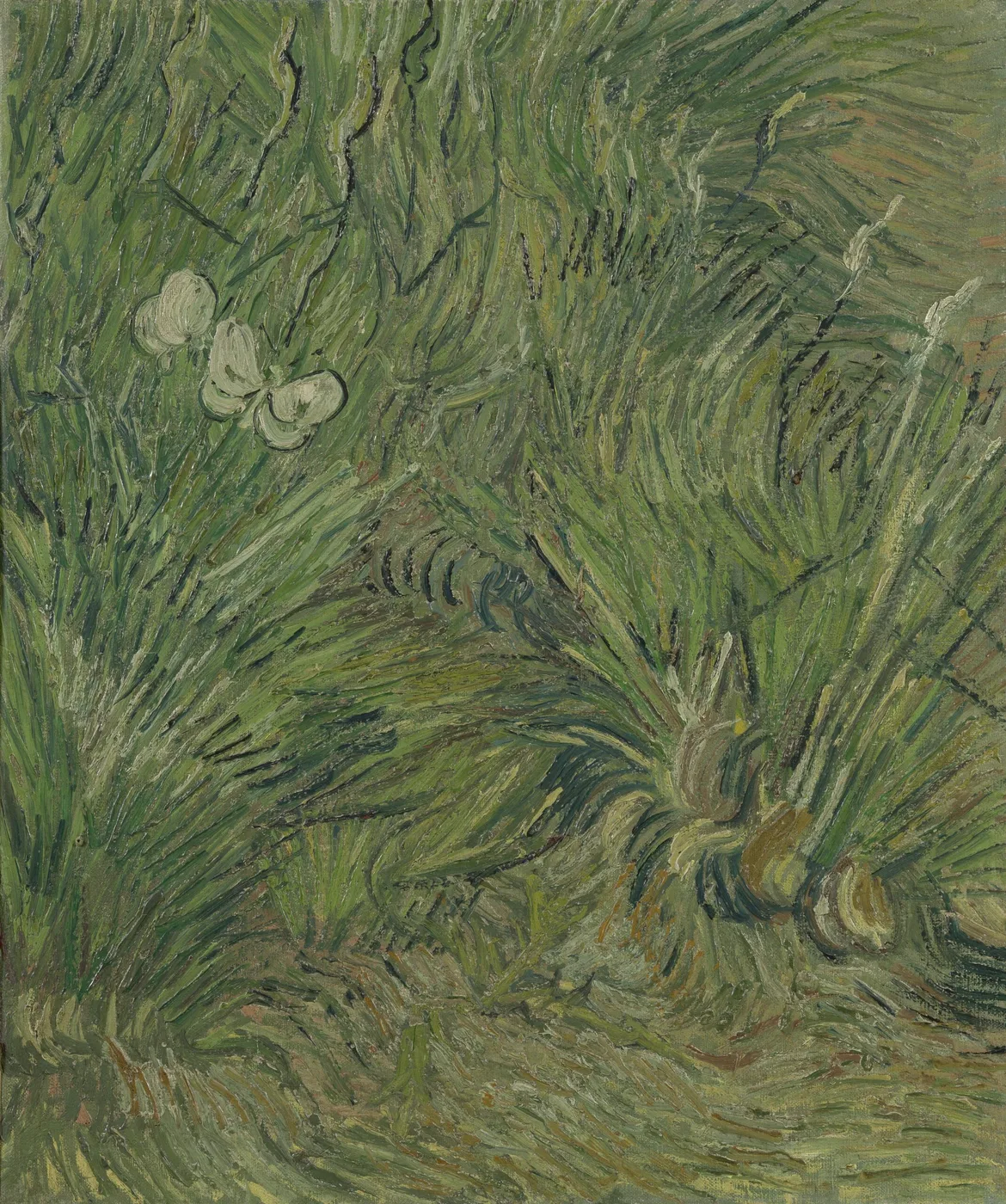
In May 1890, Vincent van Gogh left the asylum at Saint-Rémy-de-Provence and settled in Auvers-sur-Oise, a village on the Oise river north-west of Paris, where he placed himself under the informal care of Dr Paul Gachet. The weeks that followed were the most productive of his life, a stretch of near-daily painting that ran until his death there on 29 July 1890. Garden with Butterflies belongs to that final burst of work.
Rather than a view of the village, a wheat field or a church, Van Gogh chose to paint a patch of garden so small it might be a single stride across. There is no sky in it, no horizon, nothing to place the viewer anywhere except kneeling at the edge of the grass. It is one of several close, cropped studies of undergrowth he made that spring, pictures that give up landscape space in favour of pure surface.
Grass Without a Horizon
The canvas is filled edge to edge with grass. There is no sky, no distance, no middle ground in the usual sense, only the ground itself pushed right up to the eye, as though the painter had lain down at the edge of a lawn and looked straight into it.
Along the bottom edge a narrow strip of bare, ochre-brown earth breaks the green, the only hint of a path or a border. Lower right, a cluster of pale, bulbous plant forms, something like young onions or garlic pushing up through the soil, sits among sprouting green shoots, its rounded shapes a contrast to the blade-straight grass around it.
In the upper right corner, a set of faint diagonal lines cuts across the grass, the only suggestion of anything built: the edge of a wall, a trellis or a fence, barely legible against the green. It is the single architectural note in an otherwise entirely vegetal picture.
White Wings Against Green
Two pale butterflies, wings edged in dark outline, hover mid-left of the canvas, their cream-white bodies caught as though mid-flutter, one slightly behind the other. They are small against the field of grass, and it takes a second look to find them, which is part of what the picture asks of a viewer.
The palette is almost entirely green, but not one green: sage, olive, near-black in the shadowed roots of the grass, streaks of pale yellow-green where the light catches the tips of the blades. Warm ochre and brown gather around the bulbs and the strip of earth at the base, the only warmth in an otherwise cool field.
There is no strong directional light and no cast shadow to speak of. The light reads as even and diffuse, the kind that falls on an overcast day or in the dappled cover of a garden corner, so that the picture works through texture and rhythm rather than through drama of illumination.
The Weight of the Brush
Van Gogh laid the grass down in long, sweeping strokes that follow the direction each blade would actually grow, dense and repeated until the whole surface reads as woven or combed rather than painted stroke by stroke. Darker greens went in first, with paler highlights dragged over them while the paint beneath was still workable.
The paint sits thick in places, ridges of impasto that catch real light across the canvas surface, a texture no print can flatten out entirely. It is handling built for speed, the kind that comes from painting outdoors against changing light rather than composing carefully in a studio.
The butterflies and the bulb-forms carry a heavier, darker contour than the grass around them, which gives them a presence the surrounding strokes do not have. Against the calligraphic sweep of the grass, these few firmly outlined shapes are what the eye settles on first.
On a Wall, in Changing Light
At 45.7 by 54.8 centimetres, the original is a modest, intimate size, close to the scale of the patch of garden it depicts. It rewards the kind of close, unhurried looking that a small canvas asks for, rather than the glance across a room that a larger landscape invites.
Hung where daylight shifts through the day, it changes accordingly. Cool morning light draws out the blue-greens and the near-black shadows in the grass; warm evening light pulls the ochre and amber in the earth and the bulbs forward, so the same canvas reads differently at nine in the morning and at six in the evening.
From across a room it can read as an almost abstract field of green, pattern before subject. Step closer and it resolves into grass, two butterflies and a corner of turned soil, the last ordinary garden Van Gogh gave his full attention to before the summer ended. The original remains in the Van Gogh Museum.
Sizes and materials for Garden with Butterflies are listed on its product page.
More from this collection
Bring this painting home
Choose a hand-painted oil reproduction for real brushwork, or an archival canvas print for a crisp museum-image edition. Every size preserves the original proportions.
View this work & options
Further reading
Verify the original in the Van Gogh Museum collection record and continue through related works in the catalogue.