
Ravine with a Small Stream: Story & Meaning
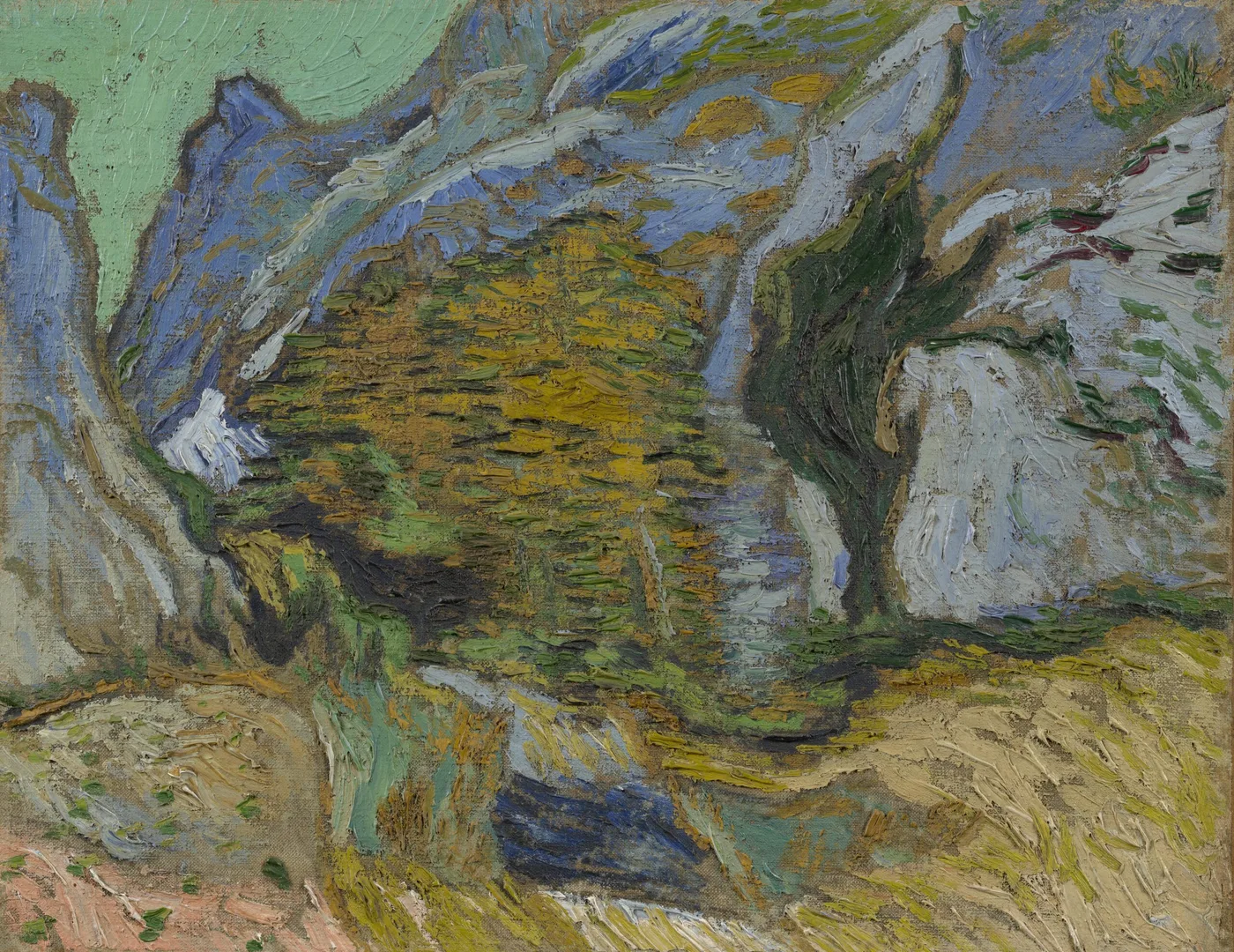
By the autumn of 1889 Vincent van Gogh had spent several months as a voluntary patient at the asylum of Saint-Paul-de-Mausole, and the terms of his stay had loosened enough to let him paint outside its walls under supervision. He walked into the hills above Saint-Rémy-de-Provence and found a fold of rock cut by a thin stream, one of the ravines of the Alpilles that he returned to more than once that year. Ravine with a Small Stream, painted in 1889, is his record of that place, a canvas small enough to have been carried and worked on the spot.
He was painting at speed that year, aware that his illness could take his ability to work before it took anything else, and a gorge suited that urgency. Rock has no fixed outline once you start looking at it closely, water will not sit still for a sketch, and the light in a narrow cutting changes within minutes. Van Gogh met all three head on rather than smoothing them into a calmer view.
A Gorge Above Saint-Paul-de-Mausole
The asylum sat below the Alpilles, and Van Gogh’s supervised excursions took him up into terrain that had nothing tidy about it: broken limestone, scrub, and cuttings where water had worn through rock over centuries. These were not the cultivated fields or garden corners he had painted earlier in his stay.
A ravine offered no horizon and no open sky to organise the composition around. Instead the eye is pushed down into a cleft, walled in on both sides, with only a sliver of sky left visible at the top. That confinement became the subject as much as the rock itself.
The painting measures 41 by 32 centimetres, a modest size that matches its origin as a study made in front of the motif rather than a large exhibition piece worked up afterwards in the studio. It is held today by the Van Gogh Museum.
Rock, Bramble and a Thread of Water
A wedge of pale mint-green sky sits in the upper left corner, the only open space in the whole picture. Everything else is rock and growth pressing in from both sides: pale grey-white cliff face on the right, banks of blue-grey and violet stone curving across the top and down the left edge.
At the centre, filling most of the canvas, is a dense mound of undergrowth painted in ochre, gold and olive green, so thick and clotted with paint that it reads almost as a separate object lodged in the gorge. Below and around it, in pale blue-grey and white touches, runs the small stream that gives the painting its title, no more than a thread of water threading past the rock.
The foreground is a band of dry grass in ochre, yellow and a faint pink, the colour of late-season growth rather than anything lush. There are no figures here, no path leading the eye out; the gorge simply closes around itself, rock above, water below, and that tangle of gold at the centre holding the whole composition together.
Paint Laid Like Undergrowth
Van Gogh handled the rock and the foliage differently, and the difference is visible up close. The cliff faces are built from long, sweeping strokes that follow the direction of the strata, grey and white pulled through with blue and a little violet, laid on thickly enough to catch light across their ridges.
The central mass of bushes is worked in short, packed, almost woven strokes of gold, ochre and dark green, one on top of another until the paint stands proud of the canvas. It is the densest, most worked passage in the whole picture, and it is where the eye lands first.
Colour does much of the structural work. The blue and violet of the rock sit against the orange and gold of the undergrowth as near-complementary pairs, a contrast Van Gogh used deliberately to make each colour push harder against the other. Nothing here is blended or softened; every stroke keeps its own direction and its own edge.
On a Wall, in Changing Light
A painting built from this much impasto behaves differently depending on where it hangs. In direct or raking light, the ridges of paint across the rock and the knotted strokes of the thicket throw their own small shadows, so the surface has a texture that shifts through the day.
In softer, indirect light the same canvas settles and reads more as colour and shape, the blue-grey stone framing that dense gold centre. Both readings are legitimate; the painting was built to hold up under scrutiny at close range and to still register its shape from across a room.
What stays constant is the sense of being enclosed. Van Gogh gave this gorge no way out for the eye, and a reproduction of it on a wall carries that same pressure into a domestic room: rock on both sides, a thread of water, and a tangle of gold that refuses to resolve into anything calmer.
Sizes and materials for Ravine with a Small Stream are listed on its product page.
More from this collection
Bring this painting home
Choose a hand-painted oil reproduction for real brushwork, or an archival canvas print for a crisp museum-image edition. Every size preserves the original proportions.
View this work & options
Further reading
Verify the original in the Van Gogh Museum collection record and continue through related works in the catalogue.