
Vase with Pink Roses: Story, Meaning & Brushwork
By the spring of 1890, Vincent van Gogh had spent close to a year moving in and out of crisis at the asylum of Saint-Paul-de-Mausole, on the edge of Saint-Rémy-de-Provence. The cypresses and the wheatfields that had absorbed him through the winter, painted in the open air whenever his condition allowed it, gave way in his final fortnight there to something smaller and calmer. He began working from cut flowers set on a table indoors, a subject that asked nothing of the weather or his nerves.
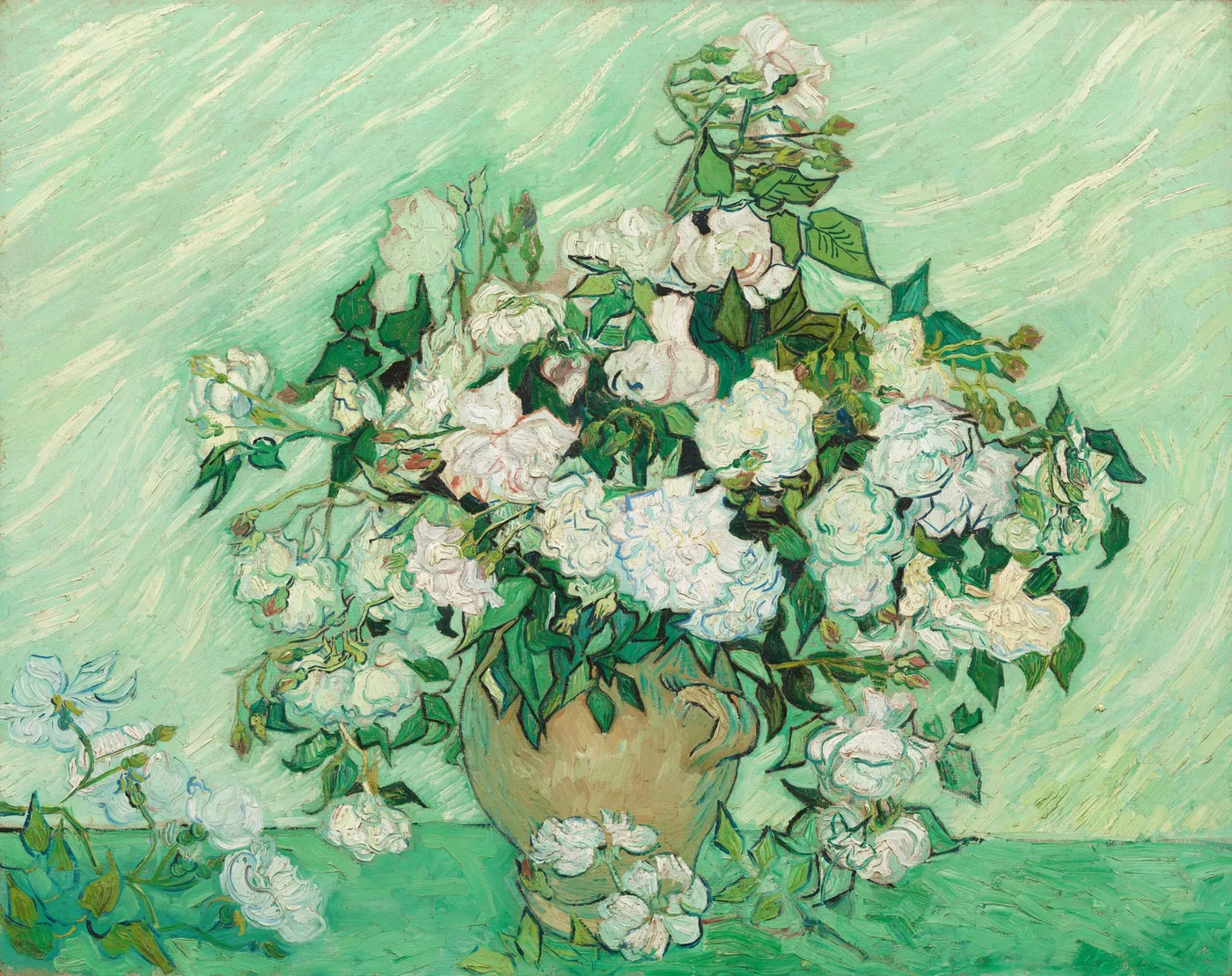
Still Life: Vase with Pink Roses, painted in 1890 on a canvas measuring 90 by 71 centimetres, belongs to this brief, deliberate change of subject. It sits among a short run of flower pieces, roses and irises among them, that Van Gogh made in the days before he left Provence for good, bound north for Auvers-sur-Oise and the care of Doctor Gachet.
A Last Task Before Leaving the South
Van Gogh had asked his brother Theo, on whose support he depended, whether he might risk the journey north once the worst of his attacks seemed to have passed. Painting flowers in the meantime kept his hand occupied without the physical strain of a long day outdoors chasing changing light across a field. It was steady, repeatable work, and it let him think about colour alone, without a horizon or a human subject to organise.
He had spent the year experimenting with how far a still life could carry feeling on colour and touch rather than incident. A vase of roses, seen close and lit evenly, gave him exactly that kind of problem to solve one more time before the move.
There is nothing valedictory in the handling. The paint goes down with the same urgency found in his views of the asylum garden, as though the subject’s stillness was a formal choice rather than a sign of fatigue.
A Bouquet Set Against Green
The canvas is dominated by a loose, overflowing bunch of roses gathered in a simple earthenware vase, its handle just visible at one side. The blooms crowd upward and outward well beyond the rim, some fully open and turned to face the viewer, others still tight buds on bending stems that spill over the vase’s edge and onto the table below.
Behind the flowers, the wall is worked in sweeping, almost weather-like strokes of pale green, laid on in long diagonal passes that give the background its own restless energy. The tabletop beneath the vase is a deeper, more solid green, anchoring the arrangement and separating it clearly from the wall behind. A few loose stems and blossoms rest at the lower left, outside the vase entirely, breaking the symmetry of the main bunch.
The eye lands first on the dense cluster of blooms at the centre of the canvas, where the paint is thickest and the petals are built up in short, layered touches. From there it moves outward along the reaching stems, following the rhythm of the leaves rather than any single line.
Paint Handled at Speed
Van Gogh worked this canvas quickly, in strokes that describe structure as much as surface. Each rose is built from a handful of curved, loaded touches rather than blended shading, so that the petals keep the shape of the brush that made them.
The leaves are set down in short dashes of two or three distinct greens, dark and cool where they fall into shadow among the stems, brighter and warmer where they catch the light near the top of the bouquet. This variation gives the foliage weight and depth without any softening of the edges.
The background strokes run in a different direction entirely from the flowers, a current of pale green moving diagonally across the wall. That contrast between a calm, contained bouquet and a background in constant visible motion is one of the picture’s most distinctive effects.
A Pink That Time Has Softened
The roses read today as close to white, touched here and there with a faint warmth at the edges of the petals. This is not how Van Gogh left them. The red lake pigments he used for pink in several of his 1890 flower paintings were notoriously fugitive, prone to losing their colour under light over the course of decades.
What remains is a bouquet quieter than the one he painted, its pink reduced to a memory held mostly in the title. The green setting, built from more stable pigments, has kept far closer to its original strength, which is part of why the picture now reads as a study in cool colour rather than the warmer contrast Van Gogh intended.
Living With the Painting
Hung in a room that gets shifting daylight, the picture changes character through the day. In flatter light the green strokes of the background read as pattern, almost abstract; when the light rakes across the surface, the ridges of paint in the petals and leaves throw small shadows of their own, and the brushwork becomes the main event.
It rewards a spot where it can be approached closely as well as seen from across a room. From a distance the bouquet reads as a single soft mass of white and green; up close, it resolves into dozens of individual, decisive strokes, each one a record of a hand moving fast in the last days before a long journey north.
Sizes and materials for Still Life: Vase with Pink Roses are listed on its product page.
More from this collection
Bring this painting home
Choose a hand-painted oil reproduction for real brushwork, or an archival canvas print for a crisp museum-image edition. Every size preserves the original proportions.
View this work & options
Further reading
Verify the original in the collection record and continue through related works in the catalogue.