
Still Life with Cheese and Bread: Story, Meaning & Brushwork
Vincent van Gogh arrived in Paris in the early months of 1886 and moved in with his brother Theo, an art dealer whose flat put him within walking distance of the galleries showing the new Impressionist and Neo-Impressionist painting. He was thirty-three, largely self-taught, and still carrying the heavy, earthbound palette he had built in Nuenen painting peasants and potato eaters. Paris asked something different of him: brighter colour, looser handling, a willingness to work from life at speed rather than from long, laboured studies.
Still life became his testing ground that year. A bottle, a plate, a loaf of bread cost nothing and complained about nothing, and could be arranged and rearranged on a table until the light and the paint agreed with each other. Dozens of these small canvases survive from 1886, food and crockery mostly, painted not as finished statements but as exercises in seeing.
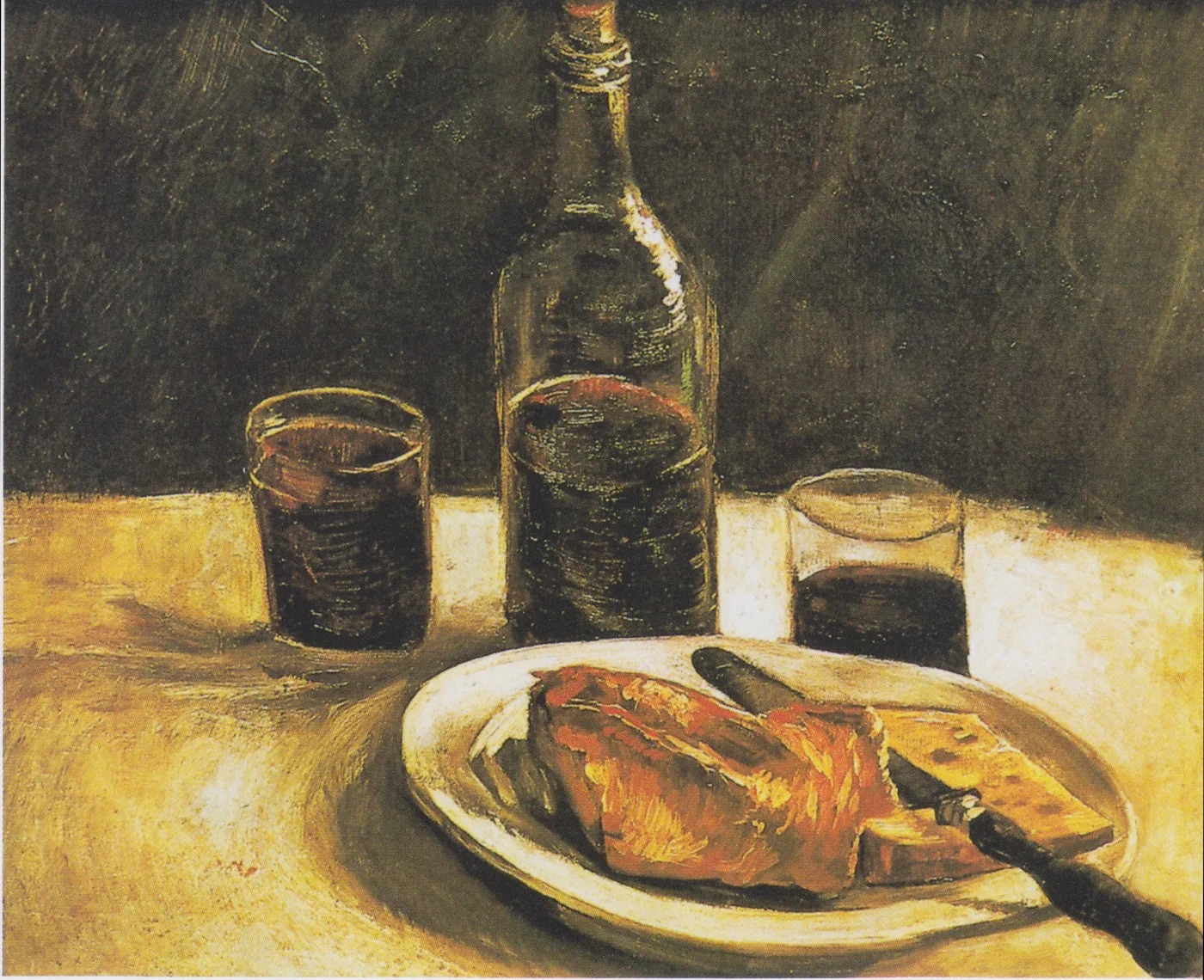
This canvas, originally titled Still Life with Bottle, Two Glasses, Cheese and Bread, belongs to that run of studies. It is a modest object, just 46 by 37.5 centimetres, and it reads like one painter working quickly through a single problem: how to make glass, cloth, bread and shadow sit convincingly on the same plane.
A Table Set for One
The arrangement is plain and almost ceremonial in its plainness. A corked bottle stands at the centre of the table, flanked by two glasses, each holding a measure of dark wine. In front of them a white plate carries a torn hunk of bread, a wedge of cheese, and a knife laid across at an angle, its dark handle jutting toward the viewer.
Light enters from the left and does most of the storytelling. It catches the rim of the tablecloth and the curve of the plate in near-white, runs a bright seam down the shoulder of the bottle, and picks out a thin fleck of reflection on the rim of each glass. Everything behind that line of light sinks into a deep greenish-brown ground that reads almost black in places.
Colour in this picture is restrained but not dull. The background is a smoked olive-brown, the tablecloth a warm ochre that pales to cream where the light strikes it directly, and the bread and cheese glow rust-orange and gold against the white plate. The wine in the glasses is painted almost black, a colour so dense it barely admits the glass around it.
The eye lands first on that plate, the one patch of near-white in the lower half of the canvas, and from there travels up the pale line of the tablecloth to the bottle standing sentinel in the middle distance. It is a simple meal for one person, set out and then, it seems, left untouched.
An Honest, Unfussy Hand
Van Gogh built the dark background out of visible diagonal hatching, short strokes laid one against the next rather than blended into a flat wash. The marks do not disguise themselves; you can trace the direction the brush travelled across the canvas, stroke by stroke, the way you might trace pencil hatching in a drawing.
Against that hatched darkness the bottle and glasses carry thicker, more deliberate touches of paint, small ridges of impasto where a highlight needed to sit proud of the surface rather than sink into it. The reflections on the glass are built from a handful of confident dabs rather than careful glazing, and they read as glass precisely because they are so economical.
The tablecloth is handled more loosely still, broad strokes of ochre and cream that let the weave of the canvas show through in places. The bread and cheese, by contrast, are worked with slightly denser paint and warmer colour, so the one object meant to hold appetite in the picture is also the one built with the most physical presence.
None of this is the broken, prismatic colour Van Gogh would adopt within a year of painting it, once Pointillism and the southern light of Provence had worked on him further. It is instead a picture of a painter still thinking in browns and greys, but doing so with a directness and a confidence in the brush that already sets it apart from his Nuenen work.
What the Painting Does in a Room
A composition this dark rewards patience. In flat daylight the background reads as a single sombre mass, and the eye is pushed firmly toward the lit plate and the warm colour of the bread. Under a lamp in the evening, the same painting changes register entirely: the highlights on the bottle and glasses catch the light source directly, and the picture starts to glow from a few small points rather than presenting itself all at once.
That shift is worth knowing before hanging it, because a still life built this way is not a picture that gives everything up in a glance. It asks to be looked at again as the light in the room moves through the day, which is a quality better suited to a kitchen, a dining room, or any space where people sit still for long enough to notice it.
The original, still known by its full title of Still Life with Bottle, Two Glasses, Cheese and Bread, is held by the Van Gogh Museum. Painted in Paris in 1886, at the point where Van Gogh’s Dutch training and his new French surroundings were still working themselves out on the same canvas, it remains a small, exact record of an artist teaching himself to see.
Sizes and materials for Still Life with Bottle, Two Glasses, Cheese and Bread are listed on its product page.
More from this collection
Bring this painting home
Choose a hand-painted oil reproduction for real brushwork, or an archival canvas print for a crisp museum-image edition. Every size preserves the original proportions.
View this work & options
Further reading
Verify the original in the Van Gogh Museum collection record and continue through related works in the catalogue.