
Still Life with Vegetables and Fruit: Story
Nuenen, Winter Light, and a Painter Teaching Himself
In 1884 Vincent van Gogh was living in his parents’ house in Nuenen, a village in the Dutch province of North Brabant, and working through a long, deliberate apprenticeship in his own painting. He had come to painting late and knew it, and he treated the kitchen table as a classroom: whatever produce was to hand became an exercise in weight, shadow and tone.
He was not yet the painter of sunflowers and cypresses. The Brabant years were about mastering the dark end of the palette, about learning how a form sits in space before he ever let colour run loose. Still Life with Vegetables and Fruit belongs to that stretch of work, painted in 1884 alongside studies of weavers, peasant heads and the cottages around him.
These still lifes were not made for exhibition. They were made because a cabbage or a pear would hold still on a table for as long as he needed it to, and because getting the weight of a vegetable right, in paint, was a problem worth solving before he tackled anything harder.
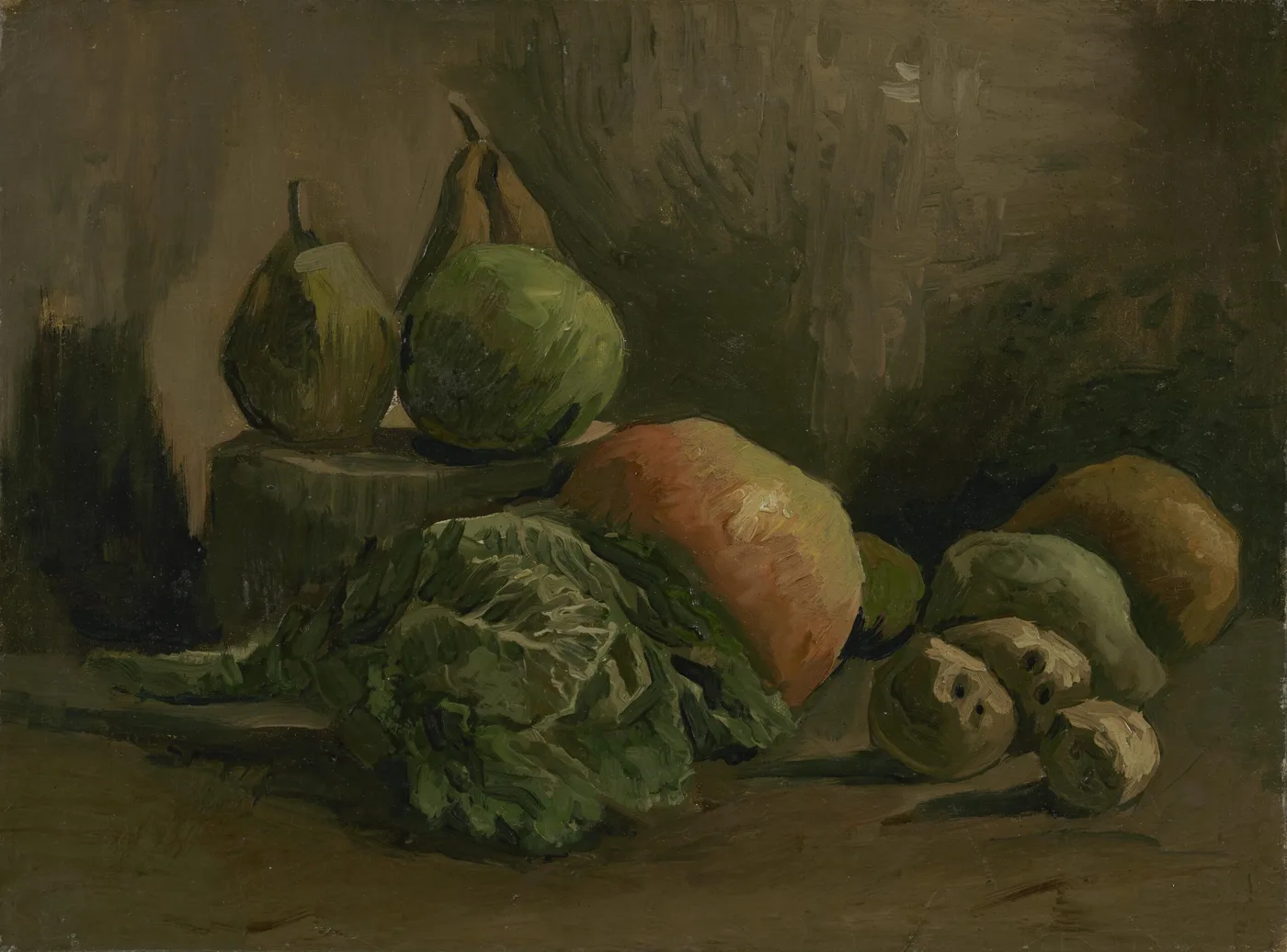
A Cabbage, Two Pears, and a Blush of Colour
Two pears stand upright at the back of the arrangement, balanced on a wooden block against a bare ochre wall. Their stalks point up and slightly apart, and their skins are painted in mottled greens with a darker line marking where one pear’s shadow falls across the other.
In front of them a savoy cabbage sprawls loosely across the table, its outer leaves splayed open so that the pale, crimped ribs catch what little light there is. It is the largest single shape in the picture and the one Van Gogh has let flop most naturally, in contrast to the upright poise of the pears behind it.
Laid diagonally across the cabbage is a single elongated root vegetable, its skin a warm rose-pink shading into cream, standing out as the one passage of real colour against all the greens and browns around it. To the right, a small cluster of round fruit, quite possibly apples, huddles together, each one marked with a pale, scarred patch where a stalk or blemish has been picked out in a stroke of near-white. A larger, softer yellow-green pear sits at the very edge of the group, half cropped by the frame.
Everything rests on a dark, undefined tabletop that gives no clue to the room around it. The eye lands first on that pink root vegetable, the only warm note in an otherwise sober arrangement, before working outward to the cabbage’s torn leaves and the pears standing sentinel behind.
Paint Laid Like a Furrowed Field
Van Gogh’s brush moves in short, dragged strokes here, closer to the marks a knife might leave than to a fine, blended finish. The cabbage leaves are built from overlapping streaks of dark and pale green, laid one over another until the crimped edges of the leaf seem to lift off the surface.
The background wall is worked in long vertical strokes of ochre and grey-brown, dragged downward so that the wall itself seems to have a grain, almost like weathered wood. Where the wall meets the shadow behind the produce, the paint darkens into near-black, giving the whole group a stage-lit isolation.
Black outlining appears around the pears and the apple-like fruits, a habit Van Gogh carried from his study of tonal drawing, used here to pin each rounded form firmly in place. Highlights are laid on thickly, in single loaded strokes, catching the light on the shoulder of a pear or the scarred top of an apple without any attempt to soften the transition.
Nothing in the handling is decorative. Every stroke does the work of describing weight, roundness or shadow, which is exactly the discipline Van Gogh was setting himself in these Nuenen exercises.
A Modest Panel with a Quiet Weight
The original measures 43.2 by 32.3 centimetres, a size that suits its subject: this was never meant to command a room from a distance, but to reward someone standing close, the way a person might actually stand at a kitchen table. Van Gogh painted it as a study, not a showpiece, and the modest scale keeps that intimacy intact.
The painting now belongs to the Van Gogh Museum, which holds it as one of the surviving records of his Nuenen period, the years immediately before he left the Netherlands and began the transformation that would define the rest of his career.
On a Wall, as the Light Shifts
Hung where daylight reaches it, the picture changes more than its dark palette suggests it should. In flat overcast light the greens and browns sit close together and the composition reads almost as a single mass, cabbage, pears and root folding into one shape.
Under a lower, warmer light, evening light especially, the pink root vegetable and the pale highlights on the pears separate out again, and the thick ridges of paint throw their own small shadows across the surface. It is a picture that rewards being looked at more than once, in different light, by someone willing to stand close enough to see the brush do its work.
Sizes and materials for Still Life with Vegetables and Fruit are listed on its product page.
More from this collection
Bring this painting home
Choose a hand-painted oil reproduction for real brushwork, or an archival canvas print for a crisp museum-image edition. Every size preserves the original proportions.
View this work & options
Further reading
Verify the original in the Van Gogh Museum collection record and continue through related works in the catalogue.