
The Church at Auvers: Story, Meaning & Brushwork
Auvers-sur-Oise, June 1890
In May 1890, Vincent van Gogh moved to the village of Auvers-sur-Oise, a short train ride north of Paris, to be near Dr Paul Gachet, who had agreed to watch over his health. He rented a room above the Ravoux inn and began painting almost daily, drawn to the thatched cottages, the wheat fields on the plateau above the village, and the twelfth-century church that stood on rising ground at its centre.
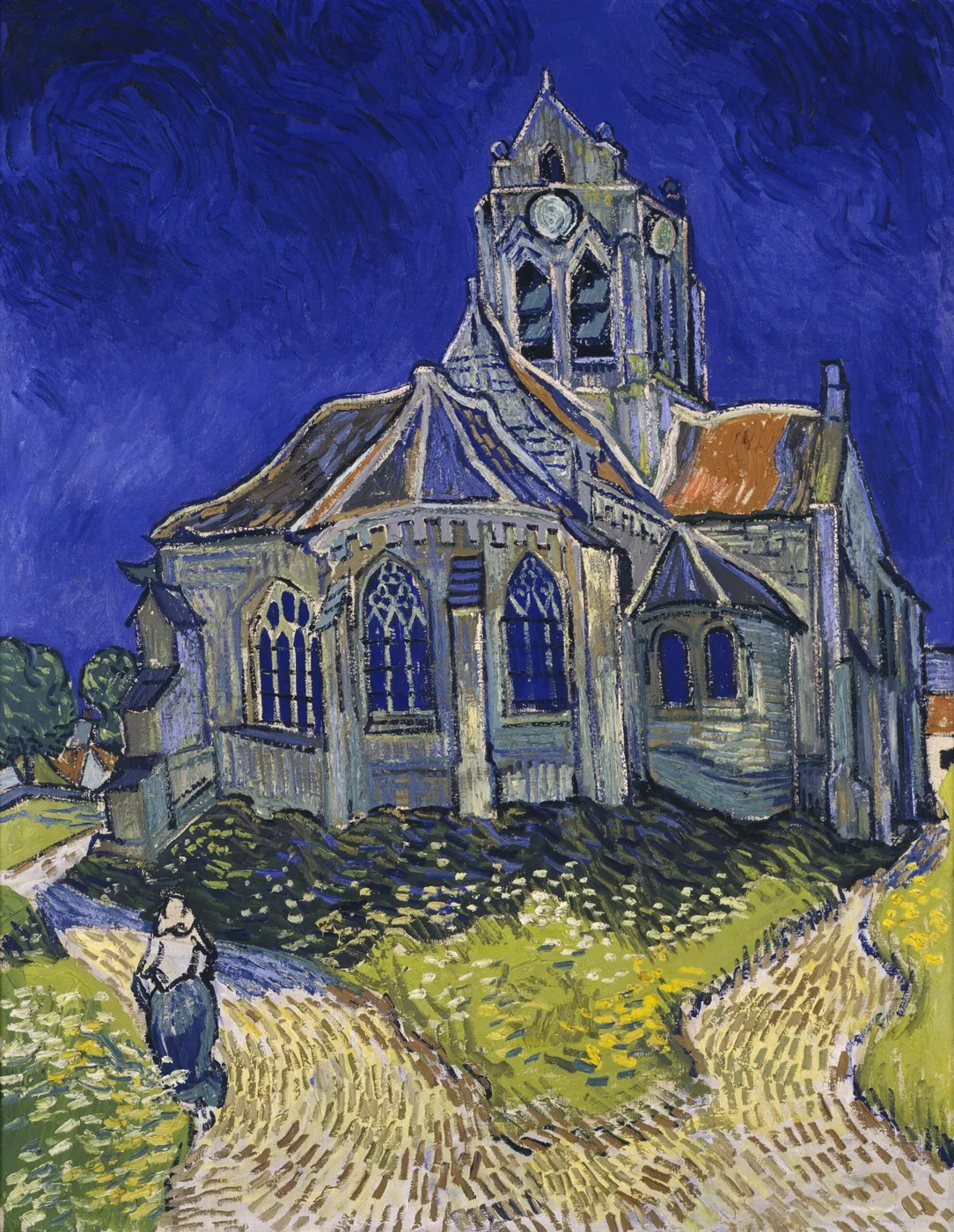
The Church at Auvers belongs to that final burst of work. Painted in 1890 on a canvas measuring 74 by 94 centimetres, it shows the building from below and slightly to one side, so that the tower looms rather than simply stands. The painting is now held by the Musée d’Orsay in Paris. Van Gogh worked fast that summer, sometimes finishing a canvas in a single sitting, and this picture carries that urgency in every stroke.
He described the subject in a letter to his sister Wilhelmina that June, telling her he had painted the village church on a larger scale, the stone reading as violet against a sky of plain, deep blue. Within weeks of finishing it he was dead, and the painting has since been read as one of the clearest statements of his state of mind in those final days.
A church built from cobalt and shadow
The church fills most of the canvas, its Gothic tower rising into a sky the colour of ink just before full dark. Two small rose windows sit high in the tower, and pointed lancet windows run along the nave below, but not one of them shows any light. The glass reads as flat, saturated blue and black, so a building meant to hold candlelight and a congregation appears sealed and empty instead.
Patches of orange and rust break across the roofline where the tiles catch what light there is, the one warm passage in an otherwise cold picture. The walls are built from grey, green and lilac strokes laid side by side rather than blended, so the stone seems to shift as the eye moves across it.
Van Gogh took liberties with the architecture. The real church at Auvers has a door on this side; here there is none, and the walls tilt and swell as though the building were made of something softer than stone. The distortion is deliberate: he was painting how the church felt to stand in front of, not a record for an architect.
Two paths and a single figure
Below the church, a grassy bank rises to meet the building, scattered with short dabs of yellow that read as wildflowers among the green. A track forks at the base of this bank, one arm curving away pale and cool toward the left, the other laid in strokes of pink, ochre and grey that suggest a rougher, sunlit road to the right.
This fork was Van Gogh’s invention, as much as the missing door. No such junction exists at the real site, but it gives the lower half of the canvas a structure to answer the mass of the church above, pulling the eye down and out toward the viewer.
A single woman in a blue dress walks along the left-hand path, seen from behind, small against the building she is passing. She is the only figure in the picture, and she is already halfway out of it, which leaves the church to dominate the scene entirely on its own terms.
The paint itself
Up close, the surface is built from thick, unmixed colour dragged straight from the tube and worked while still wet. Dark blue contour lines run around the edges of the tower and the window frames, holding each shape together much as lead lines hold a piece of stained glass.
The sky is not one blue but many, laid in short curling strokes that never quite settle, so the darkness around the tower seems restless even though nothing in it moves. Against that field, the church stands in comparatively steady, upright strokes, which is part of why it reads as solid despite its odd, bending walls.
Colour is doing the work that shading would do in a more conventional picture. The orange roof sits against the blue sky as its near opposite on the colour wheel, and the same pairing repeats in miniature across the canvas, in the yellow flowers against the green grass and the warm path against the cool one beside it.
On the wall
Hung in a room with changing daylight, the painting behaves differently by the hour. In low light the blues merge into something close to black, and the church reads first as a silhouette; brighter light draws out the violets and greens in the stone and separates the tower from the sky behind it.
It rewards the kind of looking that most pictures on a wall never get, a second and third pass once the eye has settled past the obvious shape of the building. What stays is the sense of a place seen at the edge of exhaustion, painted by a man in the last weeks of a life that was, by then, running out of road.
Sizes and materials for The Church at Auvers are listed on its product page.
More from this collection
Bring this painting home
Choose a hand-painted oil reproduction for real brushwork, or an archival canvas print for a crisp museum-image edition. Every size preserves the original proportions.
View this work & options
Further reading
Verify the original in the Musée d'Orsay collection record and continue through related works in the catalogue.