
Weaver at an Open Window: Story, Meaning & Brushwork
In December 1883 Van Gogh moved back into his father’s parsonage at Nuenen, a small village in North Brabant, after a difficult stretch in The Hague. He was nearly thirty, largely self-taught, and determined to become what he called a “peasant painter” in the tradition of Millet. Through 1884 he worked his way through the people and trades of the village: diggers, spinners, and above all the weavers who still worked hand looms in their cottages.
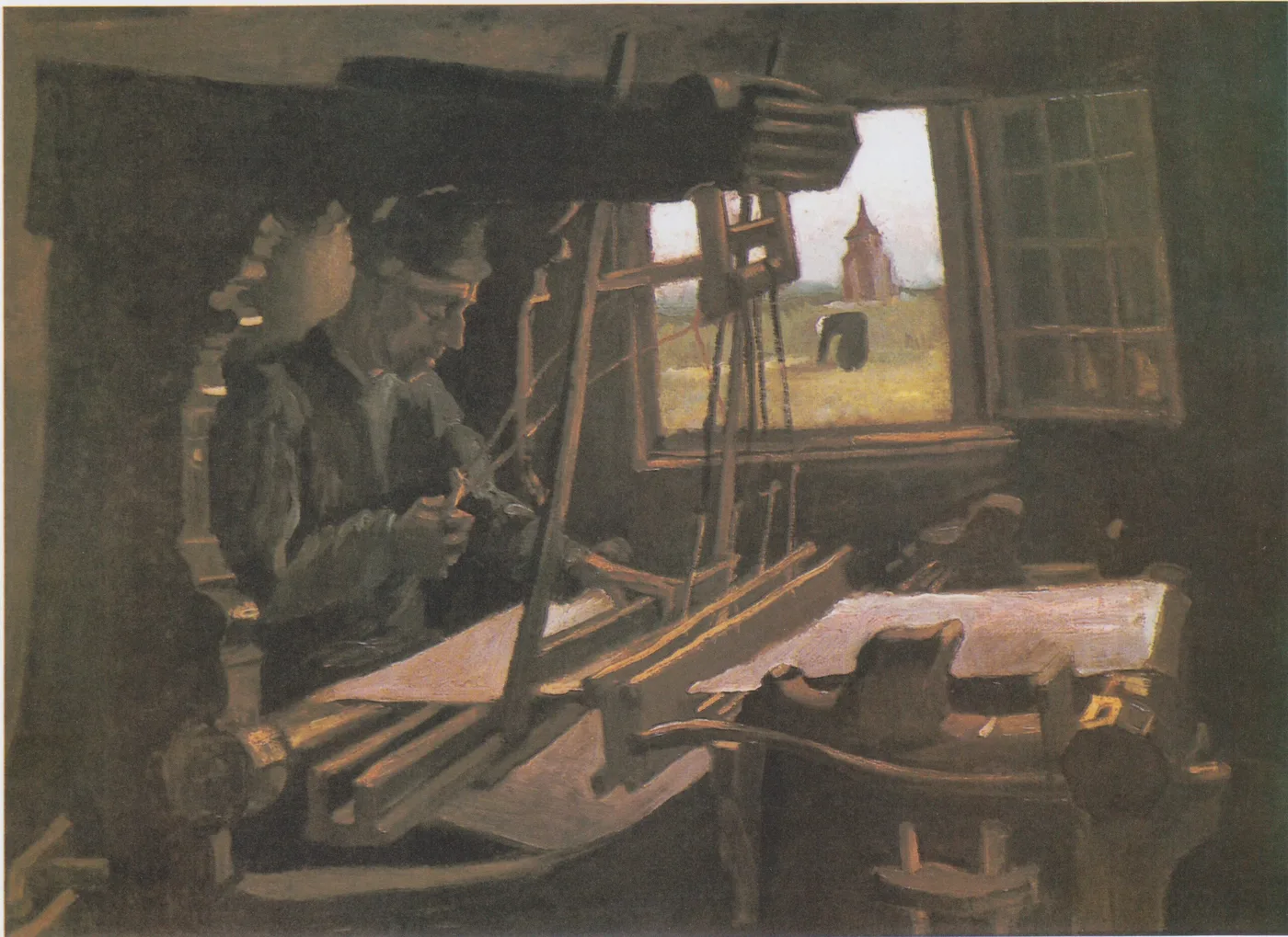
Weaver at an Open Window with View of the Tower of Nuenen, painted that year, belongs to this sustained campaign. Van Gogh returned to the subject of the weaver at his loom perhaps a dozen times in 1884, treating the loom itself almost as a portrait sitter, an engine of wood and thread that filled a cottage room and swallowed the man who worked it.
A Trade Losing Ground
Handloom weaving was already a trade in decline by the 1880s, squeezed by mechanised mills elsewhere in the Netherlands and Belgium. The weavers Van Gogh painted in Nuenen were among the last generation to work this way in their own homes, often in poor light and cramped rooms built around the loom rather than the other way round.
He was not a neutral observer of this. Van Gogh saw in the weaver’s confinement something close to his own situation: a solitary figure bent to repetitive, exacting labour, largely unseen by the wider world. He wrote often to his brother Theo about wanting to paint working people with the same seriousness given to portraits of the wealthy.
The weaver series let him practise a specific problem: how to make a large, mechanically complex object read clearly in paint without turning it into a diagram. The loom in this canvas is not simplified. Its uprights, treadles, and taut warp threads are built up stroke by stroke until the machine feels as solid and particular as the man inside it.
Inside the Cottage
The weaver sits low and half turned away, hands at work among the threads, almost absorbed into the dark bulk of the loom that surrounds him on three sides. Van Gogh gives him no heroic pose and no direct gaze out at the viewer. He is simply there, doing the job, caught mid-motion the way a photograph might catch a hand still moving.
Behind him the room falls away into shadow, its walls and beams barely differentiated from one another. Then, cut into that darkness, the window: a hinged casement thrown open, its panes catching a cool daylight that the rest of the cottage does not share.
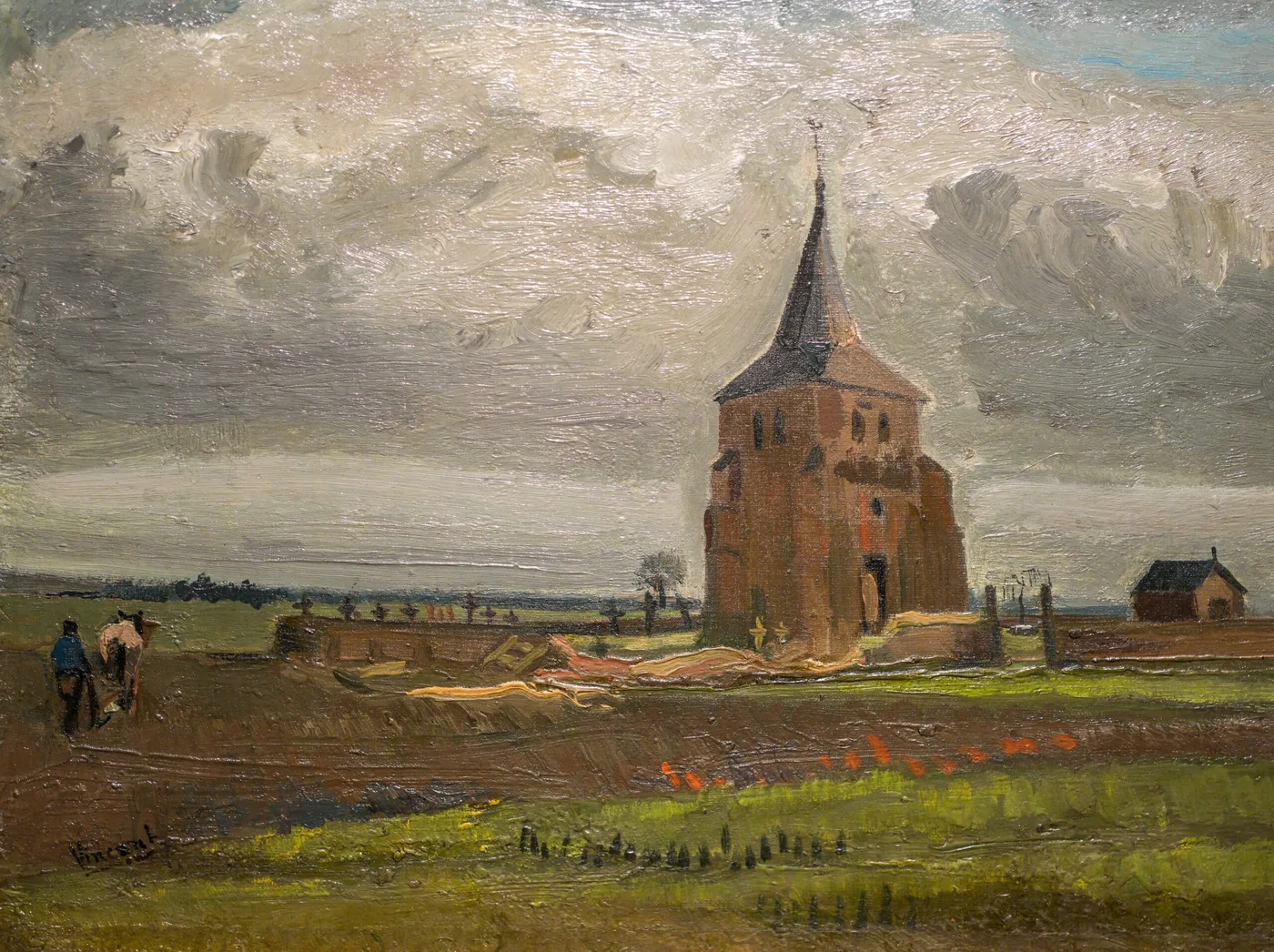
Through the window Van Gogh places a fragment of the village outside, a stretch of grass, a grazing animal, and rising above them the old tower of Nuenen’s church. That tower appears again and again in his work from this period. His father served the local Reformed congregation, and the medieval tower, then already slated for demolition, seems to have held a personal weight for him beyond its use as a landmark.
Colour Kept on a Short Leash
The palette belongs entirely to what is usually called his Dutch period: bistre browns, dull ochres, umbers, and greens so muted they read almost as greys. Van Gogh had not yet seen Impressionist colour firsthand, and here he was still working in the tonal, low-key manner he had studied from Dutch masters and from his own reading of colour theory.
Within that narrow range he is exact about value. The loom’s timbers are painted in layered darks that still let the eye separate one strut from the next. The weaver’s clothing sits a shade lighter, enough to pull the figure forward from the woodwork without breaking the room’s overall hush.
Every value in the cottage is pitched to make the window read as genuinely bright by comparison, even though the sky beyond it is a restrained, unsaturated white. It is a controlled contrast rather than a dramatic one, and it is the single decision that gives the whole canvas its structure.
The brushwork itself varies with the subject. Loom and wall are built from short, dry, directional strokes that follow the grain of the wood. The window frame and the view beyond are laid in more smoothly, a small passage of calmer paint handling that lets the eye rest after crossing the busy machinery.
What the Eye Meets First
Because the room is so dark and the window so comparatively lit, that rectangle of daylight is where the eye lands within a second or two of looking, before it works backward into the gloom to find the weaver and then the loom that dwarfs him. Van Gogh has, in effect, built a small light source into a large dark painting and let it do most of the compositional work.
At 93 by 68.5 centimetres, the canvas is large enough that the loom’s timbers register close to their true scale, which matters: this is a picture about the physical bulk of a working object as much as it is about the man operating it.
On a Wall
Hung in a room with modest, changeable daylight, the painting behaves the way its subject does. In dim light the cottage interior recedes almost to nothing and the window becomes the whole point of focus, a small bright event in a field of brown. As the room brightens, the loom’s structure resolves out of the shadow, strut by strut, and the weaver himself becomes easier to find.
That shift is not a flaw to be lit around; it is close to the point of the composition. The original hangs today with the Bavarian State Painting Collections, but reproduced at scale for a study, an office, or a quiet living room, it keeps doing the same quiet work: rewarding a second and third look with details the first glance missed.
Sizes and materials for Weaver at an Open Window with View of the Tower of Nuenen are listed on its product page.
More from this collection
Bring this painting home
Choose a hand-painted oil reproduction for real brushwork, or an archival canvas print for a crisp museum-image edition. Every size preserves the original proportions.
View this work & options
Further reading
Verify the original in the Bavarian State Painting Collections collection record and continue through related works in the catalogue.