
Daubigny’s Garden: Story, Meaning & Brushwork
In May 1890, Vincent van Gogh left the asylum at Saint-Remy and settled in Auvers-sur-Oise, a village on the Oise north of Paris where Dr Paul Gachet could keep watch over his health. He had barely two months left to live, and he used them at a pace that still startles art historians: close to seventy paintings in seventy days. Among the gardens, wheatfields and portraits of that final stretch, one subject stood apart from the rest, chosen not for its novelty but for the name attached to it.
A painter’s homage in Auvers
Charles-Francois Daubigny had lived and worked in Auvers years earlier, and Van Gogh had long admired him as one of the painters who prepared the ground for Impressionism. Daubigny’s house and garden were still standing when Van Gogh arrived, tended by his widow, and the younger painter asked to set up his easel there.
To paint that particular plot of ground was to place himself, quietly and without fanfare, in a line of French landscape painting he felt he belonged to. It was less a tourist’s view of a pretty garden than one artist paying respect to another on the artist’s own territory.
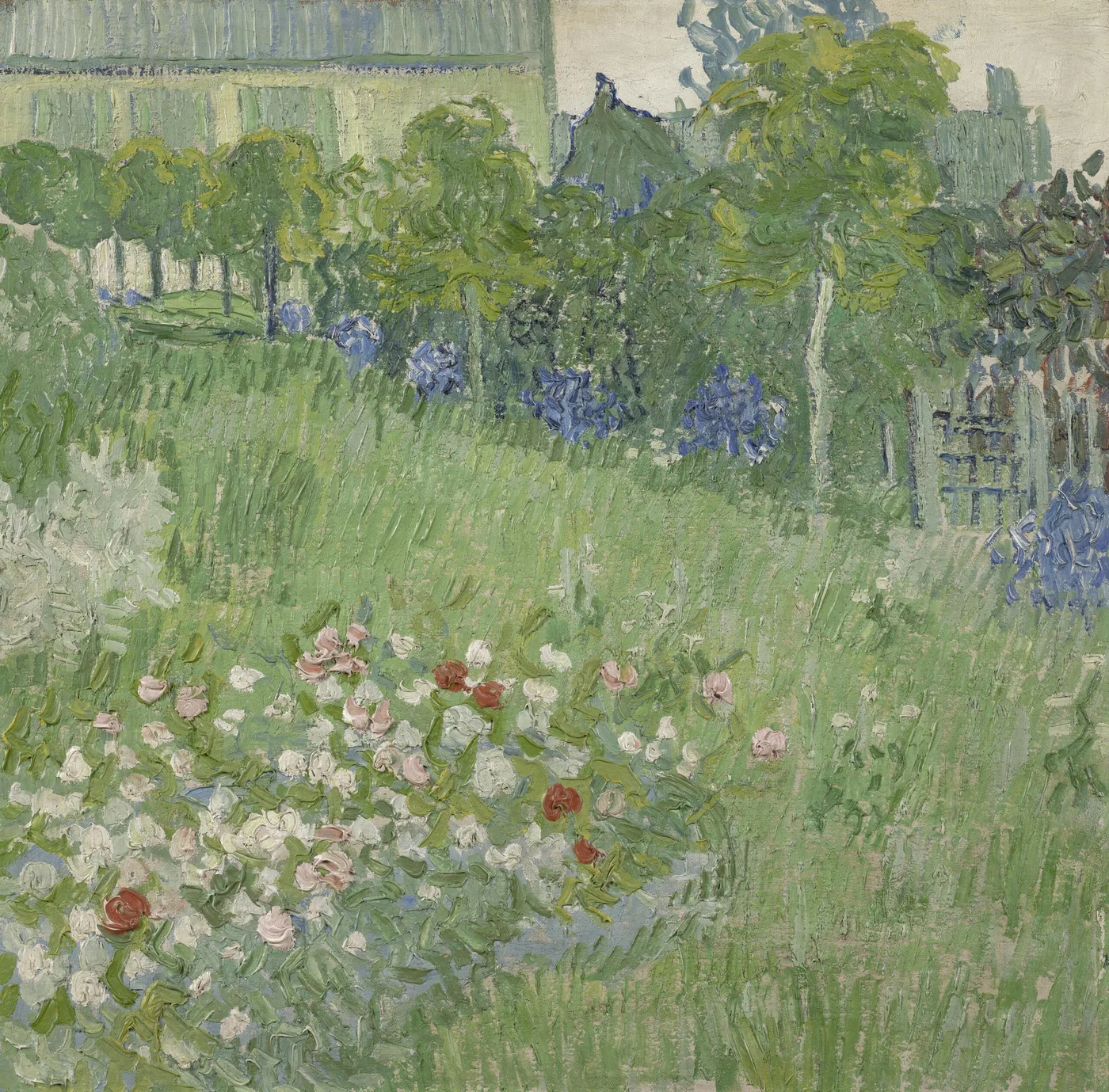
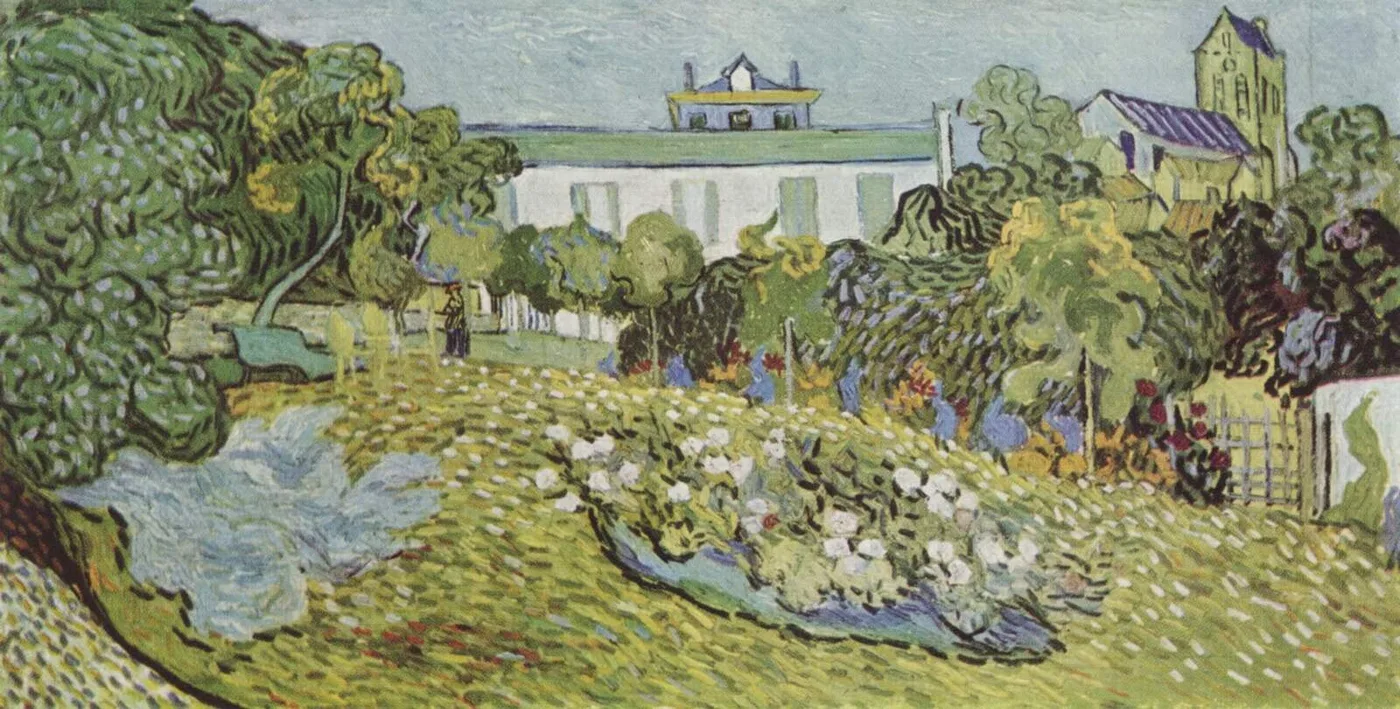
Van Gogh painted Daubigny’s Garden in July 1890, in the last weeks of his life. The canvas now held by the Van Gogh Museum measures 29 by 42 centimetres, a modest size that let him work quickly, standing close to his subject rather than at a studio remove.
What the canvas holds
The garden climbs the picture from front to back rather than receding into a conventional distance. At the top, a pale house with a green roof and shutters sits behind a dark screen of trees, its wall catching the same cool light as the sky above it.
Below the treeline, tall stems of blue flowers stand among the foliage, their colour the one clear note of contrast against so much green. A fence and a wooden trellis close the garden on the right, marking the edge of Daubigny’s property without shutting the view off completely.
The lower half of the canvas is lawn, painted as a long unbroken slope of grass rendered in short, upright strokes of varied green. In the near foreground, at the lower left, a bed of roses breaks the grass with dabs of white, pink and deep red, the only warm colour Van Gogh allowed himself in the whole composition.
Nothing in the painting asks to be read as a symbol. It is a garden observed directly, built from what stood in front of the easel that July, house, hedge, flowerbed and lawn, arranged with an eye for how the shapes stack against one another up the canvas.
How the paint sits on the surface
Van Gogh’s brush moves in short, repeated strokes throughout, laid side by side rather than blended. The grass is built from dozens of individual green touches, some cooler and greyer, some brighter and closer to yellow, so the lawn reads as a woven surface rather than a flat field of colour.
The trees behind the house are denser and darker, applied with a loaded brush that leaves ridges of paint standing proud of the canvas. Against that weight, the blue flowers and the rose bed are picked out with quicker, lighter touches, small enough that they resolve into blossoms only from a short distance back.
There is no pencil line holding any of it together. Every edge, the roofline, the fence, the border of the flowerbed, is a boundary between two areas of brushwork rather than a drawn contour, which is what gives the whole surface its restless, handmade texture.
The painting in a room
Hung where daylight reaches it, Daubigny’s Garden answers back. Morning light draws out the cool blues in the flowers and the shadowed side of the house; by evening the greens warm and the rose bed becomes the brightest thing in the picture.
It rewards the kind of looking a garden itself rewards, unhurried and repeated, since the eye finds a different passage of brushwork each time it returns. A small canvas painted quickly in a real garden, it still carries the concentration of a man who knew exactly how he wanted to spend the time he had left.
Sizes and materials for Daubigny’s Garden are listed on its product page.
More from this collection
Bring this painting home
Choose a hand-painted oil reproduction for real brushwork, or an archival canvas print for a crisp museum-image edition. Every size preserves the original proportions.
View this work & options
Further reading
Verify the original in the Van Gogh Museum collection record and continue through related works in the catalogue.