
Self-Portrait with Straw Hat and Pipe: Story
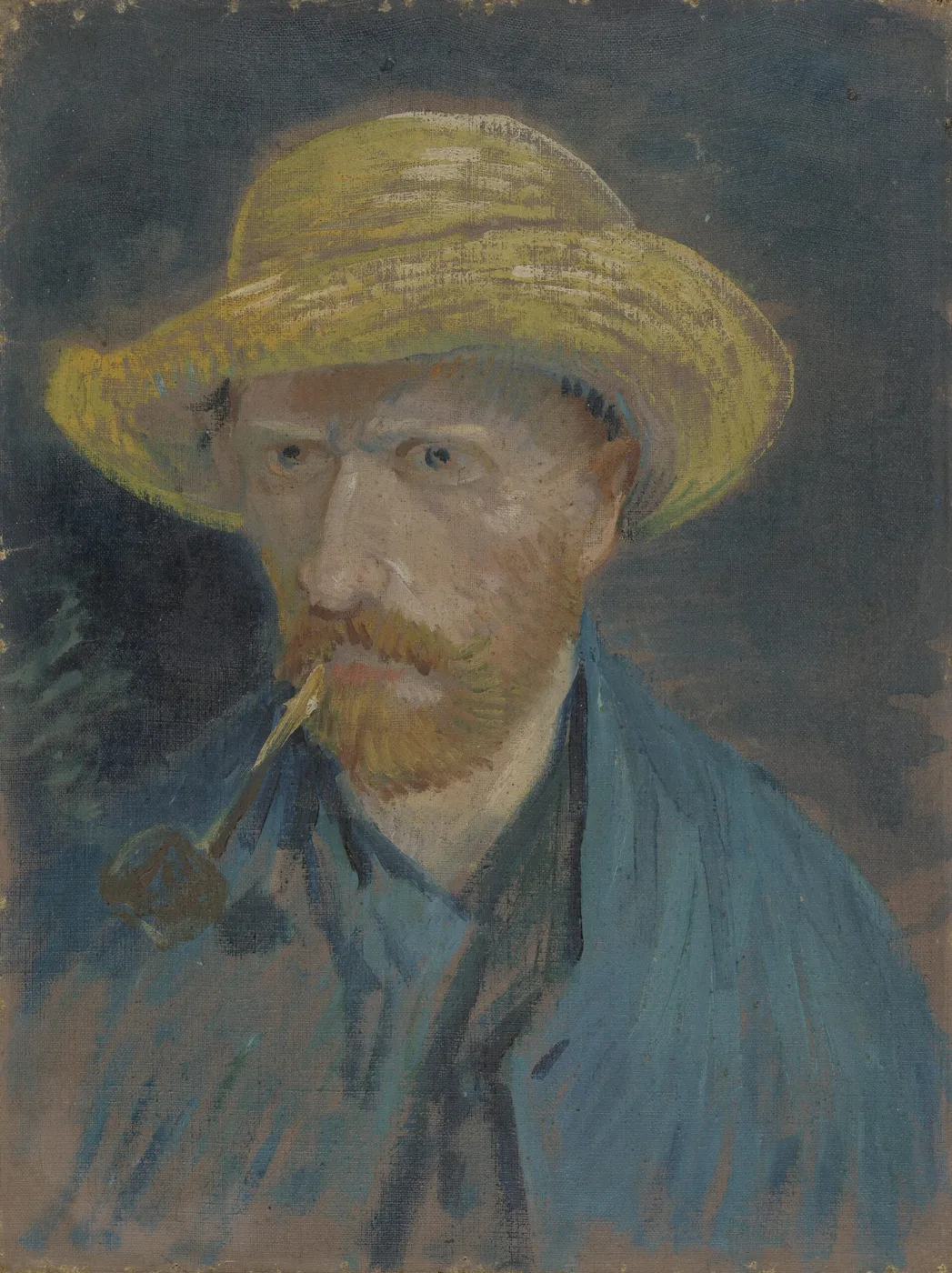
By the spring of 1887 Vincent van Gogh had been living in Paris for over a year, sharing an apartment with his brother Theo on the Rue Lepic in Montmartre. He had arrived from Antwerp painting in the dark, earthy palette of the Dutch tradition; within months he was working alongside artists absorbed in Impressionism and the pointillist experiments of Georges Seurat and Paul Signac. Self-Portrait with Straw Hat and Pipe, painted that year and measuring a modest 31.5 by 41.5 centimetres, is one of the clearest records of that change taking hold.
Painting Himself to Save Money
Van Gogh could not afford to pay professional models with any regularity, so he turned the mirror into his studio’s most reliable sitter. Over his two years in Paris he painted himself more than twenty times, using each canvas as a place to test colour, brushwork and mood without the cost or complication of hiring a stranger to sit still.
The straw hat he wears here was not a studio prop but a piece of his own wardrobe, the kind of hat a labourer or a countryman might wear against the sun. Paired with a fashionable blue coat and a pipe clenched between his teeth, he presents himself as somewhere between the rural painter he had been in Nuenen and the urban modern he was becoming in Paris.
The Face Under the Straw Hat
The hat fills much of the upper half of the canvas, its brim built from short, dry strokes of pale yellow and cream that catch what little light there is. Beneath it, van Gogh’s face turns slightly to one side while his pale blue eyes look straight out at the viewer, giving the portrait a directness that borders on confrontation.
His beard and moustache are laid in ochre and rust, threaded with strokes of pink and white that follow the growth of the hair rather than smoothing it into a flat mass. A pale clay pipe rests between his lips, its stem cutting a light diagonal across the lower half of his face, the small dark bowl hanging just below his chin.
His shoulders are wrapped in a loose coat, built from long, broken strokes of cobalt and slate that darken into near black at the collar. Behind him the background offers no scenery or furniture, only a shifting field of dark blue-brown and touches of green-black that give him no space to stand in beyond the canvas itself.
Colour Pulled from a Dark Ground
What makes the picture work is the contrast van Gogh builds between that near-black background and the hat’s pale yellow, a pairing of opposites he had been studying in the colour theory circulating among his Paris friends. Rather than blending the paint smoothly, he lays it down in separate, visible strokes, letting yellow sit next to green and blue sit next to brown, so the surface never quite settles.
This is not the loaded, sculptural paint of his later Arles work, but something more exploratory, a canvas where you can watch him testing how far he can push colour before the likeness breaks down. The skin of his face carries touches of green and violet in the shadows, an observation borrowed from the Impressionists rather than from any Dutch teacher.
Look closely at the weave of the canvas beneath the paint and you can see how thinly some passages are laid, the ground showing through in places. It is a working method, not a finished performance, the record of a painter teaching himself a new language stroke by stroke.
A Small Canvas for a Long Look
At just 31.5 by 41.5 centimetres, the painting is small enough to have sat on an easel in a cramped Montmartre room, and that intimacy has never left it. Hung at eye level in a study or a hallway, it asks to be read from close range, much the same distance at which van Gogh himself would have checked his reflection while painting it.
In daylight the yellow of the hat pulls forward and the coat recedes into the dark ground behind it, so the face seems to hover. Under lamplight in the evening that contrast softens, the background loses its last blues and the whole picture reads warmer, closer to the ochre and brown of his earlier Dutch work.
The original hangs today in the Van Gogh Museum in Amsterdam, alongside many of the other self-portraits from these Paris years, where it reads as one frame in a much longer sequence of self-scrutiny. Seen on its own, away from that sequence, it still holds up as a single, sharp piece of looking: one man’s account of his own face, arrived at one stroke at a time.
Sizes and materials for Self-Portrait with Straw Hat and Pipe are listed on its product page.
More from this collection
Bring this painting home
Choose a hand-painted oil reproduction for real brushwork, or an archival canvas print for a crisp museum-image edition. Every size preserves the original proportions.
View this work & options
Further reading
Verify the original in the Van Gogh Museum collection record and continue through related works in the catalogue.