
Cypresses with Two Women: Story, Meaning & Brushwork
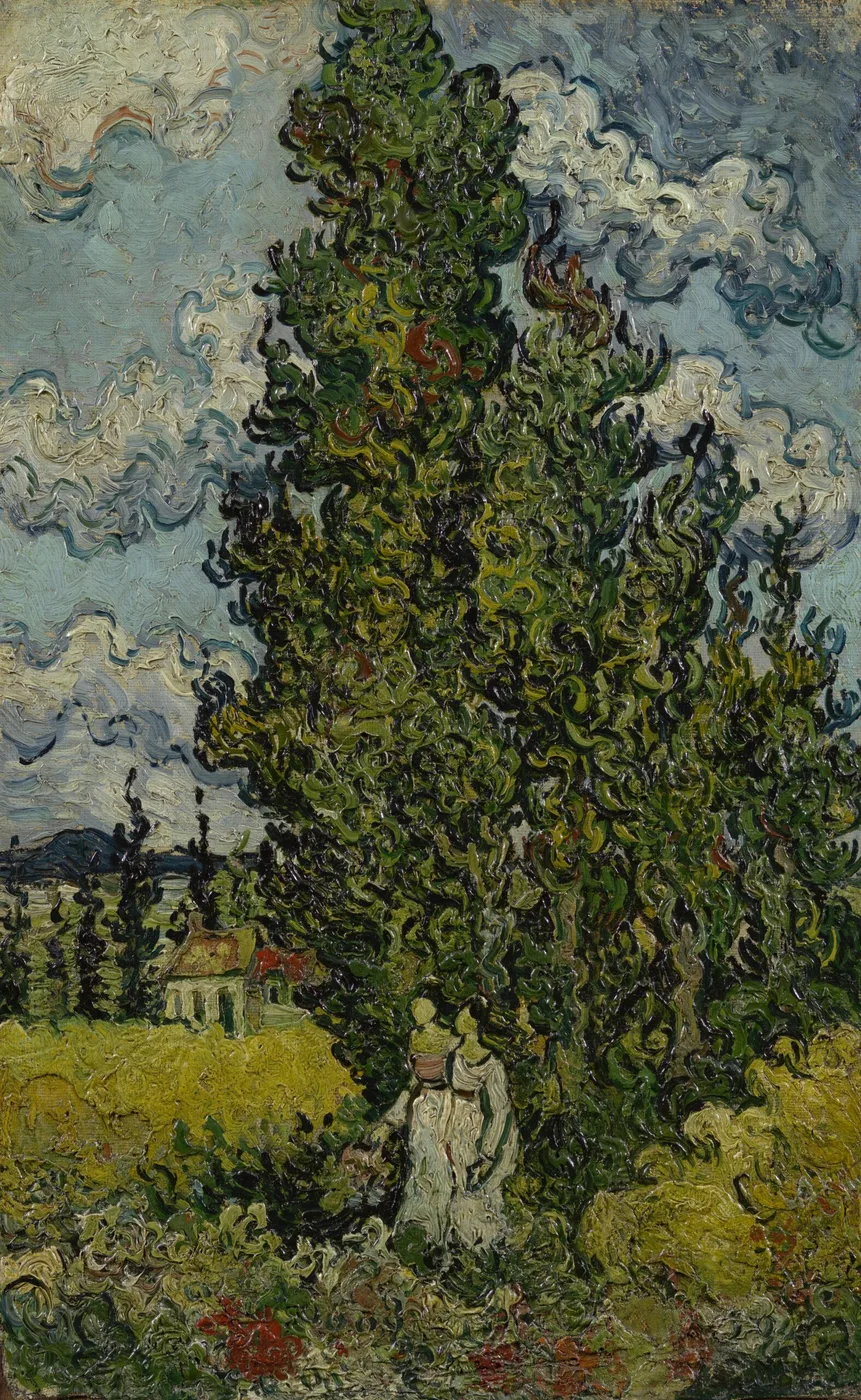
By the start of 1890, Vincent van Gogh had lived for nearly a year within the walls of the asylum at Saint-Paul-de-Mausole, on the edge of Saint-Rémy-de-Provence. He had reached the cypress the previous summer and could not leave it alone. Cypresses and Two Women, painted in that final Provençal year, is one of several canvases in which he returned to the same dark trees, testing how far a single motif could carry a whole picture.
He had already written to his brother Theo that the cypresses were constantly on his mind, that he wanted to do with the tree what he had done with the sunflower. This picture is a smaller, quieter attempt at that ambition: a tall, narrow panel measuring just 27 by 43.5 centimetres, built around two trees and two figures rather than a single dramatic trunk.
Saint-Rémy in the Year of the Cypress
Van Gogh had admitted himself to the asylum in May 1889, after the crisis in Arles that ended his time with Gauguin. Within its walled garden and from the window of his room he painted irises, olive groves and the wheatfields beyond, but the cypress kept pulling him back outdoors, past the asylum grounds and into the surrounding countryside.
By 1890 he had painted the tree in oil, reed pen and chalk, upright and alone, in pairs, seen close against the sky and set far off against low hills. Cypresses and Two Women belongs to this last group of studies, made in the months before he left Saint-Rémy for Auvers-sur-Oise, where he would die within weeks of arriving.
The two women walking beneath the trees are not identified and there is no record of who they were. They give the towering cypresses a human measure, a scale against which the size of the trees, and the size of Van Gogh’s ambition for them, can be read.
Two Trees Against a Restless Sky
Two cypresses stand close together at the centre of the canvas, rising almost to the top edge and pushing the sky to either side into two narrower bands. Their dark green mass is broken by streaks of rust red and orange buried within the foliage, as though embers were caught inside the branches.
Below them, a path opens onto a stretch of yellow-green meadow. Two women in pale, cream-white dresses walk close together at the foot of the trees, one wearing a soft rose-pink bodice, small enough against the cypresses to make the trees feel monumental rather than simply tall.
To the left, low blue hills sit under the horizon, and a red-roofed house with a slim gable stands among a run of smaller, more slender cypresses. Reddish flowers, poppies most likely, punctuate the yellow grass at the very bottom edge of the panel, a last note of warm colour before the frame.
The Weight of the Brushwork
Van Gogh built the sky from short, curling strokes of white and pale blue-grey, laid one against another until the clouds seem to turn and roll rather than sit still. The same restless rhythm runs down into the trees, where dark green and near-black marks twist upward in tight, overlapping loops.
He worked the cypresses almost like calligraphy, each stroke following the direction the branch would actually grow, so that the trees read as living, upward movement rather than a static silhouette. The paint is thick in places, thin in others, applied fast enough that individual strokes remain visible as strokes.
Against this turbulence, the two women are painted more simply, in flatter passages of white and pale pink, and the meadow is laid in broader, calmer strokes of ochre and yellow-green. The contrast lets the eye settle on the figures for a moment before being pulled back up into the trees.
A Small Panel, a Large Presence
The original canvas is modest in size, just 27 by 43.5 centimetres, closer to a study than to the grand vertical cypress paintings Van Gogh made the previous June. It is now held by the Van Gogh Museum, part of the large body of work from his last two years that the museum keeps together.
Its narrow, upright format suits the subject exactly. There is little room in the composition for anything but the trees, the sky and the two small figures at their base, so the eye has almost nowhere to go except up.
Hung on a wall, that verticality keeps working. Morning light tends to soften the blue-grey of the sky, while a warmer evening light picks out the red and orange caught inside the dark green, so the same two trees can look calm at one hour and restless at another.
Sizes and materials for Cypresses and Two Women are listed on its product page.
More from this collection
Bring this painting home
Choose a hand-painted oil reproduction for real brushwork, or an archival canvas print for a crisp museum-image edition. Every size preserves the original proportions.
View this work & options
Further reading
Verify the original in the Van Gogh Museum collection record and continue through related works in the catalogue.