
Olive Trees with the Alpilles: Story & Meaning
An asylum garden and an obsession with olives
In May 1889 Vincent van Gogh admitted himself to the asylum of Saint-Paul-de-Mausole at Saint-Rémy-de-Provence, seeking a kind of shelter after the crisis that had ended his time in Arles. The grounds were walled, but he was given a studio room and, before long, supervised walks into the countryside beyond them.
What he found there was a landscape of wheat, cypress and olive, closed in on all sides by the broken limestone ridge of the Alpilles. He returned to the olive groves again and again that year, telling his brother Theo that he wanted to do for the olive tree what he had already done for the sunflower: to make an ordinary tree of the south carry as much feeling as a face.
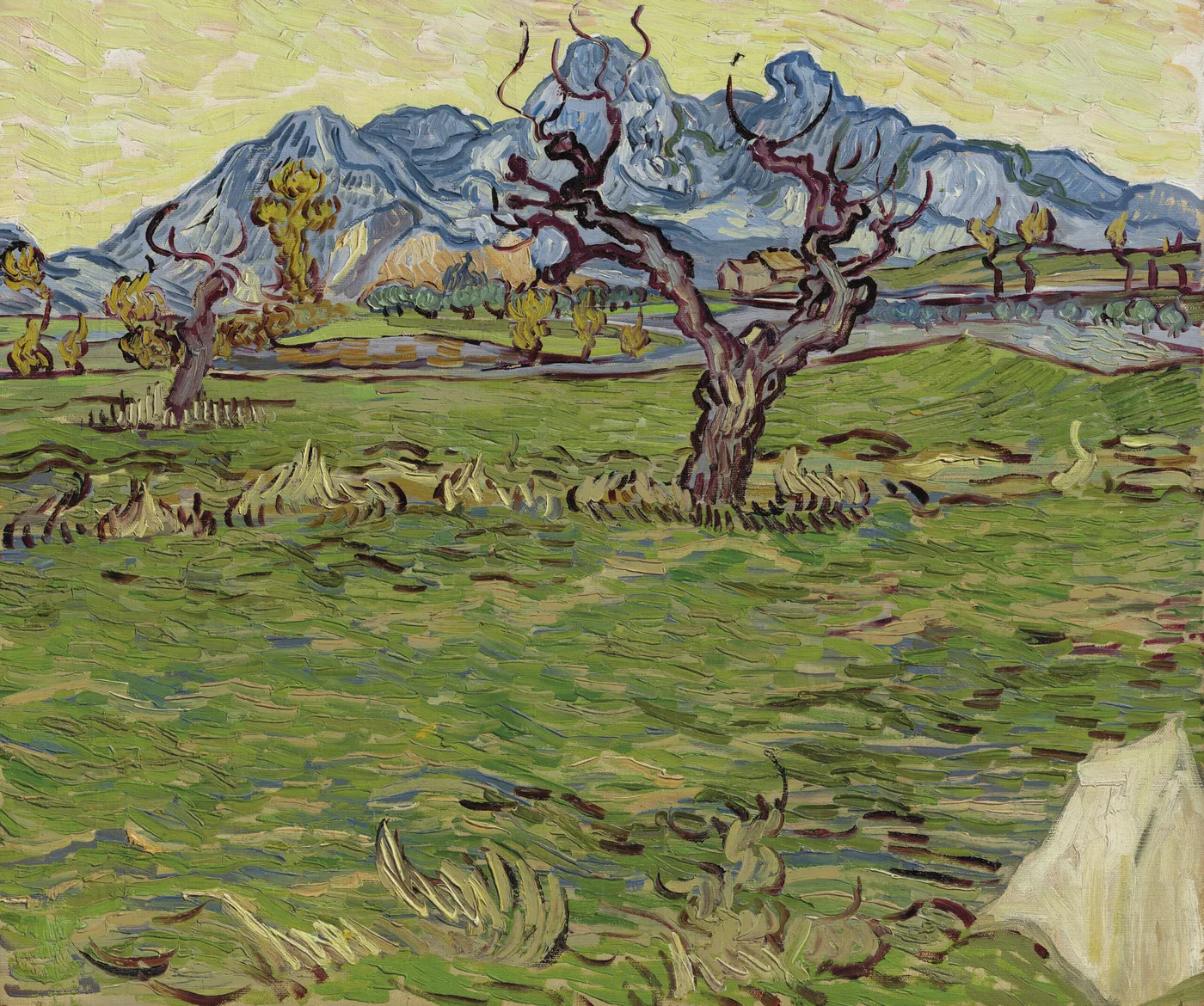
This canvas belongs to that sequence. It was recorded under the original title Landscape with Olive Tree and Mountains in the Background, painted in 1889 at 55 by 45 centimetres, small enough to have been carried on one of those walks or worked up soon after in the studio.
A single tree standing over the field
One olive tree holds the middle of the composition, its trunk twisting up from the grass in a dark, aubergine-red that has nothing to do with the grey bark of a real olive. Bare, wiry branches fork off it in loops and hooks, more like something drawn from nerve or vine than from timber.
Two smaller trees stand off to the left, their foliage reduced to a few strokes of ochre and gold, as though caught at a different hour from the tree beside them. Around the base of the central trunk the grass has been left rough, tufted into little standing clumps that catch the light differently from the smoother field around them.
Beyond this foreground, the ground drops into a middle distance of slender yellow trees, a low wall, and the pale roof of a single farm building, painted with just enough detail to place it and no more. Behind all of it the Alpilles rise in rounded, blue-violet masses, their outline as restless as everything below.
Green against violet, warmth against cold
The lower two-thirds of the canvas is almost entirely green: short, choppy dashes of olive, lime and sage laid side by side rather than blended, so the field reads as a mass of individual marks rather than a flat colour. Darker maroon strokes are threaded through the grass at the tree’s base, echoing the trunk above and pulling the whole foreground together.
That trunk is the densest passage of paint in the picture, built up in thick, almost sculpted ridges of red-brown outlined in near black. Set against the surrounding green, it sits at the far end of the colour wheel from its field, which is a large part of why it holds the eye before anything else does.
The sky breaks from convention altogether: rather than blue, Van Gogh gave it the same warm yellow-green family as the grass, laid in long, curling bands that repeat the rhythm of the mountains below. Only the Alpilles themselves are properly cool, a pale, chalky blue-violet, and it is that one shift in temperature that lets them read as distance despite a sky which, by rights, should sit in front of them.
Nothing here was mixed to match what a camera would have recorded on the day. The colour is pitched, throughout, to how the scene felt rather than how it measured, which is a large part of why the picture still reads as urgent more than a century on.
A triangle of bare canvas
Look to the lower right corner and the paint simply stops. A wedge of raw, primed canvas has been left untouched, with only a faint pencil line marking where a rock or a fold of ground was meant to sit.
It is a small thing, easy to miss at a glance, but it is worth pausing on. It shows the picture as an object made in a limited span of time, worked from the centre outward and left at the edges once the trunk, the field and the mountains had been settled to his satisfaction.
Rather than reading as unfinished, that corner works almost like a note on method: proof that this was built fast, tree first, sky and stones after, and stopped the moment it said what it needed to say.
How it sits in a room through the day
Hung where morning light reaches it, the picture leans cool: the blue of the Alpilles asserts itself and the yellow-green sky reads almost as haze. By evening, under warmer artificial light, the greens in the foreground deepen and the maroon trunk comes forward, so the same canvas can feel like two different hours of the same field.
Because so much of the surface is given over to green, worked in so many separate shades rather than one flat tone, it rewards being looked at up close as much as from across a room. Step back and the field settles into a single restless mass; step in and it breaks apart into hundreds of individual, deliberate strokes.
That double reading, calm from a distance and agitated up close, is what keeps this particular olive grove from ever quite settling on the wall.
Sizes and materials for Landscape with Olive Tree and Mountains in the Background are listed on its product page.
More from this collection
Bring this painting home
Choose a hand-painted oil reproduction for real brushwork, or an archival canvas print for a crisp museum-image edition. Every size preserves the original proportions.
View this work & options
Further reading
Verify the original in the collection record and continue through related works in the catalogue.