
Two White Butterflies: Story, Meaning & Brushwork
A Narrow View from the Asylum Garden
By the summer of 1889 Vincent van Gogh had committed himself to the asylum of Saint-Paul-de-Mausole at Saint-Rémy-de-Provence, and the walled grounds around it had become nearly the whole of his outdoor world. He was permitted to paint within the enclosure, and at times, under supervision, in the fields just beyond it, so much of what he produced that year came from looking closely at what grew within a few steps of the building rather than from any distant view.
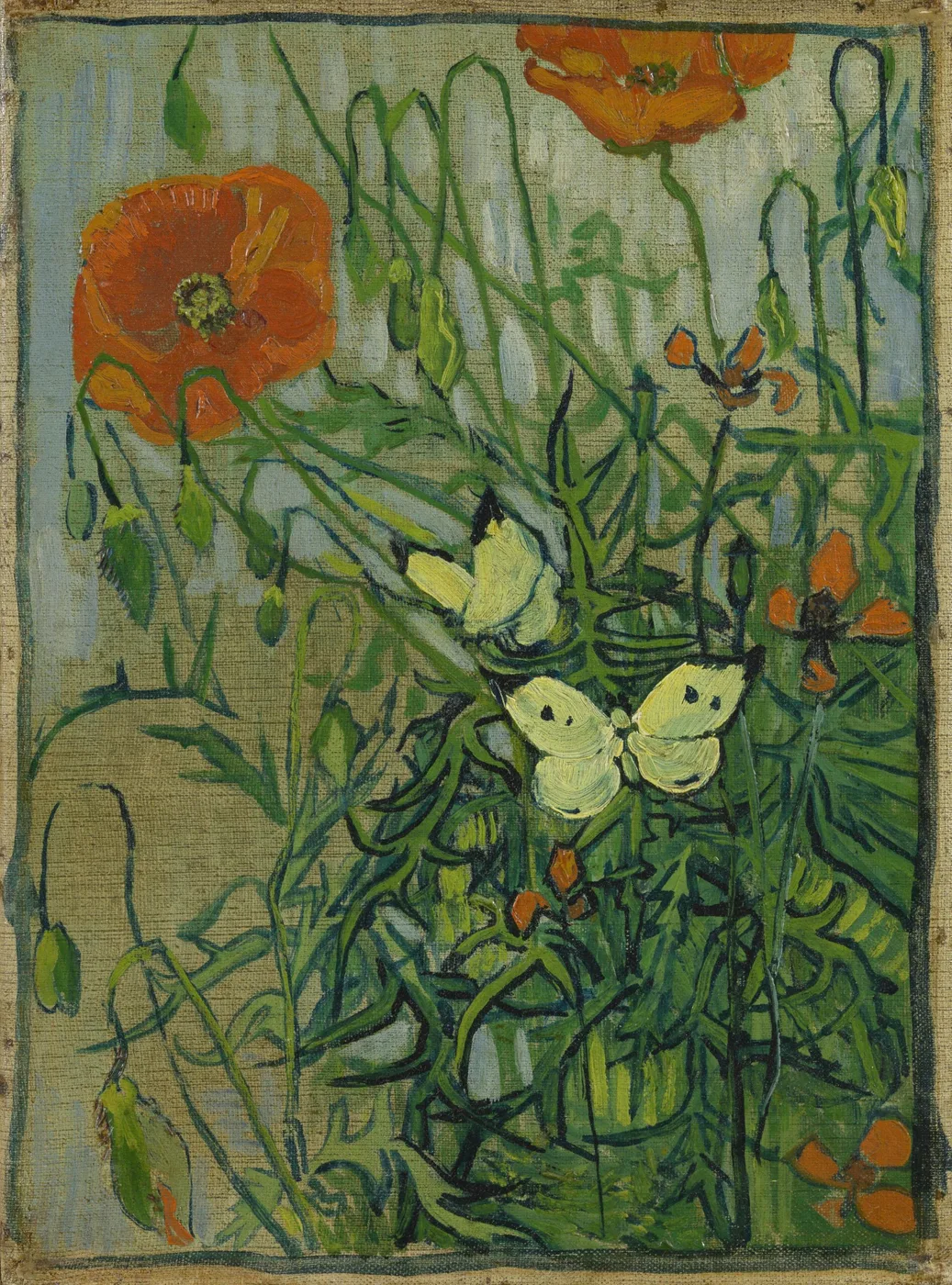
Butterflies and Poppies, painted in 1889 and now known more widely as Two White Butterflies, belongs to that narrowed field of vision. It is a small canvas, only 25.5 by 34.5 centimetres, and its size suits its subject: a patch of long grass, a few poppy stems and two butterflies caught mid flight, rather than a landscape meant to be taken in from a distance.
Van Gogh made other close studies of insects that year, working at times from specimens as well as from life. This canvas fits that same interest: a small scene worked quickly but with real attention to how the two pale wings sat against the surrounding green.
Poppies, Grass and Two Pale Wings
Two poppies open at the top of the canvas, one upper left and one upper right, their petals laid in hot orange-red against a background of pale grey-blue. Lower down, smaller orange-red buds and a half-open bloom repeat the same colour in miniature, so the eye keeps moving between the two full flowers and these scattered echoes.
At the centre, where the composition holds its weight, two butterflies rest close together on the seeding grasses. Their wings are a soft, chalky white tinted with pale yellow, each tipped in black, with a scatter of dark spots that catch the eye before anything else on the canvas does.
Around them the grass and poppy stems rise in a tangle of dark green, sketched in loose, curling lines that suggest stalks bending under their own buds rather than any tidy arrangement. Van Gogh set his viewpoint low, as though he had crouched at the edge of the bed, so the plants climb past the frame rather than sitting neatly within it.
Paint Laid Thin, and Canvas Left Bare
The handling throughout is fast. Petals are built from two or three loaded strokes rather than blended colour, and much of the grass is drawn more than painted, a dark green line doing the work a pencil might do elsewhere.
What is unusual, and worth looking for, is how much of the canvas Van Gogh left unpainted. Across the upper left and lower left of the picture, the pale ground and even the weave of the canvas itself show through a thin wash of grey-blue, so the background reads as much as raw support as it does as sky or backdrop.
That bareness is not damage or loss; it is a stopping point Van Gogh was evidently content with. It gives the picture a lightness that a fully worked background would not have, and it lets the greens and the two white wings carry the image rather than a filled-in setting.
On a Wall, in Changing Light
Hung where daylight reaches it, this is a picture that shifts with the hour. In flatter light the orange poppies dominate and the white butterflies read almost as highlights; as the light warms toward evening, the greens deepen and the pale wings seem to lift slightly off the canvas.
Because the composition is close and unguarded by any horizon, it holds attention at close range in a way a wider landscape would not. It rewards standing near it, much as the subject itself once rewarded a painter standing at the edge of a bed of grass.
The original, Butterflies and Poppies, is held by the Van Gogh Museum in Amsterdam. Seen there or in reproduction, it remains one of the smaller, quieter canvases from a year that also produced some of Van Gogh’s most turbulent work.
Sizes and materials for Two White Butterflies are listed on its product page.
More from this collection
Bring this painting home
Choose a hand-painted oil reproduction for real brushwork, or an archival canvas print for a crisp museum-image edition. Every size preserves the original proportions.
View this work & options
Further reading
Verify the original in the Van Gogh Museum collection record and continue through related works in the catalogue.