
Wheat Field with Reaper and Sun: Story & Meaning
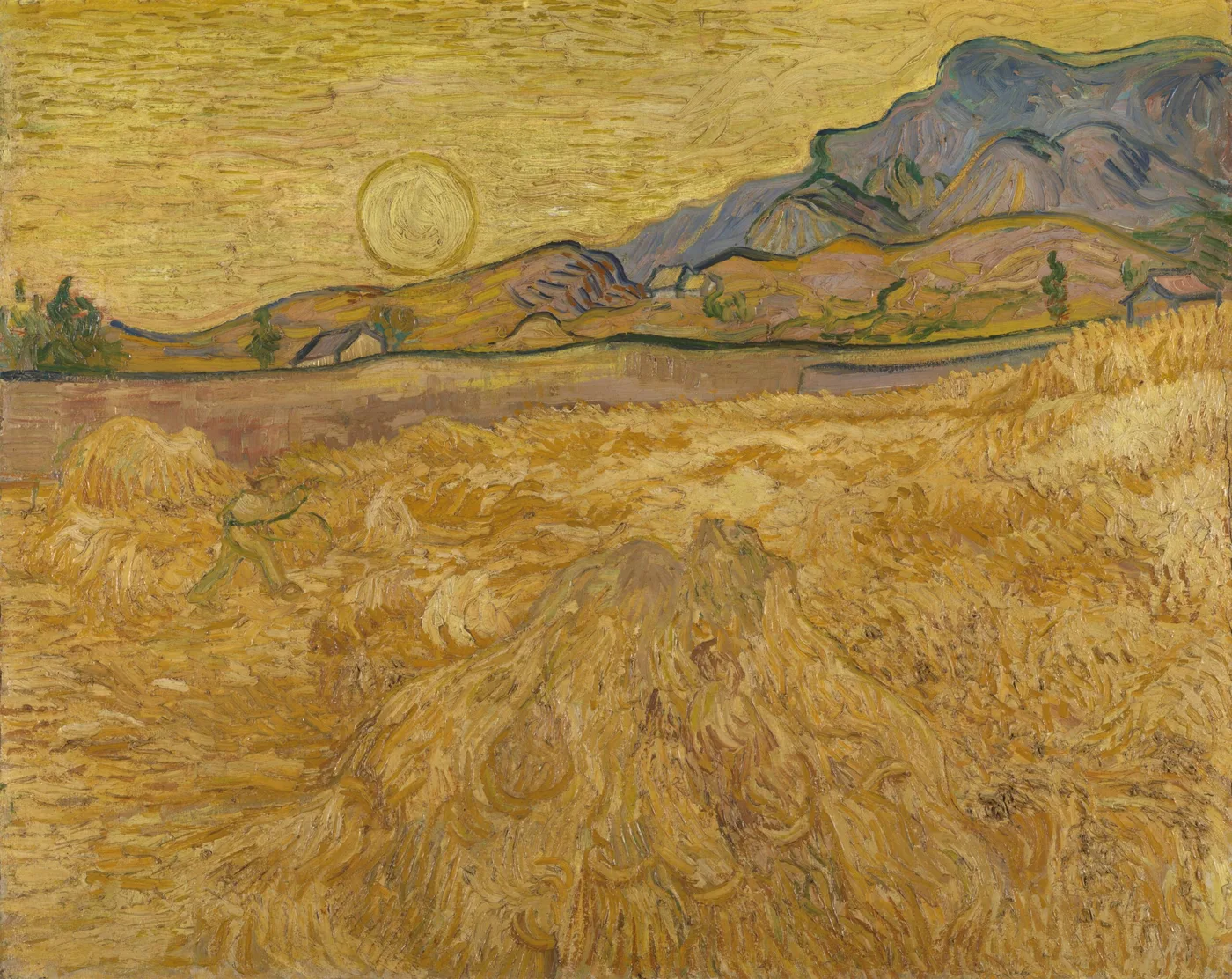
A Room at Saint-Rémy, a Field Beyond the Window
In May 1889 Vincent van Gogh admitted himself to the asylum of Saint-Paul-de-Mausole, just outside Saint-Rémy-de-Provence. From a barred window on the upper floor he could see a walled wheat field rising towards the Alpilles hills, and through the months that followed he painted that same field again and again, in rain, in wind, under a rising moon and, in this canvas, at the height of the harvest.
Wheat Field with Reaper and Sun belongs to that sequence. Van Gogh had watched the field turn from green shoots to ripe gold over the summer, and by the time he set up his easel to paint the cutting of the grain, he had already spent months studying how the same patch of ground changed under different weather and different states of mind.
He thought of the reaper working alone under the sun as a figure bound up with mortality, a labourer whose work brings the wheat, and by extension human life, to its end each year. It is a subject he returned to with unusual seriousness, painting several versions of the same motif that summer as he tried to get the image right.
Wheat, a Sun and a Single Figure
The canvas, painted in 1889 and measuring 92 by 72 centimetres, is almost entirely given over to the field itself. Sheaves of cut wheat rise in the foreground like small golden haystacks, their stalks curling and knotting under the brush, while beyond them a lone reaper bends into his work, scythe in hand, half hidden by the grain still standing around him.
Above the field a pale disc of a sun sits low in a sky the same ochre yellow as the wheat beneath it, so that sky and ground are barely distinguishable in tone. There is no horizon line of blue or grey to separate them, and the whole upper half of the picture glows with the same heat as the harvest itself.
A low stone wall runs across the middle of the composition, marking the edge of the enclosed field and separating the cut grain from the rolling hills behind it. Small farm buildings with red tiled roofs sit tucked into the slopes beyond the wall, modest and half hidden among trees.
The Mountains Behind the Grain
Rising on the right side of the canvas are the Alpilles, painted in cool blues, mauves and violets that stand in deliberate contrast to the hot yellows of the field below. Van Gogh had come to know this modest limestone range well during his stay near Saint-Rémy, and it appears in the background of many of the paintings he made there.
The choice to set such cool colour against so much yellow gives the hills a weight and distance that the flattened, close up field does not have. The eye travels from the heaped wheat in the foreground, back across the wall, and up into blue rock, before returning, inevitably, to the small working figure and the pale sun above him.
Colour Laid Like Heat
Van Gogh worked the whole field in short, directional strokes of yellow, ochre and gold, laid thickly enough that the paint itself seems to carry the texture of cut and standing grain. Where the wheat has been gathered into sheaves, the brushwork curls and coils, and where it still stands, the strokes run straighter, following the direction the stalks would fall.
The sun is built from concentric rings of paint, scored into the wet surface so that it reads as a disc of light rather than a flat shape. It is painted almost the same colour as the sky around it, so that it glows rather than shines, a source of heat more than of illumination.
Green appears sparingly, in a few trees at the left edge of the canvas and in the reaper’s own clothing, just enough to keep the golden field from tipping into monotony. Touches of red on the rooftops beyond the wall do similar work in miniature, small anchors of colour in a picture otherwise built almost entirely from a single hot family of yellows.
On a Wall, Through the Day
Hung in a room that gets real daylight, this painting behaves less like a fixed image than like a field does outdoors. In the flatter light of morning the yellows sit close together and the composition reads calmly, wall, wheat, hill and sky each settling into its place.
As the light in the room warms towards evening, the built up ridges of paint catch it at an angle and the whole surface seems to shift, the sheaves in the foreground gaining sudden weight and shadow, the sun in the sky brightening against the surrounding gold. It rewards being looked at more than once, and at different hours.
The original hangs today in the Kröller-Müller Museum, among the largest holdings of Van Gogh’s work anywhere, where it keeps company with other paintings from the same Saint-Rémy months. Seen there or in reproduction, it remains one of the clearest statements Van Gogh made of a subject he returned to all his life: work, weather and the passing of a season, rendered in a single field under a single sun.
Sizes and materials for Wheat Field with Reaper and Sun are listed on its product page.
More from this collection
Bring this painting home
Choose a hand-painted oil reproduction for real brushwork, or an archival canvas print for a crisp museum-image edition. Every size preserves the original proportions.
View this work & options
Further reading
Verify the original in the Kröller-Müller Museum collection record and continue through related works in the catalogue.