
Blossoming Chestnut Trees: Story, Meaning & Brushwork
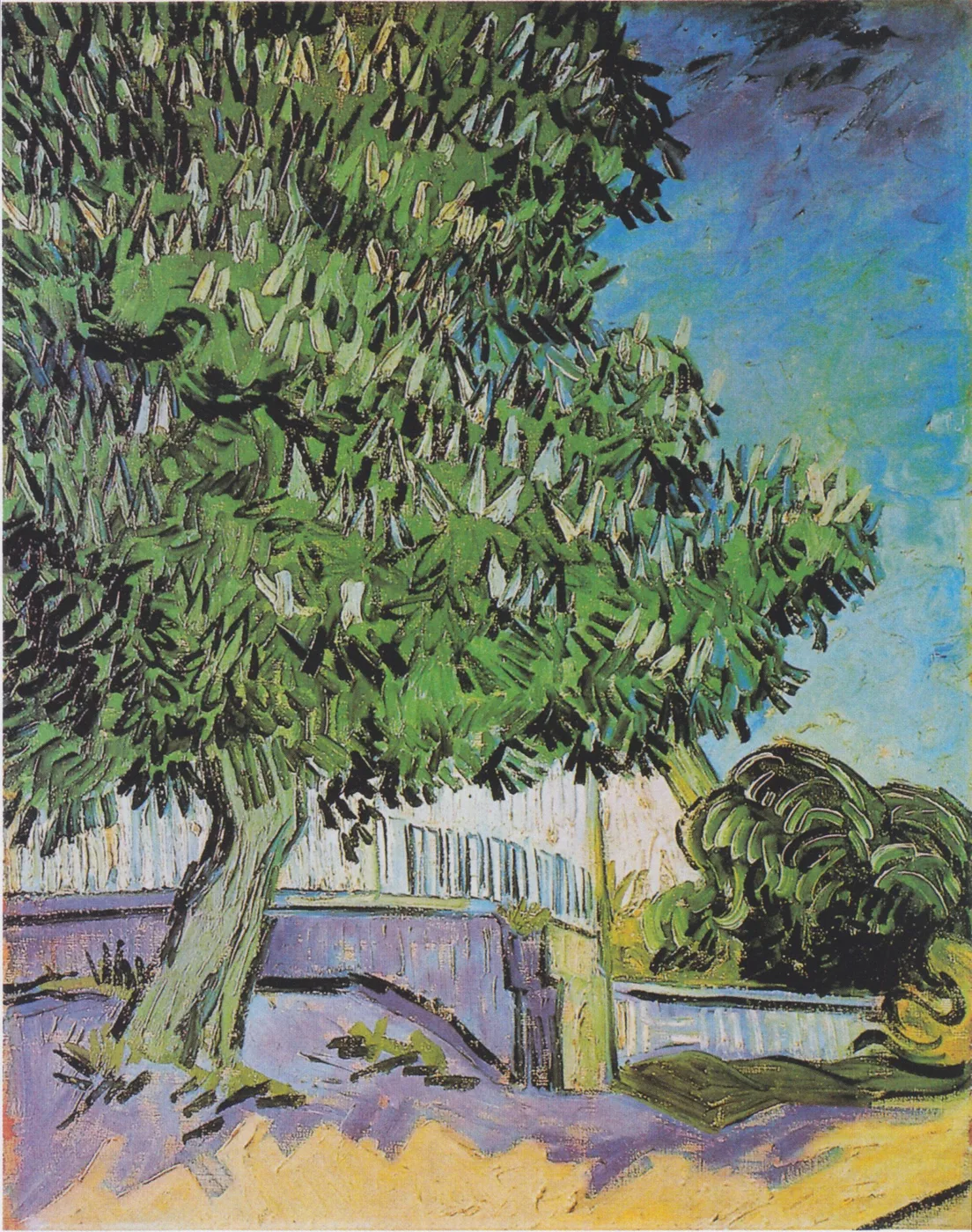
By May 1890 Vincent van Gogh had left the asylum at Saint-Rémy and settled in Auvers-sur-Oise, a village north-west of Paris where he would spend the last ten weeks of his life under the informal watch of Dr Paul Gachet. He worked at a furious pace that spring, often finishing a canvas a day, chasing the orchards and gardens as they came into flower before the blossom dropped. Blossoming Chestnut Trees, painted in 1890, belongs to that short, driven run of garden and orchard subjects.
It is not a grand statement. It is a corner of someone’s garden, observed closely and painted fast, one of several such views he made that spring as the flowering trees around Auvers gave him a fresh subject almost daily.
A corner of Auvers
Two chestnut trees fill most of the canvas, their trunks rising from a bank of lavender-shadowed ground in the foreground. A low white fence or garden wall runs behind them, catching the light in pale vertical strokes, with a further stand of dark, rounded foliage to the right.
The trees are in full flower. Their upright blossom clusters, the candle-like spikes typical of the horse chestnut, cover the crown in short white and cream strokes, some warmed with a touch of pink, standing out against the mass of green beneath.
Colour pushed to its extremes
Green dominates the canvas, but it is not a single green. Van Gogh built the foliage from dark viridian, near-black shadow strokes and lighter, sap-green touches laid side by side, so the crown reads as a dense, living mass rather than a flat shape.
Above and to the right, a patch of blue sky opens out, brushed in loose, streaky strokes that shade from pale near the horizon to a deeper blue at the top of the canvas. A dark, almost bruised cloud sits in the upper corner, a small note of weight against the lightness of the flowering trees.
Below, the ground is rendered in cool violet and lavender shadow, giving way to a warm strip of ochre and yellow along the very front of the composition. That shift from cool to warm across the lower third of the canvas anchors the picture and stops the greens above from floating free.
Brushwork built for speed
Look closely and the blossom is not painted so much as marked: short, thick dashes of white and cream, laid on with loaded brushwork, standing proud of the green beneath them. Each stroke does the work of a single flower spike without describing it in detail, a shorthand that only holds together at a normal viewing distance.
The foliage around the blossom is built from curling, overlapping strokes, some almost calligraphic, that follow the direction the branches grow. The trunks and lower branches are drawn in longer, more controlled lines, giving the mass of green above something to hang from.
Nothing in the paint surface is smoothed over. The canvas keeps the evidence of a picture made quickly, in one sustained session, by a painter working against the calendar of a season that would not wait for him.
Living with the painting
The original is a modest object, 50.5 by 63 centimetres, closer in scale to a window than a wall-filling statement, and it is now held by the Kröller-Müller Museum. That size suits the subject: a private glimpse into a garden, not a public view of a landscape.
At a distance across a room, the picture reads as a single green shape lit from within by white blossom, with the blue sky and warm foreground giving it depth. Step closer and it breaks apart into the individual strokes, the dashes and curls that only resolve into trees and flowers once the eye pulls back again.
Daylight changes it through the day. Cooler light draws out the blues and violets in the sky and shadowed ground; warmer light picks out the ochre strip at the base and the pink-tinged blossom, so the same canvas can feel quite different at nine in the morning and at six in the evening.
Sizes and materials for Blossoming chestnut trees are listed on its product page.
More from this collection
Bring this painting home
Choose a hand-painted oil reproduction for real brushwork, or an archival canvas print for a crisp museum-image edition. Every size preserves the original proportions.
View this work & options
Further reading
Verify the original in the Kröller-Müller Museum collection record and continue through related works in the catalogue.