
Poppy Field: Story, Meaning & Brushwork
Auvers, in the last weeks
By May 1890 Vincent van Gogh had left the asylum at Saint-Remy and settled in Auvers-sur-Oise, a village north-west of Paris where the physician Paul Gachet, a man with a known interest in artists, kept a house. Van Gogh took a room above the Auberge Ravoux and set to work at a pace that still surprises historians who track his output canvas by canvas.
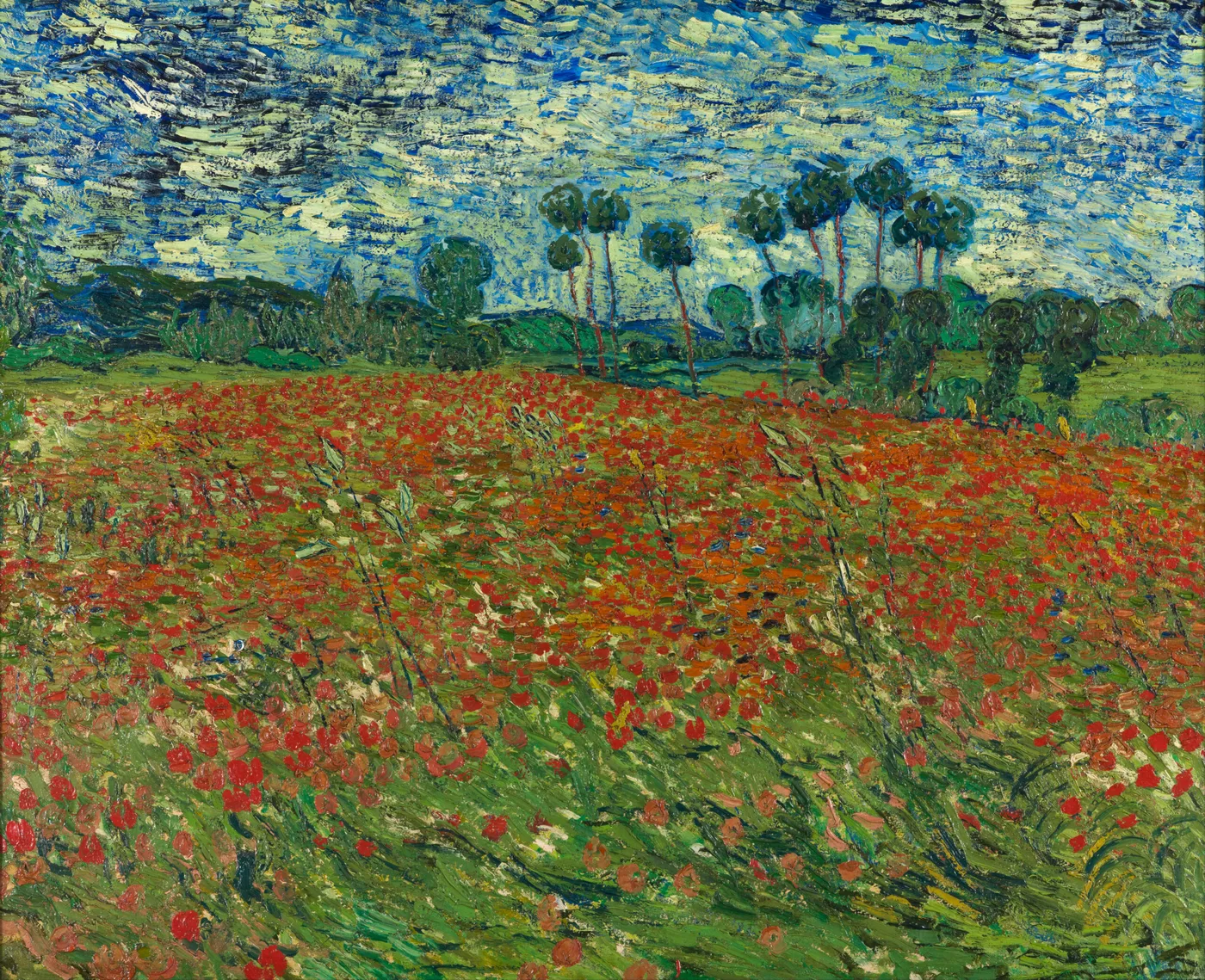
He painted the wheat fields, orchards, thatched roofs and church around the village almost daily, often finishing a canvas in a single sitting. Poppy field, painted in 1890, belongs to that final run of work, made in the same weeks as his views of wheat under a changeable sky.
There is no story attached to this particular canvas beyond the field itself. No figure walks through it, no building anchors it. It is Van Gogh looking at one stretch of ground near Auvers and setting down what the colour did to him.
A field with nowhere else to look
The picture is almost entirely field and sky, divided by a thin band of trees. A meadow thick with poppies fills the lower two thirds of the canvas, its red rising and dipping with the actual roll of the ground, while the trees mark the one point where land gives way to air.
Nothing leads the eye into the picture in the usual way. There is no path, no fence, no figure to explain the scale. Instead a few tall grass stalks, each set down as a single dark stroke, stand up out of the poppies in the foreground, close enough to the picture plane that they seem to lean toward the viewer.
A loose cluster of slender trees breaks the horizon a little right of centre, their trunks bare and pinkish where the bark catches the light. They are the only strong verticals in a composition built otherwise from horizontal drift, and they give the eye a place to rest before it climbs into the sky.
Red laid on thick, green underneath
The poppies are not painted as individual flowers so much as a field of separate, decisive touches. The reds run from a hot vermilion near the front of the canvas to a duller, brick-toned red further back, with paler pink and salmon strokes scattered through so the colour never settles into one flat note.
Underneath and around the flowers, the green is just as varied, moving from a fresh yellow-green where the light catches the grass to a darker, near-black green in the low ground and along the tree line. Van Gogh built the whole field from short, loaded strokes set close together, the paint thick enough to hold its own ridges and shadows.
At 91.5 by 73 centimetres, the canvas is large enough for the poppies to read as a field rather than a decorative pattern, yet compact enough that the whole meadow arrives in one look before the eye starts picking out individual strokes. Van Gogh gave the work the plain title Poppy field, nothing more descriptive than that. The painting is held today by the Rijksdienst Beeldende Kunst, the Dutch government service that manages works from the national art collection.
A sky that will not settle
Above the tree line, the sky is worked in the same fast, unblended strokes as the field below it: streaks of blue, teal and pale cream that suggest fast-moving cloud without ever describing a single cloud shape. It is not a calm sky, and Van Gogh clearly did not want it to read as one.
That restlessness above a field of dense, static red is where the picture’s real tension sits. The ground holds still under the weight of all that colour; the air above it will not. Van Gogh painted both passages with the same brush and the same urgency, so the shift from field to sky happens through the handling of paint rather than any change in technique.
What it does on a wall
Hung where daylight actually reaches it, Poppy field shifts through the day. Morning light draws out the paler pinks scattered through the red; by evening the field reads darker and denser, the greens pulling toward black at the edges of the canvas and the reds settling into something closer to rust.
It is not a picture that recedes into the background of a room. The density of the brushwork keeps drawing the eye back to the same passages of red and green, and the effect changes enough between morning and evening that the painting rarely looks quite settled, which is fitting for a field Van Gogh himself never saw twice in the same light.
Sizes and materials for Poppy field are listed on its product page.
More from this collection
Bring this painting home
Choose a hand-painted oil reproduction for real brushwork, or an archival canvas print for a crisp museum-image edition. Every size preserves the original proportions.
View this work & options
Further reading
Verify the original in the Rijksdienst Beeldende Kunst collection record and continue through related works in the catalogue.