
Trees and Undergrowth: Story, Meaning & Brushwork
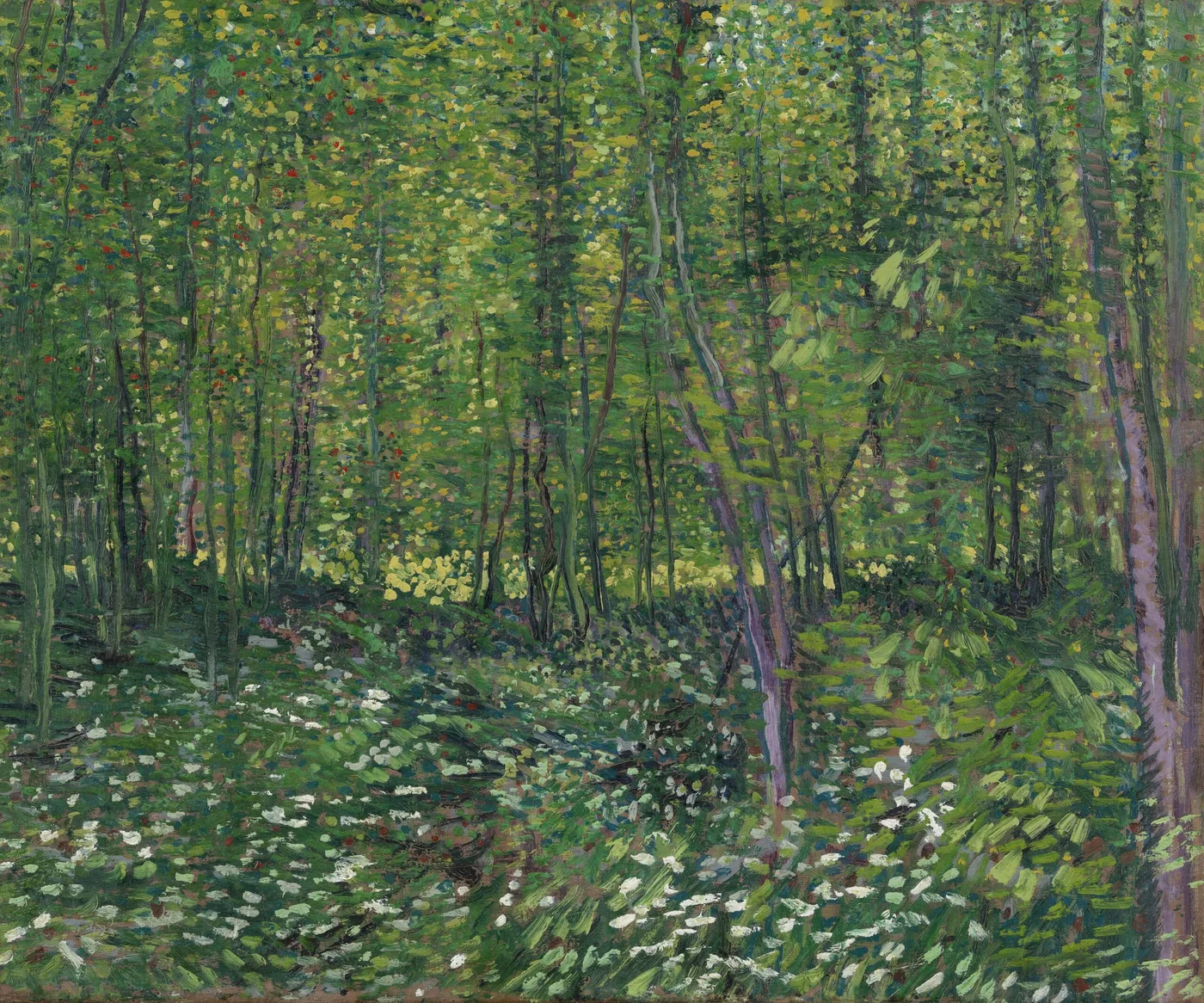
A Wood Outside Paris, 1887
By the spring of 1887 Vincent van Gogh had been in Paris for a little over a year, living with his brother Theo and working his way through the city’s galleries and studios. The heavy, earth-bound palette he had brought from the Netherlands was giving way to something lighter. He was looking hard at what his fellow painters were doing with colour, and testing how far he could push his own brush to keep pace.
That spring and summer he made repeated trips out to the woods and parks on the edge of the city, most often to Asnieres, in search of subjects that had nothing to do with the boulevards. Trees and Undergrowth, painted in 1887 and now in the Van Gogh Museum in Amsterdam, belongs to this run of woodland studies. It is a picture made by a painter learning, at speed, how to see in colour rather than in tone.
There is no obvious narrative here, no figure, no path leading the eye to a destination. Van Gogh was not illustrating a walk in the woods. He was working out, canvas by canvas, how sunlight breaks apart when it falls through leaves onto a crowded forest floor.
Inside the Thicket
The canvas, at 55.5 by 46.5 centimetres, is close to square, and Van Gogh fills every inch of it with wood. Slender trunks rise in a dense vertical screen from the bottom edge to the top, tilting at slightly different angles as real saplings do when they compete for light. There is no sky, no clearing, no distance to rest in.
A few of the nearer trunks are picked out in mauve and lilac rather than brown, catching what little direct light reaches this deep into the undergrowth. Behind them the wood dissolves into a haze of green and gold, the canopy so thick that individual leaves stop being separable and become instead a texture, a weather.
Underfoot the ground is just as busy. Small white flowers, likely wild garlic or anemone, scatter across the lower half of the canvas in loose drifts, and here and there a dab of red breaks through the green like a spark. Nothing in this lower band is drawn in outline. It is built entirely from short, loaded strokes set side by side.
The composition has no centre in the usual sense. The eye enters wherever it lands and then keeps moving, pulled from trunk to trunk and patch to patch, because Van Gogh has given no single passage more weight than any other. That refusal to compose a focal point is itself a statement about how a wood actually feels to stand inside.
How the Paint Was Handled
Van Gogh worked this canvas in short, separate touches rather than blended passages, laying green beside blue beside gold and letting the eye do the mixing at a distance. It is a method close to what the Impressionists and Neo-Impressionists around him were doing that year, though his marks stay looser and more urgent than a Seurat dot ever was.
The trunks are built with longer, drier strokes pulled straight down the canvas, which is why they read as upright and slightly stiff against the softer, more broken handling of the foliage. That contrast between a controlled vertical stroke and a scattered, almost weather-beaten touch above it gives the picture its structure without any drawn lines at all.
Across the undergrowth the brushwork turns short and stabbing, dabs of white and cream flicked on in clusters to stand for flowers, with the green around them left rougher and more varied in tone. Up close the surface is almost entirely abstract paint. Only at a normal viewing distance does it resolve into grass, leaf and petal.
Green dominates, but it is never one green. Van Gogh moves through olive, sap, viridian and a yellowed lime within a few centimetres of canvas, and it is this internal variation, more than any single bright colour, that keeps the picture from going flat or decorative.
On a Wall
A painting this dense rewards a room with steady, natural light, since the surface itself is doing so much of the work of catching and breaking illumination. In the morning the cooler greens and the lilac trunks tend to come forward. Later in the day, under warmer light, the gold and cream touches in the canopy and the flowers gain ground.
Because there is no horizon and no single point the eye is asked to settle on, the picture behaves less like a window and more like a patch of wall that has been given weather. It suits a spot where it will be seen often and at some length, a stairwell, a reading corner, a wall opposite a chair, rather than a room glanced through in passing.
Van Gogh painted this wood at a moment when he was still finding out what his own eye could do with colour. What survives on the canvas is that search itself, caught mid-stroke, still legible more than a century on.
Sizes and materials for Trees and Undergrowth are listed on its product page.
More from this collection
Bring this painting home
Choose a hand-painted oil reproduction for real brushwork, or an archival canvas print for a crisp museum-image edition. Every size preserves the original proportions.
View this work & options
Further reading
Verify the original in the Van Gogh Museum collection record and continue through related works in the catalogue.