
Thatched Cottages and Houses: Story, Meaning & Brushwork
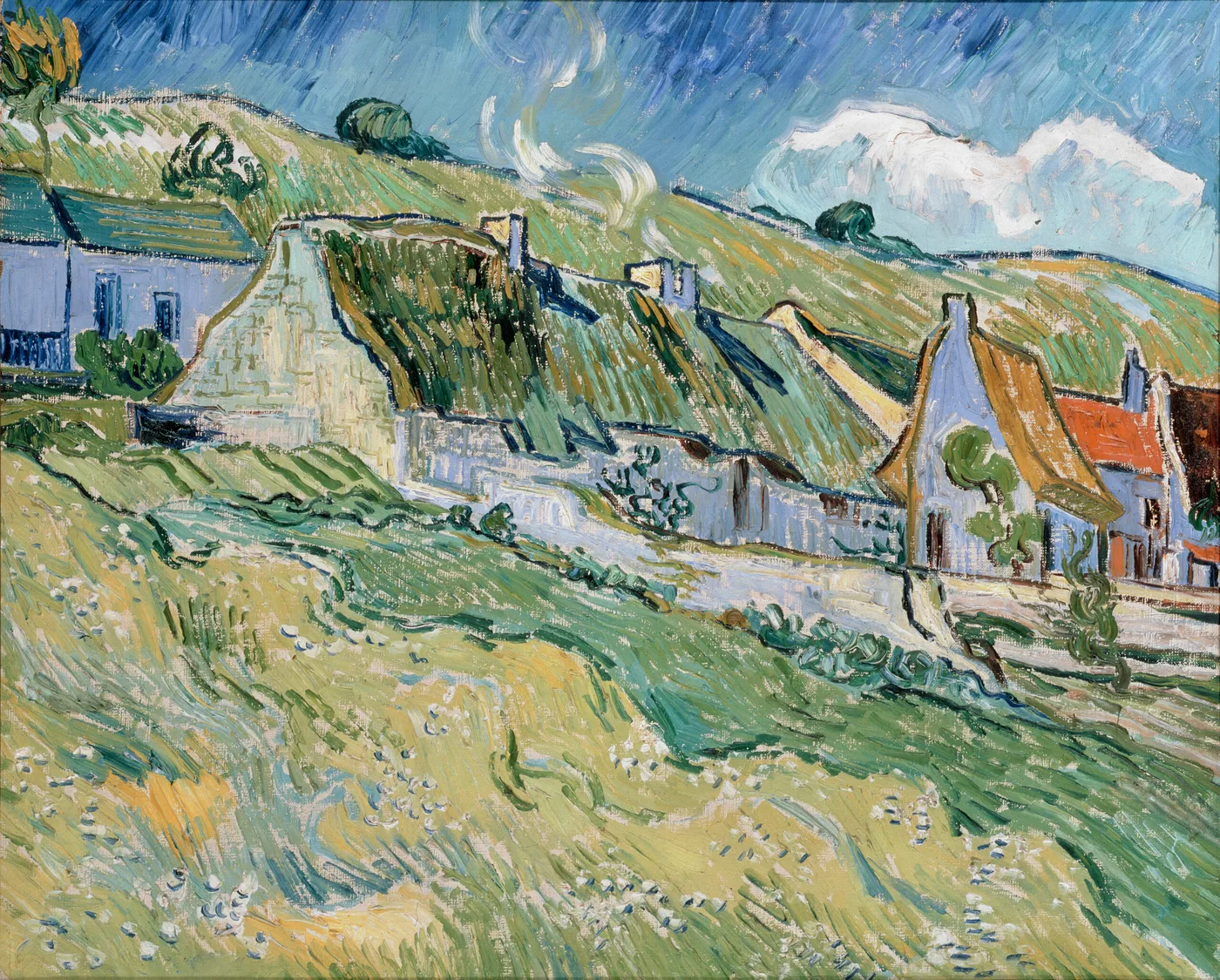
Vincent van Gogh arrived in Auvers-sur-Oise at the beginning of May 1890, released at last from the asylum at Saint-Remy and placed under the informal watch of Dr Paul Gachet. He had barely two months left to live, and he painted as though he knew it, often finishing a canvas a day. Thatched Cottages and Houses belongs to that final burst, one of a small group of village views he made along the lanes above the Oise, and it shows a painter still hungry for a subject rather than one running out of things to say.
A Roofline That Reminded Him of Home
Auvers still had rows of old thatched roofs at a time when slate and tile were replacing them almost everywhere else in France. Van Gogh had grown up among similar roofs in Brabant and had drawn them obsessively as a young artist in the Netherlands, so their reappearance here was not incidental. He wrote to his brother Theo about the village’s old cottages more than once that summer, clearly struck by how much of his own past they held.
In this canvas the thatch is not a single texture but several. Some roofs are a deep, mossy green, others shift toward ochre and gold where the straw has weathered and caught the light differently. A ridge of dark tiles cuts across the roofline midway along the row, and further right one house wears a roof of warm orange tile instead of straw, its walls a pale, chalky blue that sits apart from the whitewash around it.
A Village Read from a Rise of Grass
The picture is built on a diagonal. A grassy bank rises from the lower edge of the canvas and carries the eye up and across to where the cottages are banked along a lane, their rooflines stepping down the slope like a loose staircase. There is no single doorway or figure to fix the gaze; instead the eye travels the whole run of buildings before settling on the orange-roofed house at the right, the one warm note among so much green and blue.
A slim chimney rises from one roof near the centre of the row and lets out a pale curl of smoke that twists up into the sky, the only sign of anyone at home. Beside the orange-roofed house a tree with a rounded, dark green crown leans in close to the wall, and further houses and hedges continue past it, cut off by the canvas edge as if the village simply carries on beyond the frame.
Behind the cottages the land keeps climbing, a bare green hillside dotted with dark shrubs and a stand of trees along its crest. There is no sky at the horizon proper, only more hill, so the houses sit tucked into a fold of land rather than silhouetted against open air. It gives the whole scene a slightly enclosed, sheltered feeling, a hamlet held in the curve of a slope.
Sky and Grass in Restless Strokes
The upper third of the canvas is where van Gogh lets the brush run loose. At the top left the blue turns dark and agitated, laid down in short curved strokes that seem to churn rather than sit still, while at the top right the blue lightens and a heavy white cloud is built from thick, twisting dabs of paint. Between the two the sky feels genuinely unsettled, weather caught mid-change rather than a backdrop.
The foreground grass answers the sky in its own register. Long, directional strokes of yellow-green, blue-green and paler cream run down the slope in bands, some almost horizontal, some raking diagonally, giving the impression of grass moving under wind rather than a lawn lying flat. Small flecks of white and pale blue are scattered through it, standing in for wildflowers without ever resolving into individual blooms.
Against that movement the cottages themselves are handled with more restraint. Their walls are built from flatter, more even strokes of white, grey and pale blue, and the thatch is combed in tight parallel marks that follow the pitch of each roof. The contrast matters: the houses hold still while everything around them, sky and field alike, keeps stirring.
Colour Carried Across the Canvas
Green dominates, but van Gogh never lets it settle into one shade. The roofs run from near-black moss to golden ochre, the hillside behind shifts through several distinct greens as it catches or loses light, and the foreground grass adds yet another register in yellow-green and blue-green. Blue does similar work, threading from the deep, restless sky through the pale cottage walls down to the cool shadows cut into the grass.
Against all that green and blue, the single orange-tiled roof and the warm gold of the driest thatch carry real weight. They are small in area but they are the only passages of true warmth in the picture, and they anchor the eye each time it drifts back from the sky or the grass.
A Painting for a Room That Changes
Hung where morning or afternoon light can reach it, this canvas shifts noticeably through the day. Under a low, warm light the ochre thatch and the orange roof step forward and the picture reads as a sunlit village; under flatter, cooler light the greens and blues take over and the same scene feels closer to the unsettled sky at its top edge. Few paintings this size carry that much range.
The original, painted in 1890 and measuring 72 by 59 centimetres, is held by the Hermitage Museum. It belongs to the handful of Auvers pictures that show van Gogh still working outward, toward a subject and a landscape, rather than inward. Whatever else the final weeks held, this canvas is evidence of a painter looking hard at an ordinary row of cottages and finding, once again, something worth the whole of his attention.
Sizes and materials for Thatched Cottages and Houses are listed on its product page.
More from this collection
Bring this painting home
Choose a hand-painted oil reproduction for real brushwork, or an archival canvas print for a crisp museum-image edition. Every size preserves the original proportions.
View this work & options
Further reading
Verify the original in the Hermitage Museum collection record and continue through related works in the catalogue.