
Edge of a Wheat Field with Poppies: Story
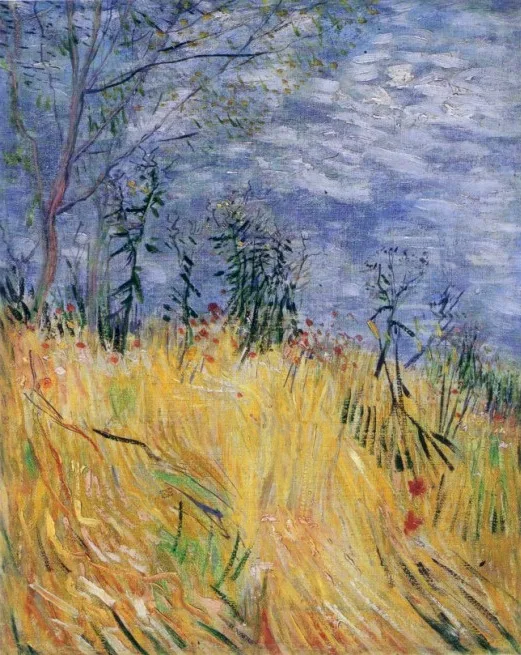
In the spring of 1887 Vincent van Gogh was walking out from Paris toward the edge of the city, easel and canvas under his arm, hunting for wheat, kitchen gardens and open sky. He had arrived a little over a year earlier still carrying the dim palette of his Dutch years, the browns and umbers of The Potato Eaters. Paris did not let that palette survive long.
He was staying with his brother Theo, seeing the Impressionists and the younger Neo-Impressionists at close range, and testing in his own hand what their broken, unmixed colour could do. A field on the edge of town, with its stripes of gold and its litter of red poppies, gave him a motif he could return to again and again, trying a slightly different brush each time.
A Small Canvas from a Restless Year
Edge of a wheat field with poppies, to give it its original title, is dated 1887 and measures a modest 32.5 by 40 centimetres. It belongs to a run of field and garden pictures Van Gogh made that year around Asnières and Montmartre, painted fast and mostly outdoors, before summer sent him further out of the city.
The scale of the canvas matters. This is not a picture built up over weeks in a studio. It reads as something seen, decided on, and painted before the light or the wind changed the scene in front of him.
Gold Underfoot, Red Scattered Through It
The lower two thirds of the canvas is given over to the wheat itself, a dense mass of yellow and ochre strokes laid on at odd angles, some upright, some falling, as though the artist copied the lean of the stalks stem by stem. Pale cream and white touches run through it where the light catches the heads of grain.
Poppies are scattered through that gold rather than gathered into a bouquet: a dab of red here at the lower left, another rising through the stalks at centre, a last cluster near the top of the field where the grass meets the trees. Small strokes of green break up the yellow at intervals, roots and low grass showing through where the wheat thins.
Nothing in this lower field is drawn with a firm outline. Van Gogh built the wheat from many short, separate marks, and it is the accumulation of those marks, not any single one, that reads as a field from a normal viewing distance.
Saplings Against a Working Sky
Above the wheat, a line of slender young trees and bushes crosses the canvas from the upper left, their trunks thin and their leaves picked out in small, loose touches of light green and yellow. They do not form a solid screen; sky shows through the gaps between branches, and a few wiry stems reach up on the right without any leaf cover at all.
The sky itself takes up close to half the canvas, painted in lavender, grey-blue and touches of white, worked in the same short, visible strokes as the field below rather than blended smooth. It is an overcast sky, or a shifting one, with no sun located anywhere in it and no horizon line drawn hard against it.
That balance between a busy lower field and a paler, quieter upper sky gives the eye somewhere to land first, on the poppies against the gold, before it climbs up into the cooler colour above.
The Hand Behind the Marks
Van Gogh was not yet painting in the long, rope-like strokes of his final years at Saint-Remy and Auvers. Here the marks are shorter, more staccato, closer in spirit to what he was learning from Impressionist canvases he was seeing in Paris that year.
He varies the stroke by subject: longer, drawn-out marks for the falling stalks of wheat, small dabbed touches for the poppy heads and the leaves overhead, thinner scumbled passages for the sky. The paint is not laid on thickly in most areas, letting the weave of the canvas show through in places.
What holds the picture together is colour rather than line. Gold, red, green and lavender sit next to each other at close range, and it is that juxtaposition, more than any drawn contour, that separates wheat from poppy, tree from sky.
On a Wall, Through the Day
A picture built from this many short strokes changes with the light in a room the way it changed with the light in the field it was painted from. Under a warm lamp in the evening the gold of the wheat pulls forward and the poppies glow. In flatter daylight the lavender sky and the green undertones in the grass come forward instead.
It is a picture that rewards a second look rather than a single glance, because so much of what it shows, the exact lean of a stalk, the placement of a single red dab, only settles into place once the eye has spent a moment with it. That makes it suited to a spot where it will be seen more than once a day: a hallway passed often, a reading corner, a bedroom wall caught by morning light.
The original hangs at the Denver Art Museum, one small, fast, sunlit record of a year in which Van Gogh was still working out, field by field, what his own colour would look like.
Sizes and materials for Edge of a Wheat Field with Poppies are listed on its product page.
More from this collection
Bring this painting home
Choose a hand-painted oil reproduction for real brushwork, or an archival canvas print for a crisp museum-image edition. Every size preserves the original proportions.
View this work & options
Further reading
Verify the original in the Denver Art Museum collection record and continue through related works in the catalogue.