
Quay with Men Unloading Sand Barges: Story
Arles, and a river that had to work for a living
By 1888 Vincent van Gogh had settled in Arles, in the south of France, drawn there by a light he had first admired second-hand, in Japanese prints passed round the cafés of Paris. He wanted colour that did not apologise for itself, and a subject he could return to day after day without exhausting it. The Rhône, running along the edge of the town, gave him both.
The river was not scenery to the people who worked it. Barges brought sand and stone up from the delta, and gangs of men loaded and unloaded them at the quays, the same heavy, repetitive labour whatever the weather. Van Gogh set up in front of this rather than the more obviously picturesque corners of the town.
He painted the scene at speed, the way he painted most of that year’s outdoor work, wanting to catch the barges and the men before the light or the labour moved on. Nothing about the result reads as posed. It reads as something seen once, hard, and put down before it could change.
What sits on the water
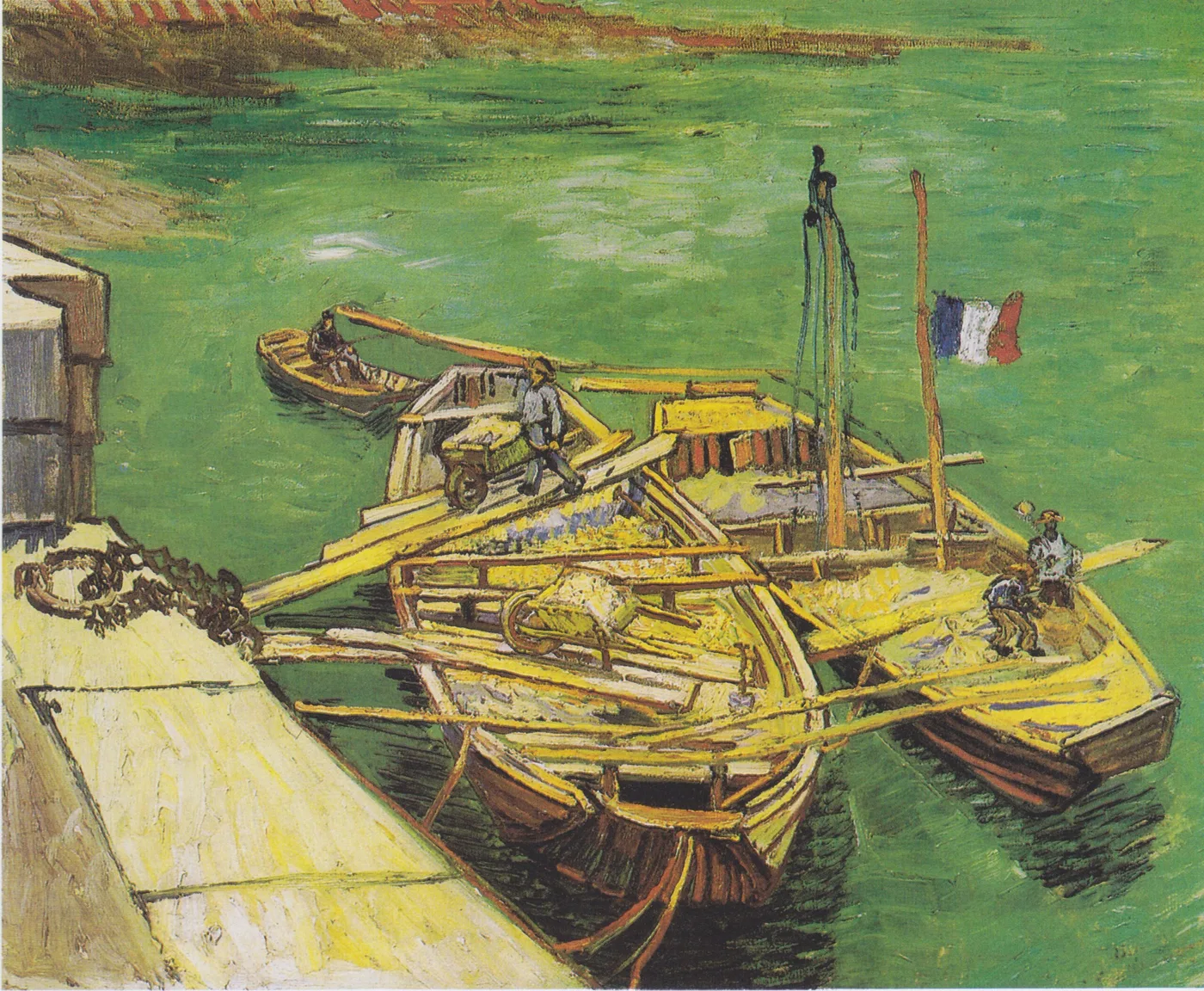
Two flat-bottomed barges are moored side by side at the quay, their hulls heaped with pale sand and timber. A man in a blue smock leans into a loaded wheelbarrow on the nearer boat, caught mid-push, his weight thrown forward into the work.
Further along the deck another figure crouches low over the cargo, and beyond him a third stands with an oar or pole, steadying the boat against the current. A small rowing boat with a single seated oarsman drifts just behind the barges, its plain outline a quiet counterpoint to the busier vessels.
A French tricolour hangs from a mast near the stern, one of the few vertical accents in a composition built mostly from diagonals. Across the water, the far bank is only just legible, a low run of rooftops in red and ochre under a soft haze.
The pale stone of the quay itself fills the bottom left corner, anchored by a heavy iron mooring ring and a coiled chain. It is the one solid, still thing in the picture, everything else pitched at an angle, sliding towards the water.
Green water, yellow cargo
The river takes up most of the canvas, and Van Gogh paints it an emphatic, almost unnatural green, laid on in short, choppy strokes that never quite settle into a single flat tone. Paler streaks catch where the light hits the surface; darker green sits in the shadow of the hulls.
Against that green, the barges and their cargo are pushed hard into yellow and ochre, the sand catching whatever sun there is and throwing it straight back at the viewer. The contrast is deliberate and entirely characteristic of his Arles work, where he was reaching again and again for pairs of colours that would not sit quietly together.
The figures are kept small and dark by comparison, blue and black notes dropped into the yellow, enough to read as men and their labour without asking for individual likeness. The eye finds the wheelbarrow first, then follows the diagonal of the boats out towards the flag and the far bank.
How the paint sits on the canvas
The brushwork is fast and visible throughout, laid on in short dashes and longer dragged strokes that follow the shape of whatever they describe, the boards of the barges, the ripple of water, the fall of a sleeve. Outlines are drawn in with a darker line rather than blended away, a habit that owes something to the woodblock prints Van Gogh collected.
At sixty-six by fifty-five centimetres, the canvas is compact enough that the whole working quay reads at a single glance, then holds the eye as the smaller details, the crouching figure, the coiled chain, the second small boat, come forward on a longer look.
Nothing here is smoothed for comfort. The paint stays thick and the strokes stay countable, so that the labour of making the picture sits visibly alongside the labour it depicts.
On a wall, through the day
Hung where morning light can reach it, the green of the river tends to dominate, cool and slightly startling against most interiors. As the light in the room warms towards evening, the yellow of the sand and the barges comes forward instead, and the whole scene tips from water towards work.
It rewards the kind of room where someone actually stops in front of it, a study, a stairwell, a spot passed daily rather than once. The composition has enough incident, the wheelbarrow, the flag, the second boat, that it does not exhaust itself on a first viewing.
The original hangs in the Museum Folkwang, in Essen, where it has become one of the gallery’s well-known records of Van Gogh’s Arles year. Reproduced at scale in a home, it carries the same working directness that made him choose this stretch of river over the town’s quieter corners in the first place.
Sizes and materials for Quay with men unloading sand barges are listed on its product page.
More from this collection
Bring this painting home
Choose a hand-painted oil reproduction for real brushwork, or an archival canvas print for a crisp museum-image edition. Every size preserves the original proportions.
View this work & options
Further reading
Verify the original in the Museum Folkwang collection record and continue through related works in the catalogue.