
La Berceuse (Lullaby): Story, Meaning & Brushwork
A portrait painted after a crisis
In December 1888, Van Gogh’s plan to build a community of artists around him in the Yellow House at Arles fell apart. Paul Gauguin left after a bitter quarrel between the two men, and in the days that followed Van Gogh cut his own ear and was admitted to the hospital at Arles. Painting resumed slowly, in fits, once he was well enough to work at home again.
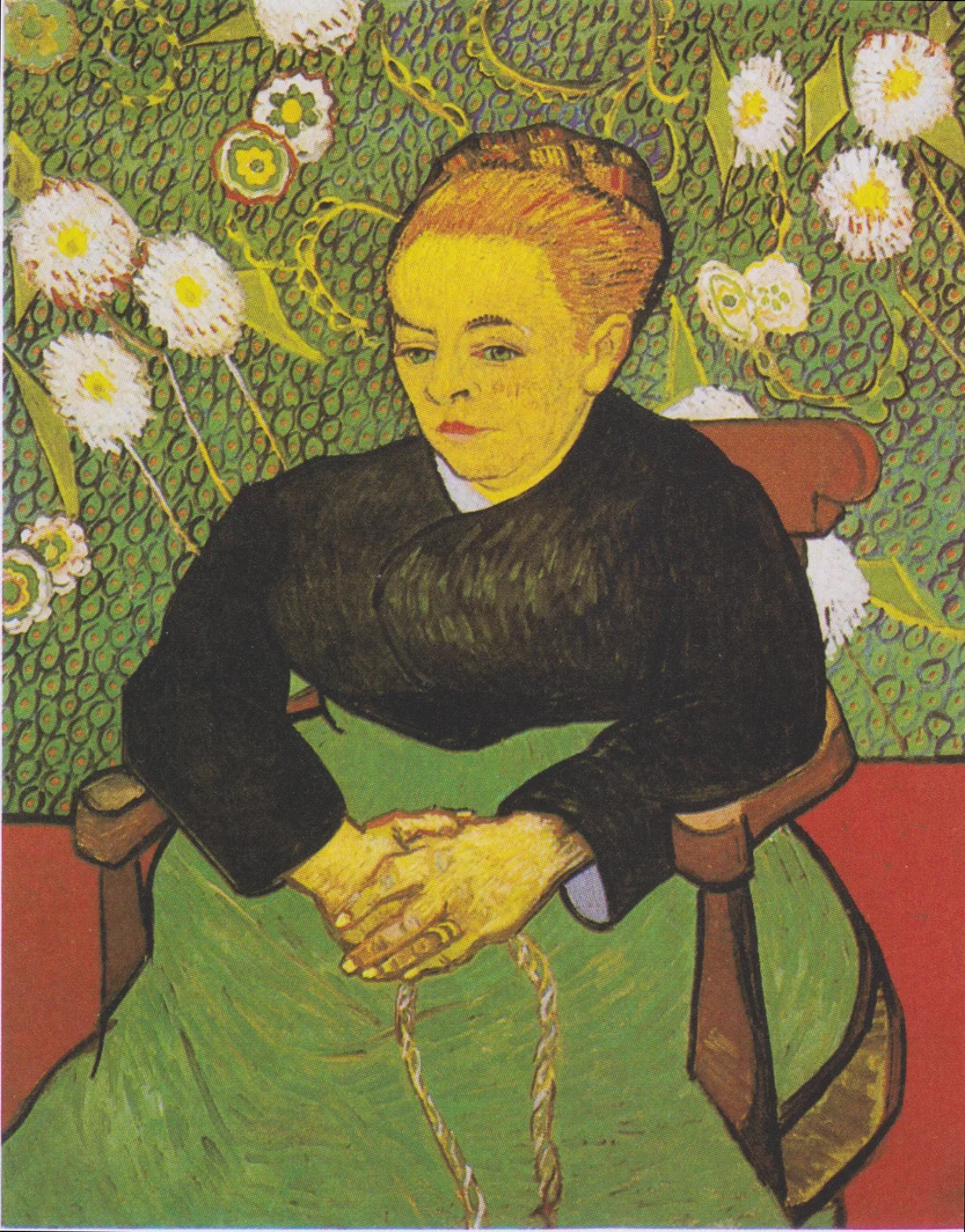
Among the few people who stayed close to him through that period was Joseph Roulin, a postal official in the town, and it is Roulin’s wife, Augustine, whom Van Gogh painted seated in a chair, her hands wrapped around the cord of a cradle that stays just out of view. He called the picture Lullaby: Madame Augustine Roulin Rocking a Cradle, La Berceuse, and returned to the same sitter and pose across several canvases into the spring of 1889.
This particular canvas, painted in 1889 and measuring 72.7 by 92.7 centimetres, is one of those versions. It is held today by the Museum of Fine Arts, Boston.
Augustine Roulin, held in yellow and black
She sits square to the viewer in a wooden armchair, her forearms resting along its arms, her hands loosely clasped around a length of rope that drops out of the bottom of the picture toward the cradle it is tied to. Her face and hands are painted in the same warm, unbroken yellow, as though skin and lamplight were made of the same substance.
Over a plain white collar she wears a black bodice, worked in short, dry strokes that make the wool look coarse and heavy against the smoothness of her skin. Below it, her green skirt is built from long vertical strokes, the brush following the fall of the cloth in her lap the way a hand might smooth it.
Her expression gives away very little. She looks past the viewer rather than at them, patient and a little tired, with the particular stillness of someone used to sitting still for long stretches while a household carries on without her.
Red floor, green leaves, and a rope in the dark
Behind her the wall is covered in a wallpaper-like pattern of pale flowers scattered across a field of green, daisies with yellow centres and looping stems that fill almost the whole upper half of the canvas. Van Gogh painted them loosely, closer to a repeating sign than to any one particular bloom, until the whole surface reads as pattern rather than as a room.
A band of red runs along the base of the picture at floor level, meeting the green wall in a hard line behind the chair. Red against green was a pairing Van Gogh returned to again and again during his years in Arles, and here it holds the composition together, pulling the eye between the sitter’s dark shape and the decorative field that surrounds her.
The rope in her hands amounts to no more than a few dark lines of paint, but it is the detail that explains everything else in the picture. It ties the painting to a cradle we are never shown, and turns what could have been a plain seated portrait into a picture of an action, rocking, repeated without end.
An image meant to console
Van Gogh wrote about wanting La Berceuse to work the way a piece of popular religious imagery works, a picture that a lonely person could look at and feel less alone. He imagined it hanging in the cabin of a fishing boat, or set between two of his sunflower canvases, glowing on either side of her like the wings of an altarpiece.
That ambition explains the painting’s flatness and its confidence with pattern. Van Gogh was not trying to produce a naturalistic likeness of Augustine Roulin so much as build an image with the directness of a devotional print, something that would still carry clearly from across a room, or a cabin, in poor light.
On the wall
Seen from a distance, the painting resolves into three simple shapes: the dark bodice, the pale face and hands, and the green field behind them, before the flowers and the rope reassert themselves up close. In low light the black of the bodice seems to absorb the room around it, while the yellow of the face holds on to whatever light remains.
In brighter light the green of the wallpaper and the red band at the base separate out and begin to compete for attention, and the picture turns busier, more insistent, less quiet than it first appeared. That shift, from a single still figure to a restless field of pattern and colour, is part of what keeps the painting from settling into the background over years of living with it.
Sizes and materials for La Berceuse (Lullaby) are listed on its product page.
More from this collection
Bring this painting home
Choose a hand-painted oil reproduction for real brushwork, or an archival canvas print for a crisp museum-image edition. Every size preserves the original proportions.
View this work & options
Further reading
Verify the original in the Museum of Fine Arts Boston collection record and continue through related works in the catalogue.