
Landscape at Twilight: Story, Meaning & Brushwork
Auvers-sur-Oise, early summer 1890
By the time Van Gogh reached Auvers-sur-Oise in May 1890, he had left the asylum at Saint-Remy and placed himself under the informal care of Dr Paul Gachet, a homeopath with a taste for painters. The village north-west of Paris gave him thatched roofs, orchards, wheat rising in the fields, and roads that ran out towards the horizon in every direction. He painted at a pace that still astonishes: dozens of canvases in barely ten weeks, many worked in a single sitting, before his death that July.
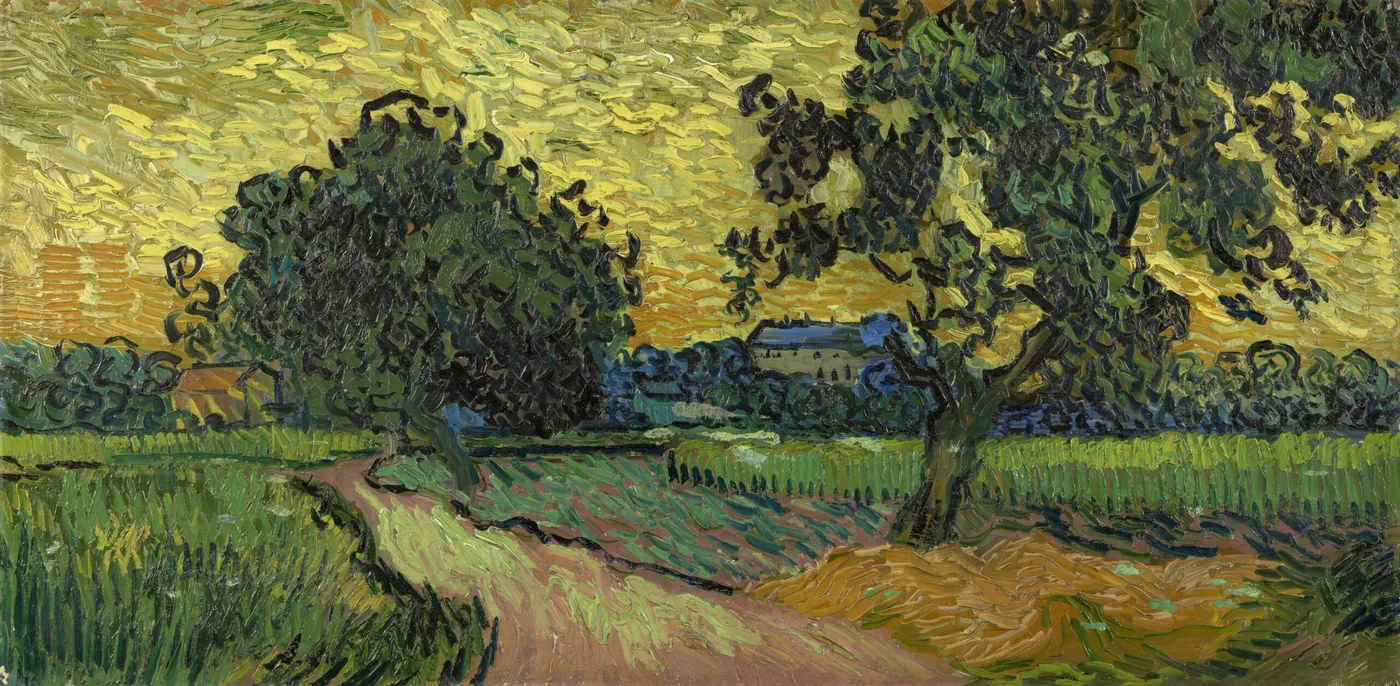
Landscape at Twilight belongs to this final burst of work. It is dated 1890 and now hangs in the Van Gogh Museum in Amsterdam, which holds much of what survives from these Auvers months. The canvas is unusually elongated, 107 by 50 centimetres, a format Van Gogh used for several of his last landscapes, as though the low wide shape of the wheat country had asked for it.
A track between two trees
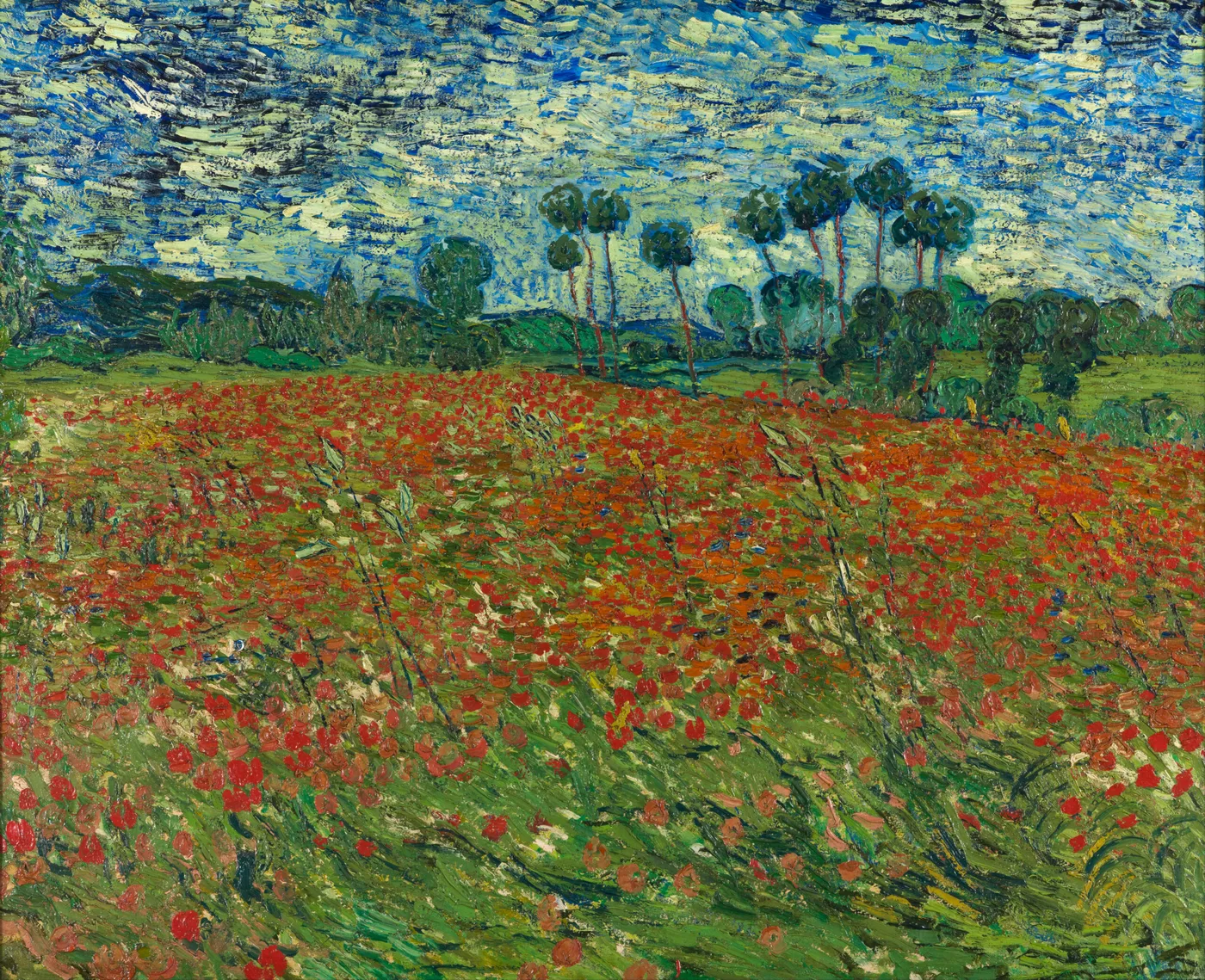
Two dark, heavily foliaged trees frame the middle of the composition, their crowns almost black against the sky. Between them a dirt path curves in from the lower left, cutting through young green wheat before it loses itself among the houses at the centre of the canvas.
A cluster of buildings sits low on the horizon: a blue-roofed house, walls touched with white and pale blue, half hidden by a run of smaller trees. It is the only architecture in the picture, and Van Gogh gives it just enough definition to anchor the eye before sending it back out into the fields.
The foreground right is given over to bare orange-brown earth, freshly turned or trodden, set directly against the cool greens of the crop rows beside it. Nothing in the scene is posed; it reads as a working landscape, seen on a walk rather than arranged for the canvas.
A sky on fire at ground level
The sky takes up more than half the canvas, and it is where the painting does its most extraordinary work. Van Gogh built it from short, curling strokes of yellow, gold and pale green, thickening towards orange near the horizon, as though the last of the sun were still burning behind the trees.
Against that heat the two central trees are painted almost in silhouette, their leaves reduced to loops and knots of near-black green. The contrast pulls the eye upward and back down in the same glance: sky first, then the dark mass of foliage, then the path leading the eye home through the fields.
Lower in the picture the palette cools into blue-greens and ochres, the wheat rendered in short vertical dashes that catch what light is left. The whole canvas reads as dusk exactly as its title says, that brief window when the sky still glows but the ground has already gone into shadow.
The hand behind the paint
The brushwork is fast and undisguised. Van Gogh laid the sky in overlapping arcs and commas of colour, never blending them, so that the paint keeps the rhythm of the hand that put it there. The trees are built the same way, but tighter and darker, almost scribbled, giving them a density that holds against the loose sky behind them.
In the fields the strokes straighten into short vertical marks that stand in for individual stalks of wheat without describing any single one. It was a shorthand Van Gogh had been refining for months, and by Auvers he could set it down without hesitation, canvas after canvas, in whatever light the day gave him.
Nothing here has been corrected or softened. The pace of the brush is part of what the painting is about: a landscape caught quickly, in the failing light of an early summer evening, by someone working against the hours he had left.
Living with the picture
Hung where morning or evening light can reach it, the painting changes with the room around it. In low light the gold of the sky deepens and the trees all but disappear into the dark; under a stronger lamp the individual strokes separate out again, and the picture opens back into a wide summer field.
It rewards a second look more than a first. The path, once noticed, is hard to stop following, and the small blue-roofed house at its centre gives the eye somewhere to rest between the turbulence of the sky and the quiet, ordered rows of the field below.
Sizes and materials for Landscape at Twilight are listed on its product page.
More from this collection
Bring this painting home
Choose a hand-painted oil reproduction for real brushwork, or an archival canvas print for a crisp museum-image edition. Every size preserves the original proportions.
View this work & options
Further reading
Verify the original in the Van Gogh Museum collection record and continue through related works in the catalogue.