
The Langlois Bridge at Arles: Story, Meaning & Brushwork
Vincent van Gogh reached Arles in February 1888, stepping off a train into snow, having left Paris and its crowded studios and quarrelsome cafes behind him. He wanted plainer subjects and a light he had heard described but not yet seen. Within a few weeks of arrival he found both a short walk from the town, at a small lifting bridge on the road south towards Port-de-Bouc.
A Bridge That Recalled Home
The bridge was a modest, practical structure, a wooden drawbridge worked by chains and counterweights so that boats could pass along the canal beneath it. It was the kind of thing a town engineer would barely notice, but Van Gogh recognised it at once. He wrote to his brother Theo that it reminded him of the drawbridges of his native Netherlands, and of Dutch painting more generally.
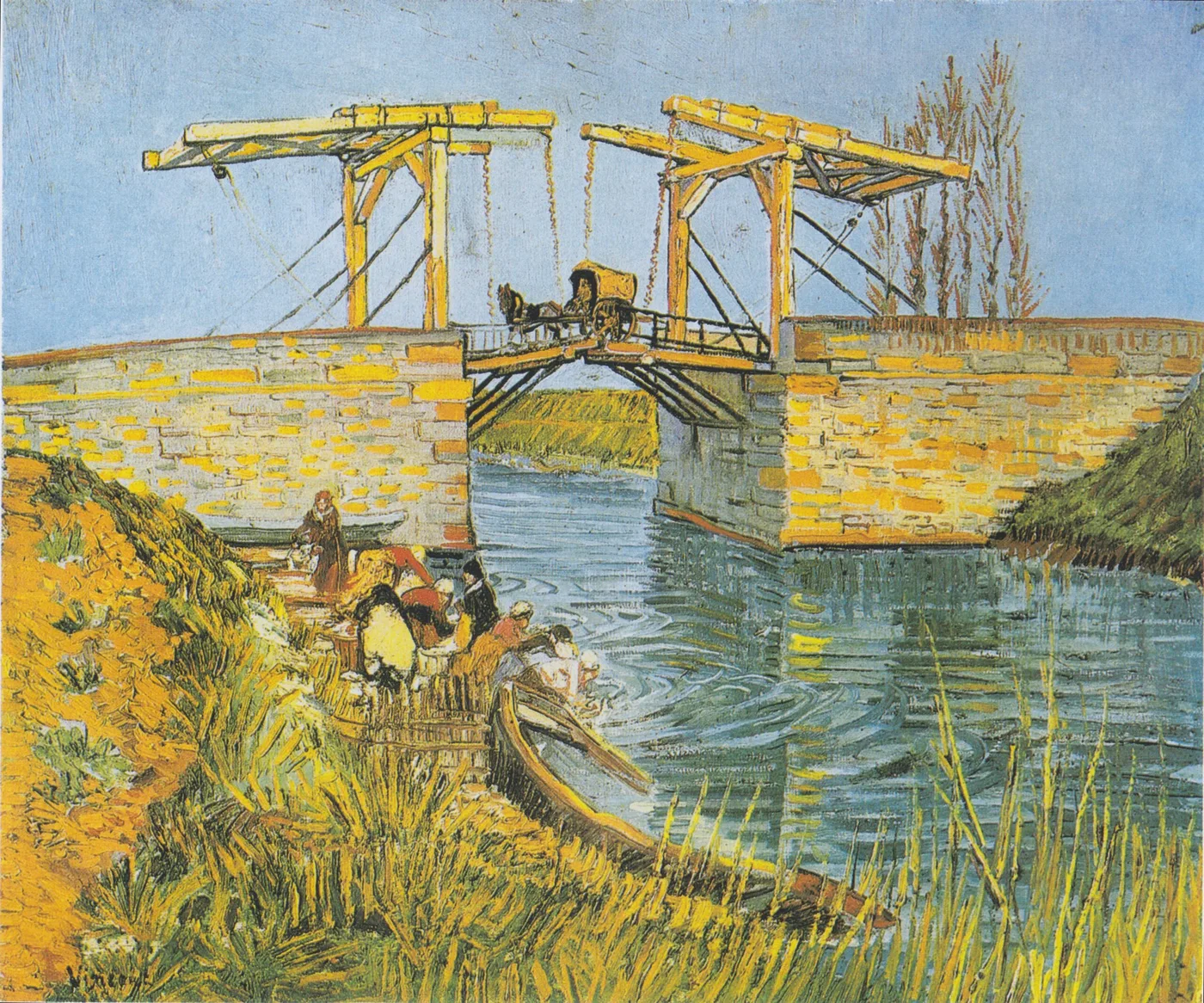
He returned to the subject several times that spring of 1888, working the same bridge from different distances and angles as the light and his own thinking about colour changed. This particular canvas, painted in 1888 and originally titled The Langlois Bridge at Arles with Women Washing, adds a second subject to the bridge itself: the women who did their laundry on the bank below it.
The picture is not large, just 65 by 54 centimetres, and that modest scale suits its subject. It is a study of an unremarkable working corner of a small town, not a grand statement, and it reads best at something close to its own size.
What the Canvas Actually Shows
The drawbridge crosses the canvas roughly through its centre, its two raked wooden trestles rising against a flat, cloudless blue sky. A horse pulls a small cart over the span, a detail easy to miss at first glance but one that gives the crossing a reason to exist beyond decoration.
Below the timber, the stone piers are built up in creams and greys, interrupted by patches of warm ochre and orange brick that catch the sun on their upper courses. The canal itself fills the lower half of the composition in blue-greens and slate blues, broken into short curling strokes where the surface catches light and reflects the piers above it.
On the near bank, in the bottom left corner, a group of women kneel over the water doing their washing, their dresses picked out in reds, whites and dark blues among tall yellow-green grasses. A small boat has been pulled up onto the sloping bank beside them, and on the far right a line of slender trees stands against the sky, their thin trunks a deliberate contrast to the bridge’s heavy geometry.
Van Gogh signed the canvas simply Vincent in the lower left corner, among the grass, in the way he signed most of his mature work.
Colour Laid Down Without Apology
The drawing throughout is firm and economical, each plank and rope of the bridge set down with a clean, confident line before colour was added, a habit that owed something to the Japanese woodblock prints he had been collecting and studying in Paris. Colour, once applied, is rarely mixed to a middle tone. Blue sky sits directly against yellow timber, and orange brick sits directly against blue-green water, so the picture holds its brightness even from across a room.
The water is where the brushwork works hardest. Instead of one even colour, Van Gogh built the canal from dozens of short, curved strokes, blues and greens and the odd stroke of white, so that the surface seems to move even though nothing in the scene is in motion. The grass in the foreground is handled the same way, laid in with quick, directional strokes that follow the way the blades actually grow.
Nothing in the picture is softened or blended for comfort. The result is a scene that feels lit from a very particular, very bright southern sun, quite unlike the grey Dutch and Parisian light Van Gogh had painted under before, and unlike anything he had painted before arriving in Provence.
Living With the Bridge
Hung in a room that gets any natural light through the day, this is a painting that keeps changing without ever changing. Morning light draws out the cool blues of the water and sky; lamplight in the evening pulls the ochres and oranges of the bridge and bank forward, so the same canvas can feel crisp at breakfast and warm by nightfall.
It rewards being looked at twice. From a distance, the eye goes straight to the yellow trestles against blue sky. Closer in, the washerwomen, the boat and the play of strokes across the water start to matter just as much, and the picture stops being a bridge and becomes a whole working morning by a canal.
The original hangs today in the Kröller-Müller Museum, one of the clearest and most approachable pictures from Van Gogh’s first, hopeful months in the south, painted before the summer heat and the wheat fields pushed his colour and his brush into something more urgent.
Sizes and materials for The Langlois Bridge at Arles are listed on its product page.
More from this collection
Bring this painting home
Choose a hand-painted oil reproduction for real brushwork, or an archival canvas print for a crisp museum-image edition. Every size preserves the original proportions.
View this work & options
Further reading
Verify the original in the Kröller-Müller Museum collection record and continue through related works in the catalogue.