
Thatched Cottages in the Sunshine: Story
Vincent van Gogh reached Auvers-sur-Oise on the twentieth of May 1890, carrying his easel off the train from Paris and, for the first time in years, no asylum wall around him. He had just spent twelve months committed at Saint-Remy. Auvers was meant to be recovery: a village of thatched farms, gardens run to seed, and a doctor, Paul Gachet, who understood painters. Van Gogh had ten weeks left to live, and he worked through nearly all of them.
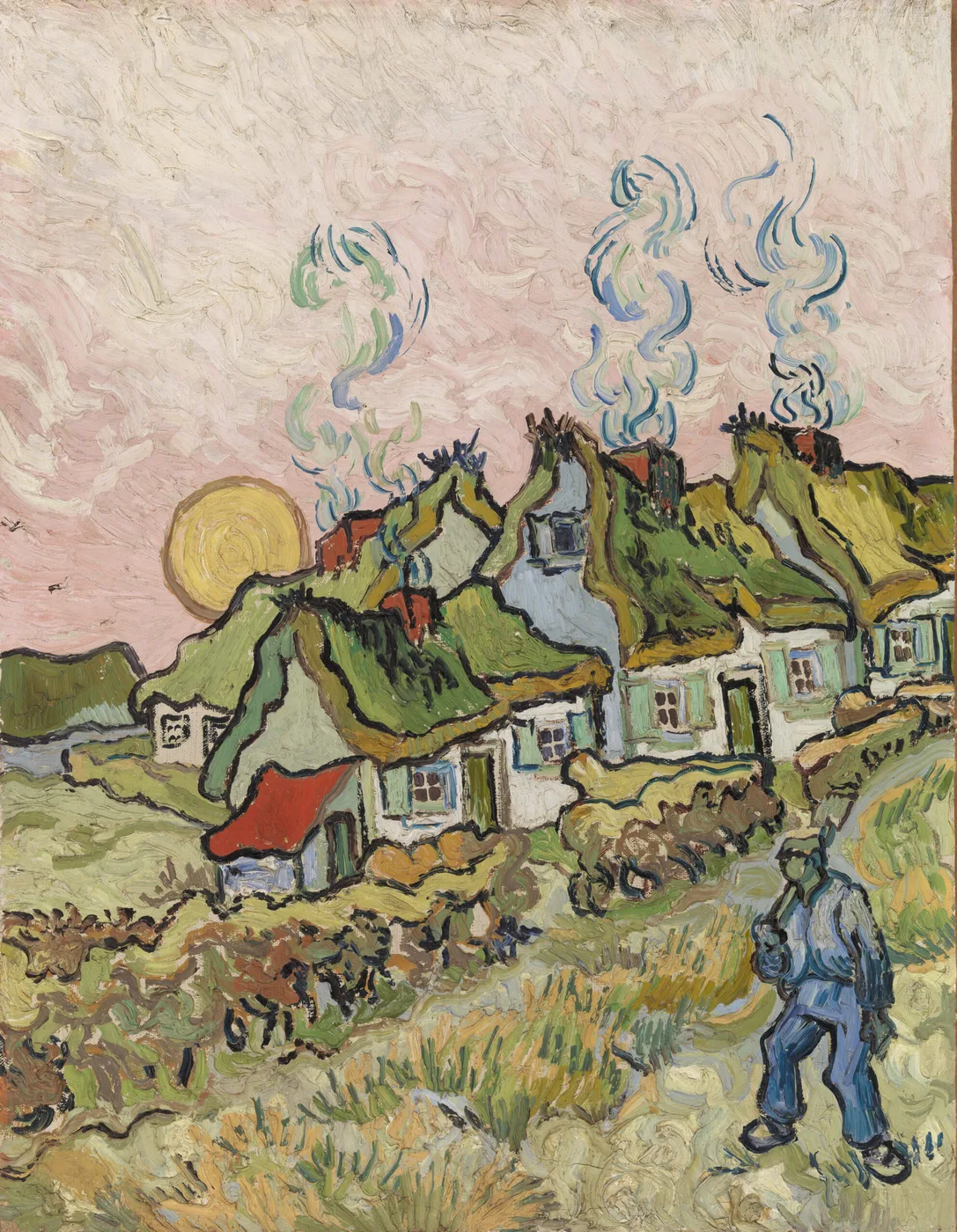
Thatched Cottages in the Sunshine belongs to that final burst. He painted it in 1890, one of a run of canvases in which the old farm roofs of the village became, briefly, his whole subject. The picture is small, just 40.5 by 52 centimetres, built for close looking rather than a grand wall.
A Village Doctor and Seventy Days
Auvers had been recommended to van Gogh by his brother Theo, on Gachet’s word that the air and the company would help. The village sat on the Oise, an hour from Paris by rail, still farmed in the old way with thatch on the roofs and geese in the yards. For a painter who had spent a year inside an institution, the change was total.
He rented a room above a cafe and painted at a pace that still startles cataloguers: something close to a canvas a day through June and July. The thatched roofs of Auvers, ancient even then and already being replaced by tile elsewhere in France, caught him early and held him. He returned to them again and again, from different angles and in different weather.
This is one of those returns. It shows no drama, no incident beyond a man walking home. That restraint, from a painter three months from his death, is worth sitting with.
Roofs Like Waves
A row of cottages runs across the lower half of the canvas, their thatch built up in thick, rounded ridges that read almost as a coastline of green and ochre. One roof is tiled in red, breaking the rhythm of the thatch and pulling the eye first. Whitewashed walls sit beneath, pierced by small windows framed in pale blue and green.
Three chimneys send up smoke in tight blue-green spirals, curling against the sky like a signature. Van Gogh painted smoke this way more than once in his last months, less as observed weather than as a mark he liked making, a loop of the wrist repeated three times across the roofline.
In the foreground a man in workman’s blue walks the track past the houses, a tool slung over one shoulder. He is small against the roofs and barely modelled, there to give the lane a use rather than to hold the eye. The grass around his feet is built from short, dry strokes of gold, olive and rust.
A Sky the Colour of Chalk and Rose
Above the roofline the sky is not the blue one expects of a painting called “Sunshine.” Van Gogh laid it in chalky pink and cream, swept in long horizontal strokes, with a pale gold sun sitting low near the horizon on the left. The effect is closer to first light than to noon.
That low sun explains the title without shouting it. Its glow is picked up faintly in the upper edges of the thatch and in a scatter of warm ochre through the grass, so the whole lower half of the canvas seems to be catching light thrown from one low, quiet source.
Set against the pink sky, the greens of the roofs and gardens turn unusually cool and deep, almost blue-green in the shadowed folds of the thatch. Van Gogh was working with a narrow, considered palette here: rose, cream, and gold above; green, ochre, and white below; very little else.
The Weight of the Brush
Every roof edge is drawn first in dark blue or near-black outline, then filled with short, packed strokes of green and yellow-green that follow the pitch of the thatch. The paint sits thickly enough to catch real shadow across its surface, a texture you feel as much as see.
The sky, by contrast, is built from longer, looser passes, the brush dragged sideways so the strokes read as moving cloud or haze rather than solid air. Van Gogh varied his touch by what he was painting rather than applying one method throughout, tight and searching on the roofs, open and rhythmic overhead.
Nothing in the picture is blended smooth. Colours sit next to each other, stroke against stroke, so the surface keeps a kind of nervous energy even in a scene this settled. It is the same hand that painted the wheatfields outside Auvers that same summer, applied here to something domestic and small.
On a Wall, Through the Day
Hung where morning or evening light can reach it, the picture changes with the room. Under warm lamplight the rose sky deepens and the thatch glows almost amber. In the flatter light of midday, the greens and blues in the roofs come forward and the picture reads cooler, quieter.
It rewards the kind of looking that does not happen all at once. The three plumes of smoke, the single red roof, the small blue figure on the path: none of these announce themselves from across a room, but each holds up under a second and third look, which is the mark of a picture painted quickly by someone who had stopped wasting time.
The original hangs today in the Barnes Foundation, among the collection Albert Barnes assembled largely on his own judgement rather than fashion. It keeps company there with other late van Goghs from the same short, productive stretch at Auvers.
Sizes and materials for Thatched Cottages in the Sunshine are listed on its product page.
More from this collection
Bring this painting home
Choose a hand-painted oil reproduction for real brushwork, or an archival canvas print for a crisp museum-image edition. Every size preserves the original proportions.
View this work & options
Further reading
Verify the original in the Barnes Foundation collection record and continue through related works in the catalogue.