
The Pink Peach Tree: Story, Meaning & Brushwork
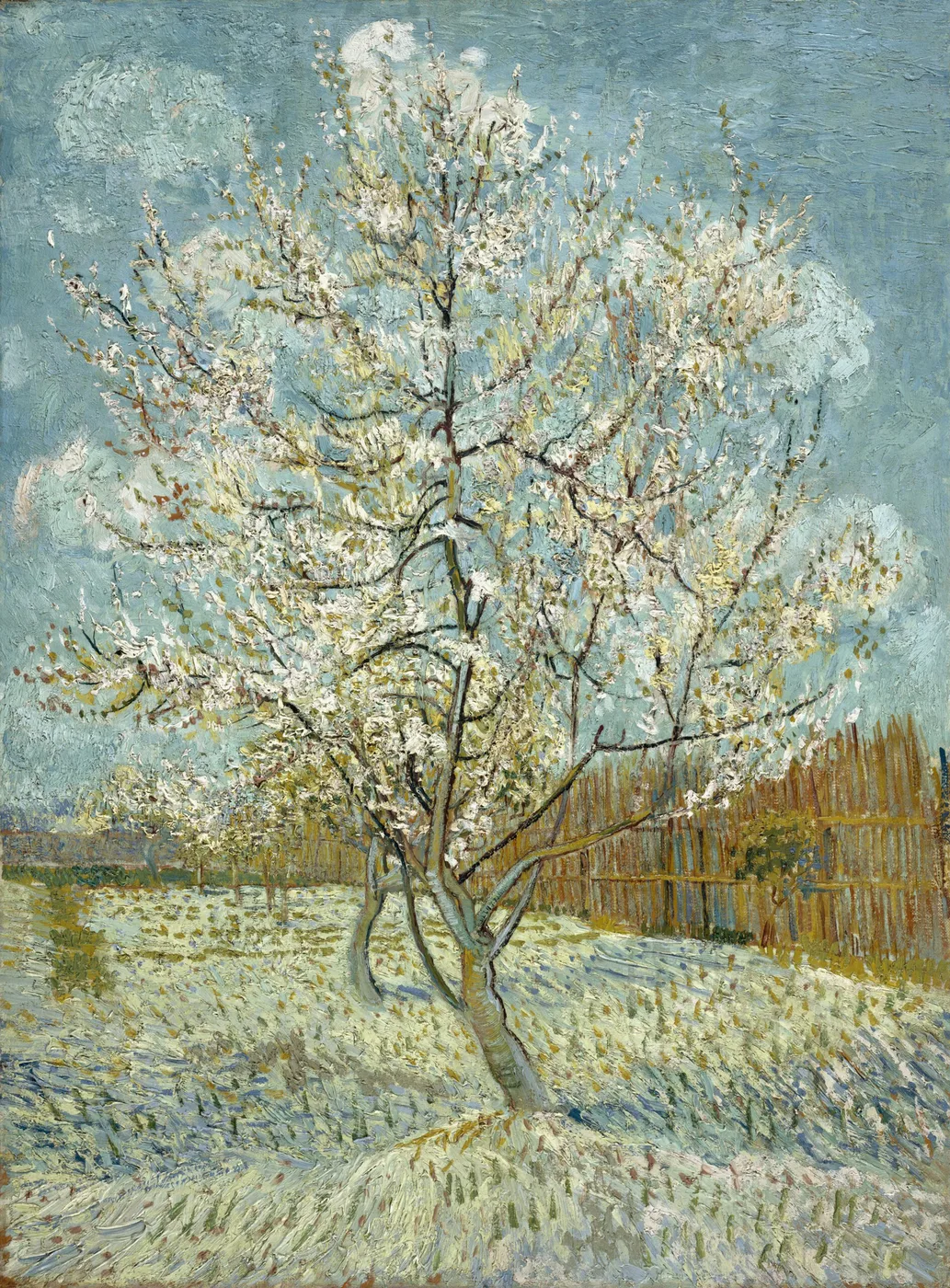
Vincent van Gogh reached Arles in February 1888, arriving to snow and a raw Provençal wind, not the light he had promised himself when he left Paris. He had spent two years in the capital surrounded by other painters, by theory, by exhaustion, and he wanted distance from all of it. Within weeks the cold broke and the orchards around the town came into flower, and he began painting them almost daily, working against the blossom’s short life before the petals dropped.
Arles, February to April 1888
The move south was partly a search for health, partly a search for a kind of light he associated with Japanese prints he had collected in Paris. He rented a room, then the Yellow House, and set up to paint outdoors whenever weather allowed. The orchards on the edge of town gave him a subject that changed by the day.
He wrote to his brother Theo through March and April about the blossoming trees, describing the rush to get each one down before the flowers fell. Some days he worked on more than one canvas, moving between orchards as the light shifted. The pink peach tree belongs to this stretch of weeks, painted in 1888 during that same short season.
Most of the orchard paintings from this period show rows of trees receding into an avenue, several trunks repeating down the canvas. This one is different. Van Gogh isolates a single tree, giving it the whole picture to itself.
A Single Tree Against a Pale Sky
The trunk forks low, near the ground, into two leaning limbs that then split again into a fine network of branches. Almost every branch carries blossom, so that the crown reads as a dense cloud of pale pink and white rather than as individual flowers. Only near the base does bare, grey-brown wood show through.
Behind the tree the sky is a soft, chalky blue, broken by loose white clouds that echo the shape of the blossom below. The two are close in tone, so the tree seems to dissolve slightly into the air around it rather than standing out sharply. Van Gogh keeps the palette narrow: blue, white, pink, and the ochre of the ground and fence.
The ground is built from short, dry strokes of pale green, cream, and light ochre, suggesting new grass and turned soil rather than describing either in detail. To the right, a low wooden picket fence in warm orange-brown closes off the orchard from whatever lies beyond it. On the left the ground opens out toward a hazy, low horizon, giving the tree room to stand alone.
Paint Laid Down at Speed
The blossom is built from short, loaded dabs of paint, some almost dry, some thick enough to catch light as raised ridges on the surface. Van Gogh does not blend these strokes into a smooth surface. Each one stays visible as a distinct mark, so the canopy reads, up close, as a field of separate touches rather than a painted mass.
The branches and trunk are drawn in thin, dark, slightly twisting lines, laid in with a loaded brush rather than sketched first and filled in. This gives the tree its slightly nervous, searching structure, branches that seem to have grown quickly and irregularly, which peach trees do. The sky, by contrast, is worked in broader, calmer strokes.
The urgency behind all this is not incidental. Blossom lasts days, not weeks, and Van Gogh knew he had one chance at each tree before the flowers went. That pressure shows in the directness of the paint handling, in the absence of reworking or careful correction.
On a Wall, in Changing Light
Hung in a room that gets morning sun, the blues in the sky tend to lift and the pinks read cooler and clearer. In afternoon or lamp light, the same canvas warms, the ochre of the fence and ground coming forward while the blossom softens toward grey-white. It is a painting that keeps changing hands with the room around it.
Against a plain or dark wall it holds its own quietly rather than dominating the space, since the palette stays close in tone throughout. It suits a room meant for rest more than one meant for display, given the stillness of the single tree and the softness of its colour.
The pink peach tree, at 59 by 80.5 centimetres, is now held by the Van Gogh Museum in Amsterdam. It remains one of the clearest statements from that Arles spring: a tree in full, brief flower, painted by someone who understood exactly how little time he had to catch it.
Sizes and materials for The pink peach tree are listed on its product page.
More from this collection
Bring this painting home
Choose a hand-painted oil reproduction for real brushwork, or an archival canvas print for a crisp museum-image edition. Every size preserves the original proportions.
View this work & options
Further reading
Verify the original in the Van Gogh Museum collection record and continue through related works in the catalogue.