
Thistles: Story, Meaning & Brushwork
By the summer of 1888 Vincent van Gogh had been in Arles for several months, working at a pace that alarmed even him. He wrote to his brother Theo of canvases finished almost daily, of colour he could barely contain, of a light in Provence that made everything he had painted in the grey north look tentative by comparison. Amid the wheat fields, orchards and portraits of that extraordinary year, he also stopped to paint a stand of thistles growing wild at the edge of a road.
There was nothing precious about the subject. Thistles are weeds, the kind of plant a farmer curses and a walker steps around. That Van Gogh gave them a canvas at all tells you something about how he was looking at Arles that summer: nothing was too rough or too ordinary to earn his attention.
A Weed Given the Weight of a Portrait
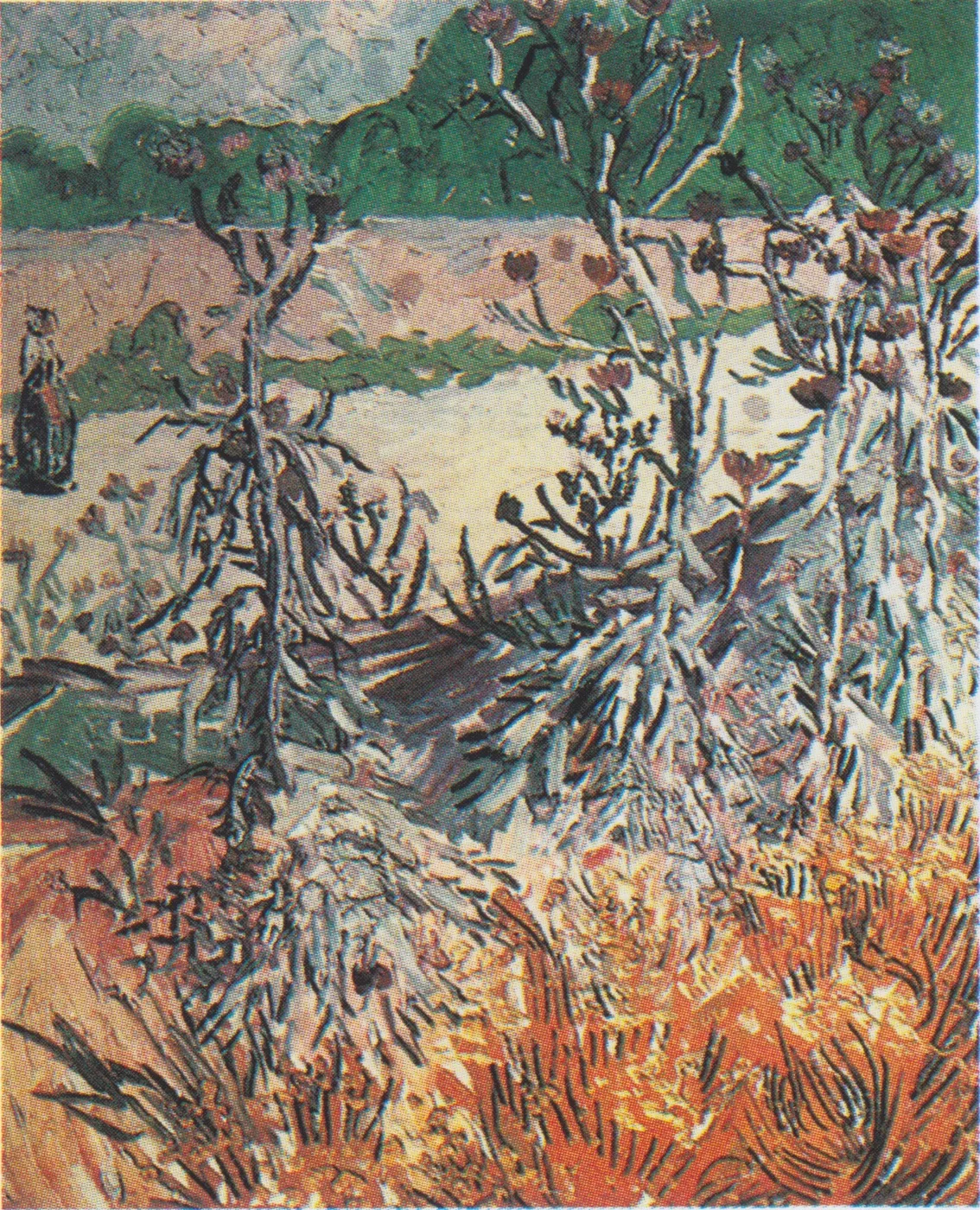
The picture is built almost entirely from the plants themselves. Their pale, wiry stems rise the full height of the canvas, cutting across a hazy strip of road and a line of green hedgerow beyond. Van Gogh has pushed the thistles right up to the viewer, so close that a handful of them fill the frame edge to edge.
Each stem forks and re-forks into thin, bristling branches, and every branch ends in a dry, dark seed head or a small burst of pink and violet flower. The drawing is fast and slightly ragged, done with a loaded brush rather than a pencil, so the thistles seem to bristle and crackle rather than sit still.
Against that tangle, the ground reads almost bare: a pale, sun-bleached track running back between the plants toward a low horizon. It is the kind of unremarkable verge you would walk past without a second look, which is exactly the point.
Where the Eye Lands First
The lower edge of the canvas is where the picture is loudest. Van Gogh has laid in a mass of dried grasses and foliage in hot orange, red and gold, painted in short, urgent strokes that seem to catch fire against the cooler tones above. This is where the eye goes first, before it climbs into the greys and silvers of the thistle stems.
From there the palette cools by stages. The stems themselves are painted in chalky white and grey-green, streaked with darker outlines that give them a wiry, almost metallic quality. Their flower heads carry the only strong colour in the upper half of the canvas, small knots of mauve and dusky pink scattered among the dark green foliage at the top edge.
Behind the thistles, the road and the hedge are handled far more thinly, with a paler, more diluted paint that keeps them from competing with the foreground. That difference in handling, thick and urgent up close, calm and sketchy at a distance, does most of the work of pushing the space back.
A Figure on the Road
Look past the thistles and there is a small dark figure walking along the pale track, a woman rendered in only a few strokes of black and brown. She is barely more than a silhouette, but she anchors the whole picture. Without her, the road might be read as an abstract band of colour; with her, the scene resolves instantly into a real place, a real distance, a real morning.
That contrast between the meticulous, close-up plants and the loosely sketched figure in the distance is one of the picture’s quiet pleasures. Van Gogh had painted enough poplar-lined roads and working figures around Arles that season to place her there with a handful of marks and trust the viewer to read her correctly.
Why Paint the Roadside
Van Gogh had spent the previous years painting peasants, potato eaters, and the stubborn textures of rural labour, and something of that same respect for the unglamorous carries over here. A thistle survives where softer plants cannot. It grows in poor soil, on verges and wasteland, and defends itself with the same spines that make it a nuisance to everyone else.
He was not painting a symbol so much as a fact of the landscape he lived in that summer, but the choice still says something about his eye. He found as much to paint in a roadside weed as in a sunflower or a wheat field, and gave it the same close, patient attention.
The result sits between a landscape and a still life. It has the intimacy of a study made close to the ground, plant by plant, and the depth of a proper view out across open country, road, hedge and walking figure all included.
On the Wall
Painted in 1888 at 49 by 59 centimetres, the original now belongs to the Collection Stavros Niarchos. It is a modest size for how much the canvas holds: a wall of thistles, a strip of road, a whole small world compressed into arm’s reach.
Hung in a room, it rewards the same kind of attention Van Gogh gave the subject. From across a room the picture reads as a burst of orange and green, warm at the base and cooling toward the top. Move closer and the individual strokes take over, the wiry stems, the seed heads, the small figure on the road, all of it built from paint that still looks wet with intention.
Morning light picks out the ridges of impasto in the foreground grasses and makes them glow. Later in the day, as the light flattens, the picture settles into its cooler greens and greys, the thistles standing quieter but no less stubborn. Few paintings of a roadside weed ask to be looked at this closely, or reward it this well.
Sizes and materials for Thistles are listed on its product page.
More from this collection
Bring this painting home
Choose a hand-painted oil reproduction for real brushwork, or an archival canvas print for a crisp museum-image edition. Every size preserves the original proportions.
View this work & options
Further reading
Verify the original in the Collection Stavros Niarchos collection record and continue through related works in the catalogue.