
White Vase with Roses and Other Flowers: Story
Paris, 1886: Relearning How to See Colour
Vincent van Gogh arrived in Paris in the spring of 1886 carrying a habit of paint he needed to break. The pictures he had made in Nuenen, dark studies of peasants and potato fields, belonged to a palette built on umbers and blacks. Paris asked something different of him.
He moved in with his brother Theo and began looking, hard, at what other painters were doing with colour. Impressionist canvases, Japanese prints pinned to the studio wall, the broken brushwork coming out of Montmartre studios: all of it argued that light was not brown.
Flowers became his exercise book. They were cheap, they did not need a model to sit still for hours, and a vase of mixed blooms let him try one combination of colour against another without the pressure of a finished, sellable subject hanging over every stroke.
A Bouquet Gathered Into a White Vase
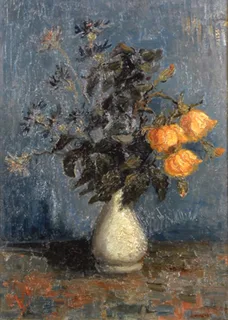
White Vase with Roses and Other Flowers, painted in 1886 and measuring a modest 25.5 by 37 centimetres, is one result of that private curriculum. It is a small, close picture, built to be worked out in a sitting or two rather than laboured over.
A pale, bulbous ceramic vase sits low in the frame, its glaze catching cool grey-blue reflections thrown back from the wall behind it. Out of it rises an unruly handful of stems: clustered orange-apricot blooms lean to one side, sprays of blue-violet flowers open on the other, and dark, almost black-green foliage threads through the whole arrangement to hold it together.
The vase itself is barely modelled beyond a few economical strokes, just enough to suggest its swelling belly and narrow neck. Van Gogh was not interested in describing porcelain. He wanted a light, neutral shape that would let the colour of the flowers do the work.
Behind the bouquet the wall reads as a soft, smoky blue-grey, laid on thinly and unevenly so that warmer ground shows through in places. Below it, the tabletop is a ruddy brown streaked with dabs of red, a warm shelf that the cool wall and the pale vase both sit against.
Orange Against Blue
The picture’s whole logic turns on one contrast: the warm orange clusters set against the cooler blues of the background and the violet flowers beside them. It is a pairing straight out of the colour theory Van Gogh was absorbing that year, complementary hues placed side by side so each intensifies the other.
Look closely and the orange blooms are not rendered as individual petals so much as loaded, separate touches of paint, thick and a little clumsy, laid down wet and left alone. The blue-violet flowers opposite them are built the same way, in short dabs rather than blended passages.
The foliage is the darkest note in the picture, near-black in places, and it is painted more loosely still, almost scribbled, giving the bouquet its sense of having just been dropped into the vase rather than arranged. Nothing here is smoothed or polished; the brush moves quickly and the marks stay visible.
That speed is the point. A flower study made in an afternoon could not afford the patient glazing of academic still life painting, and Van Gogh was not trying for that kind of finish. He wanted to see, immediately, what one colour did sitting next to another.
What the Painting Does on a Wall
Hung at eye level in a room with changing daylight, this kind of picture behaves differently through the day. Morning light picks out the cool blue-grey of the background and lets the vase read almost silver; later, warmer light draws the orange blooms forward until they seem to sit slightly in front of the canvas.
It is a small painting, and it rewards being looked at up close, where the individual loaded strokes separate out into distinct touches of colour rather than resolving into a smooth surface. Stand back and the same strokes settle into a bouquet again.
That double reading, legible as brushwork up close and as a gathered handful of flowers from across a room, is exactly what a quick, exploratory study like this one can offer a wall that a more finished, careful picture cannot.
Sizes and materials for White Vase with Roses and Other Flowers are listed on its product page.
More from this collection
Bring this painting home
Choose a hand-painted oil reproduction for real brushwork, or an archival canvas print for a crisp museum-image edition. Every size preserves the original proportions.
View this work & options
Further reading
Verify the original in the collection record and continue through related works in the catalogue.