
Self-Portrait without Beard: Story & Meaning
A shave, and a portrait for his mother
By September 1889, Vincent van Gogh had been living at the Saint-Paul-de-Mausole asylum in Saint-Rémy-de-Provence for four months, admitted after the crisis that had ended his time in Arles. Painting was one of the few activities the doctors left in his own hands, and self-portraiture became one of the few subjects he could pursue without leaving his room. He worked from a small mirror, alone, in the intervals between the attacks that periodically closed him off from his work altogether.
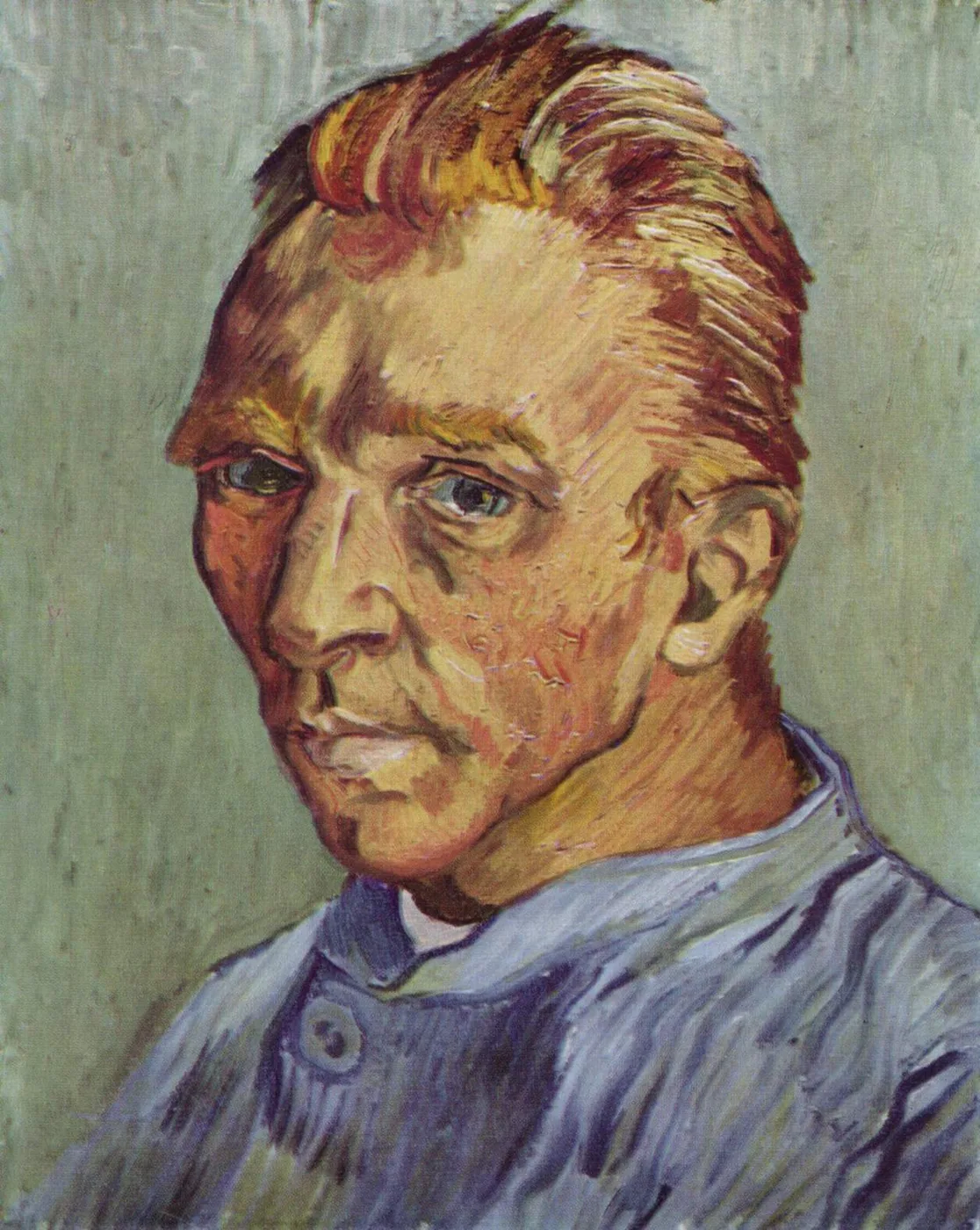
Sometime that month he shaved off his beard. It was a small, deliberate act, and he used the change to make a portrait he could send home to his mother, a picture of himself looking steady and well rather than as she might have imagined him. The result is Self-portrait without beard, painted in 1889 and measuring just 31 by 40 centimetres, smaller than most of the self-portraits that surround it in his output from that year.
It is also, among his surviving self-portraits, the only one in which his face appears without any facial hair at all. Every other likeness from his Paris, Arles and Saint-Rémy years shows him bearded or moustached to some degree. This one strips that away, and with it a certain amount of the disguise a beard offers a tired face.
A face turned three-quarters to the light
The canvas holds nothing but the man himself, cropped close at the shoulders and turned slightly away from the viewer so that one side of his face catches more light than the other. His hair is combed back off his forehead in streaks of ochre and auburn, and his pale blue-grey eyes look out past the frame rather than directly at us, steady rather than confrontational.
He wears a buttoned jacket in a soft blue-grey, its collar closed high at the throat, painted in the same loose, weather-beaten strokes as the rest of the picture. There is no hand, no table, no window, nothing to place him in a room. The background is a flat wash of sage green, worked in vertical strokes that run the height of the canvas like the grain of old wood.
The left side of his face, in shadow, is built from ruddy reds and browns that push it back into the ground. The right side catches a cooler, paler light that brings the cheekbone and temple forward. It is a small asymmetry, but it does most of the work of making the head feel solid rather than flat.
Colour set against colour
Van Gogh paints the head with the same short, directional strokes he used across his Saint-Rémy work, laid down fast and left visible rather than blended smooth. Around the jaw and under the eyes the paint changes direction almost stroke by stroke, following the structure of the face rather than smoothing over it.
The palette turns on a single contrast: the warm flesh tones of the face against the cool green-grey of the background and the blue-grey of the coat. Reds, oranges and ochres in the skin sit directly beside the muted green behind the head, and the two colours sharpen each other rather than blending at the edge.
There is very little black anywhere in the picture. Shadow is built from darker reds and browns rather than from grey or black paint, which keeps the whole surface warm even where the face turns away from the light. It is a controlled, almost disciplined way of painting, closer to the steadiness of the gaze than to the turbulence often associated with his later work.
A calmer likeness than the rest
Van Gogh painted more than thirty self-portraits over the course of his career, and the Saint-Rémy group is usually read as some of the most searching among them. Set against those, this one stands out for its restraint. There is no swirling halo of brushwork around the head, no visible agitation in the paint; the surface is worked hard but kept under control.
That control matters given when the picture was made. He was painting between periods of illness, in a year that also produced some of his most turbulent canvases, and this portrait shows none of that turbulence on its surface. Whatever the shaving meant to him personally, the picture he built around it reads as an act of composure.
It is worth noticing what the painting withholds as much as what it shows. No setting, no possessions, no other figure, nothing beyond the face and the collar of a plain jacket. The directness is almost clinical, a record of how he wanted to be seen rather than an account of where or how he was living.
The picture in a room
Hung at eye level, the portrait holds a room the way a fixed gaze holds a conversation. The face sits close enough to the front of the picture plane that there is little real distance between the sitter and the viewer, and the sage-green ground gives the eye almost nowhere else to rest.
Daylight changes it more than most portraits. In flatter, cooler light the green background reads as grey and the face pulls forward; under warmer evening light the ochres and reds in the hair and skin deepen and the whole picture turns closer to bronze. Either way, the eyes stay the fixed point the rest of the painting works around.
Sizes and materials for Self-portrait without beard are listed on its product page.
More from this collection
Bring this painting home
Choose a hand-painted oil reproduction for real brushwork, or an archival canvas print for a crisp museum-image edition. Every size preserves the original proportions.
View this work & options
Further reading
Verify the original in the collection record and continue through related works in the catalogue.