
The Sower (after Millet, Sun Version): Story
Painting from Memory, Not from a Field
In May 1889 Vincent van Gogh committed himself to the asylum of Saint-Paul-de-Mausole at Saint-Rémy-de-Provence, seeking shelter after the crises that had ended his time in Arles. The grounds gave him a walled garden and glimpses of wheat fields beyond, but for long stretches he could not simply walk out and find a model or a motif. He wrote to his brother Theo for reproductions of the painters he trusted most, the same names he had leaned on since his earliest attempts at drawing.
Chief among them was Jean-François Millet, whose Sower had already become one of the most copied images of rural labour in Europe. Van Gogh did not trace Millet’s design so much as translate it, the word he used himself, working from a black-and-white print into a scheme of colour that was entirely his own invention.
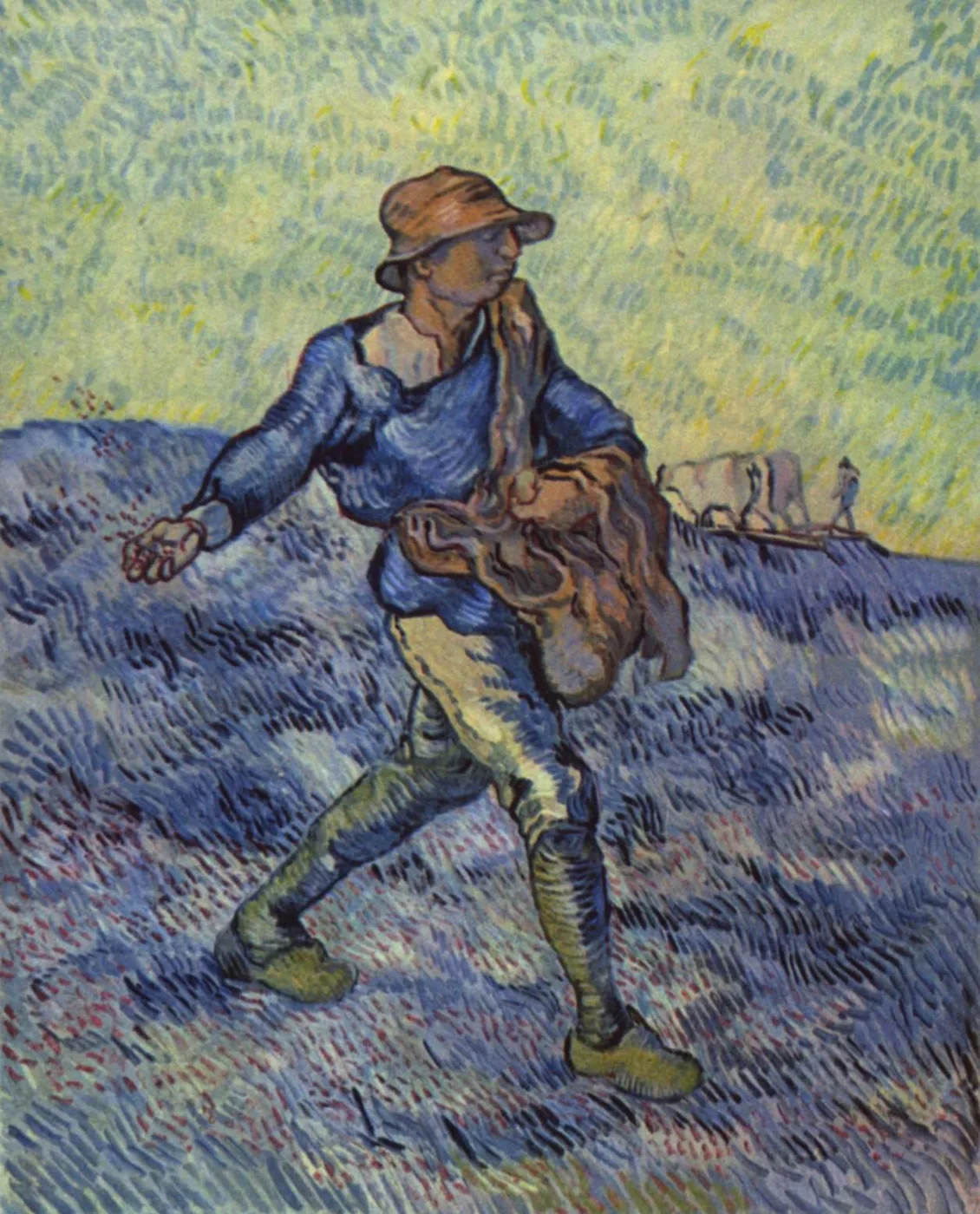
Sower, The (after Millet), painted in 1889, belongs to that practice. Millet supplied the pose and the composition, and Van Gogh supplied nearly everything a viewer actually sees: the colour, the light, and the rhythm of the brush.
A Man in Blue Against Violet Earth
The sower fills the middle of the canvas, caught mid-stride down a sloping field, his right leg planted forward and his left trailing behind. He wears a broad, curling-brimmed hat in warm ochre, a loose blue smock open at the collar, and pale trousers gathered above heavy boots. A dark orange seed bag, slung across his chest, feeds the hand that swings out ahead of him mid-throw.
His face is turned down and largely shadowed, so the picture reads through posture rather than expression. The whole weight of the figure sits in the stride and the reaching arm, caught at the instant of releasing the seed rather than before or after it, which is why the pose still feels like motion rather than a held stance.
Behind him, far smaller and built from only a few strokes, a ploughman and a pair of yoked animals cross the field toward the horizon. They give the field its scale and its distance, and confirm that this is working farmland rather than an isolated figure set against an empty backdrop.
The Sky That Gives This Version Its Name
The ground beneath the sower is built from short, packed strokes of blue and violet, laid in overlapping directions so the furrows seem to tilt and shift rather than recede along an ordinary perspective. There is no flat horizon line; earth and sky meet in a soft, broken seam somewhere behind the ploughman.
Above it, the sky is a field of hooked yellow-green brushstrokes, denser and brighter toward the upper half of the canvas. This is the sun that gives the Sun Version of the composition its name, though Van Gogh has not painted a hard disc. Its light is dissolved into the same curling marks that cover the rest of the sky, so the whole upper half of the picture reads as a single source of glow rather than a lit object within it.
Set against the blue-violet ground, that yellow-green sky and the sower’s orange-brown pouch and hat form a scheme of near-opposites on the colour wheel, the kind of pairing Van Gogh had been working out in his letters since Arles. The effect is less naturalistic light than heat: the picture feels as though it is radiating rather than merely lit.
Paint Laid Down Like Seed
Van Gogh’s brush moves in short, repeated marks throughout: curling commas in the sky, straighter dashes in the furrows, a few longer strokes to build the smock and trousers. Ridges of paint stand up from the canvas where the brush was loaded heavily, so the surface itself carries a texture that shifts with the angle of light falling on it.
Nothing in the picture is blended smooth. Colour sits next to colour in distinct strokes, green beside gold, blue beside violet, and the eye does the mixing rather than the brush.
At 66 x 80.8 cm, the original is a modest, close-viewing size rather than a grand exhibition piece, closer to the scale of a page than a wall-filling canvas. It now belongs to the Collection Stavros Niarchos, one of many works from Van Gogh’s Saint-Rémy year that left France for private hands over the following century.
On a Wall, Through the Day
Hung in a room that gets real daylight, this Sower changes hour to hour. Morning light picks out the ridges of paint in the sky and pushes the yellow-green closer to true gold; by evening, under lamp light, the blue-violet ground comes forward and the whole picture reads cooler and quieter.
It rewards standing close, where the individual strokes separate into visible marks, and stepping back, where they resolve into a striding man and a burning field. Few paintings ask for both distances in the same viewing.
What stays constant, at any hour, is the sense of a man mid-motion, unhurried by ordinary time, set against a sky that will not stop moving under him.
Sizes and materials for The Sower (after Millet, Sun Version) are listed on its product page.
More from this collection
Bring this painting home
Choose a hand-painted oil reproduction for real brushwork, or an archival canvas print for a crisp museum-image edition. Every size preserves the original proportions.
View this work & options
Further reading
Verify the original in the Collection Stavros Niarchos collection record and continue through related works in the catalogue.