
Olive Trees on a Hillside: Story, Meaning & Brushwork
In May 1889 Vincent van Gogh admitted himself to the asylum of Saint-Paul-de-Mausole, on the edge of Saint-Rémy-de-Provence, hoping that a period of quiet and supervision would steady him after the crisis in Arles. For the first weeks he was permitted only the walled garden and the fields immediately around the building, and it was there, among the terraced groves climbing the slopes behind the asylum, that he found the subject that would occupy him for the rest of that year.
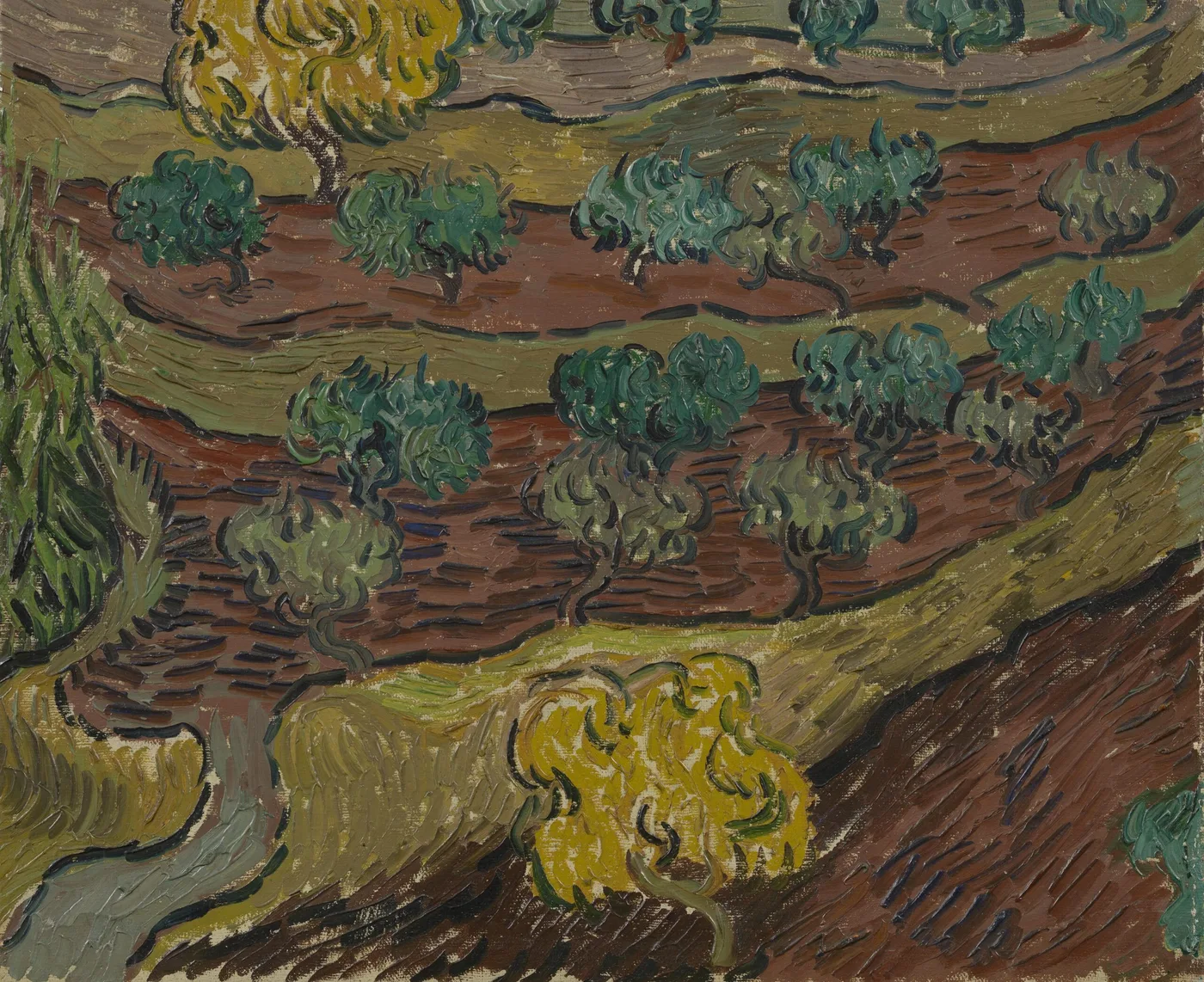
Olive trees were everywhere in that landscape, and van Gogh returned to them again and again through the summer and autumn of 1889, painting them at different hours and in different weather until the grove became almost a private motif, in the way the cypress had already become one. Olive Trees on a Hillside, painted that year, is one canvas from that sustained effort, a small oil measuring 40 by 33.5 centimetres that concentrates the whole subject into a single steep, close view.
A Hillside With No Sky
There is no horizon in this picture and no sky. Van Gogh has tipped the whole scene up and in, so that the viewer looks down and across a slope of terraces rather than out at a distant landscape. The effect is closer to a wall of striped earth than a conventional view, the terraces stacking in bands of rust red, ochre and green from the bottom edge to the top.
A track in pale green and ochre cuts diagonally across the lower half of the canvas, curving away toward the right as though the ground itself were folding. In the bottom right corner, a stand of tall, spiky green foliage anchors the composition and gives a sense of scale against the smaller olive trees scattered across the slope above.
Two shrubs break from the pattern entirely, their foliage rendered in bright yellow rather than the blue-greens of the olives around them, one near the top left corner and one low in the centre foreground. Whether gorse, broom or another flowering plant, they read as deliberate points of warmth set against a hillside otherwise built from cooler greens and reds.
Where the Eye Lands First
Because nearly everything else in the picture sits in a narrow range of green, blue-green and brick red, those two yellow shrubs are what the eye meets first. They pull attention down through the composition, from the corner at top left to the lower foreground, before the rest of the grove asserts itself.
Once past the yellow, the eye settles on the olive trees themselves, painted not as individual specimens with trunks and branches spelled out but as compact clusters of curling brushwork, dark green and grey-blue commas of paint gathered into rounded canopies. They are set loosely along each terrace, more rhythm than record, repeating at slightly different sizes as the slope recedes.
The earth between the trees carries as much incident as the foliage. Van Gogh worked it in short, directional strokes of maroon, rust and ochre that follow the tilt of each terrace, so that the ground itself seems ploughed by the brush rather than merely coloured in.
Paint Laid Like Weather
The handling throughout is fast and physical. Strokes of pigment sit close together, sometimes overlapping wet into wet, and dark contour lines in blue-black pick out the edge of a canopy or the turn of a path without ever settling into outline for its own sake.
Colour does the work that modelling might otherwise do. The rust reds of the exposed earth push forward, the blue-greens of the foliage sit back, and the ochre paths thread a lighter note between the two, giving the hillside a sense of depth even without a horizon to measure it against.
Nothing in the paint surface is smooth. Ridges of thick oil catch the light differently depending on where the viewer stands, so the same passage of ground can look dry and cracked from one angle and almost molten from another.
A Subject He Kept Returning To
Van Gogh thought of the olive groves as a counterpart to the cypresses he had been painting since arriving in Provence, another form standing in for feeling rather than simply describing a place. In a letter written that year he described the sound of the trees as something that stayed with him: ‘the rustle of an olive grove,’ he wrote, ‘has something very secret in it, and immensely old.’
He was drawn to the olive as a subject partly because of its long association with the region’s history and with scripture, without ever painting it as illustration. The gnarled, ancient character of the trees, and the way whole groves of them had stood on these slopes for generations, gave the subject a weight that a single tree could not carry alone.
Olive Trees on a Hillside is now held by the Van Gogh Museum, alongside other paintings from this same sustained campaign of work at Saint-Rémy, a body of pictures that together trace how differently he could paint the same slopes depending on the light and his own state of mind that day.
On a Wall, Through the Day
Reproduced at scale and hung in a room, the painting behaves differently depending on the light that falls across it. Morning light draws out the rust reds of the terraces, making the earth read almost hot against the cooler foliage. Later in the day, as the light flattens, the blue-greens of the olive canopies come forward instead and the picture settles into something quieter.
It rewards being looked at from a short distance as much as across a room. Close up, the surface breaks into the individual strokes that built the trees and the ground; stepped back, those same strokes resolve into a hillside that seems, as van Gogh intended, to be still moving.
Sizes and materials for Olive Trees on a Hillside are listed on its product page.
More from this collection
Bring this painting home
Choose a hand-painted oil reproduction for real brushwork, or an archival canvas print for a crisp museum-image edition. Every size preserves the original proportions.
View this work & options
Further reading
Verify the original in the Van Gogh Museum collection record and continue through related works in the catalogue.