
Madame Augustine Roulin with Baby: Story
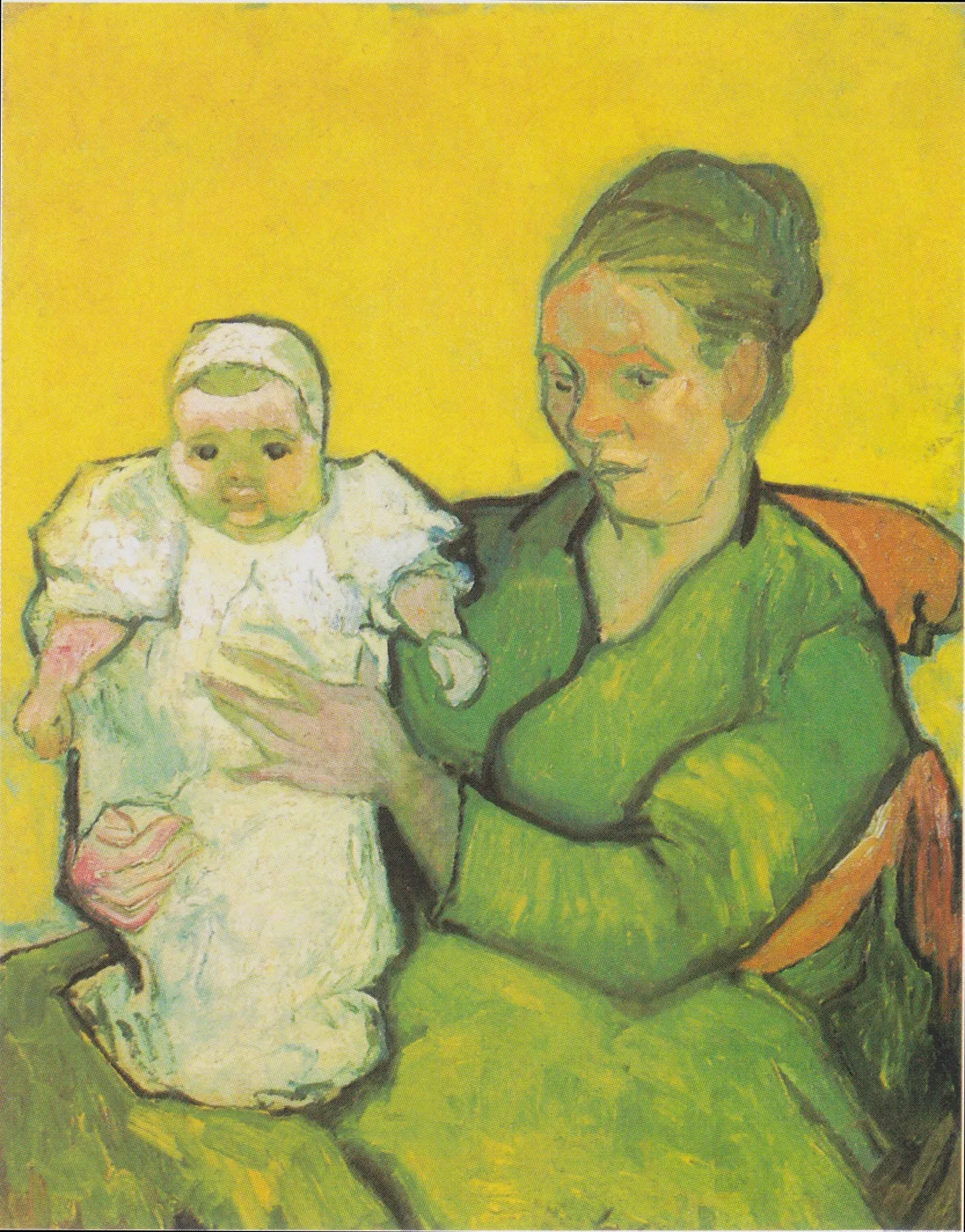
In the autumn of 1888, Vincent van Gogh was living in Arles on borrowed nerve, waiting for Paul Gauguin to arrive and trying, in the meantime, to paint his way into some kind of steadiness. The people who kept him company that year were not fellow painters or dealers but a postal worker’s household: Joseph Roulin, his wife Augustine, and their three children. Van Gogh painted all of them, more than once each, and this canvas is one result: Madame Augustine Roulin with Baby, made in 1888 and measuring 73.5 by 92.4 centimetres.
A postman’s household becomes a subject
Joseph Roulin had modelled for Van Gogh first, his blue uniform and full beard giving the painter something solid to work from. Through Joseph, Van Gogh met the rest of the family, and Augustine sat for him with the youngest child, a baby daughter born that same year.
He was short of models he trusted and short of company he could rely on. The Roulins gave him both, and the sequence of portraits he made of them, individually and in this pairing of mother and infant, reads less like a commission and more like a record of the one household in Arles that let him in.
There is no pretence of a studio setting here. The baby is held up rather than posed, arms slightly raised, the way an infant is lifted to be shown off or settled, and that unrehearsed gesture is part of what makes the picture feel observed rather than arranged.
A field of yellow with two figures in it
The background is a single expanse of yellow, laid on flat with almost no incident in it beyond the movement of the brush. It gives the whole canvas its temperature before the eye has settled on anything else, and it pushes both figures forward as if there is nowhere else in the room for the light to go.
Against that yellow, Augustine’s dark green bodice and the baby’s white gown read as the two poles of the picture. A wedge of orange, the back of her chair, shows through at her shoulder, and that touch of orange against the surrounding green and yellow is doing real work: it is the kind of complementary pairing Van Gogh had been chasing since he arrived in the south, colour used to generate heat rather than describe fabric.
Thick black contour lines hold every shape in place, the woman’s collar, the sleeve of her jacket, the outline of the baby’s bonnet. It is a graphic, almost stained-glass way of building a figure, and it lets the colour inside each shape stay simple and undiluted.
Mother and child, seen from the side
Augustine is turned three-quarters toward the baby, her eyes lowered, her attention entirely on the small figure she is holding upright in front of her. She is not looking at whoever is painting her, which keeps the picture from feeling like a sitting and closer to a moment caught mid-gesture.
The baby’s face is where the eye lands first: round, pale, faintly greenish in the shadows the same way the mother’s skin carries green undertones, with dark eyes set wide and a mouth held in the neutral, slightly startled expression infants have when they are being lifted. The bonnet and gown are painted in loose strokes of white, cream and a little pink, with none of the fine detail a more academic portraitist would have insisted on.
Augustine’s hand, large and pink against the white gown, does the work of showing how she is holding the child steady. It is not a delicate hand in the picture; it is a working hand, and Van Gogh does not soften that.
Paint laid on fast and left alone
Nothing here has been reworked into smoothness. The strokes in the yellow ground run in one direction, short and even, and the green of the dress is built from visible passes of the brush rather than blended shading.
This is the manner Van Gogh had settled into by his second year in the south: strong outline, flat colour, brushwork left legible on the surface instead of disguised. It suited a sitter he did not need to flatter and a household he had come to know well enough to paint quickly.
The result carries none of the formality of a commissioned portrait. It has the pace of something painted in an afternoon, by someone who knew exactly what he wanted from the yellow, the green and the orange before he began.
What the picture asks of a wall
Hung where daylight reaches it, the yellow ground does not sit still. It shifts from warm gold in full sun to something closer to ochre as the light drops, and the green of Augustine’s dress moves with it, cooler in the morning, deeper by evening.
That is the effect Van Gogh was building toward with this kind of flat, saturated colour: a picture that keeps changing character depending on what light falls across it, rather than one that reads the same way at every hour.
The original is held by NEPIP, catalogued at the collection record for Q11771568. What stays with a viewer afterward is not the setting but the gesture, a mother holding her child up to be seen, painted by a man who had few enough people left in Arles willing to sit for him.
Sizes and materials for Madame Augustine Roulin with Baby are listed on its product page.
More from this collection
Bring this painting home
Choose a hand-painted oil reproduction for real brushwork, or an archival canvas print for a crisp museum-image edition. Every size preserves the original proportions.
View this work & options
Further reading
Verify the original in the collection record and continue through related works in the catalogue.