
Seascape at Saintes-Maries: Story, Meaning & Brushwork
In the first days of June 1888, Vincent van Gogh left Arles for a village he had never seen: Saintes-Maries-de-la-Mer, a scatter of white houses on the edge of the Camargue, reachable only by a long jolting ride across flat marshland. He was there to look at something he had never looked at before. The Mediterranean.
He had been in the south for barely four months, chasing the clear light he believed would sharpen his colour the way it had sharpened Japanese prints. Arles had given him orchards and wheat fields. The sea gave him something that would not hold still, and he set about painting it before the feeling wore off.
A Hired Cart Across the Camargue
Van Gogh spent roughly a week at Saintes-Maries, working fast because he knew the visit was short. He drew on the spot in reed pen and ink, then carried the sketches back to canvas, keeping the speed of the drawing in the speed of the paint.
He wrote to his brother Theo about the trip, describing a coastline unlike anything in the north: flat, bright, and edged by a sea that changed colour by the minute. That restlessness in the water became the subject of more than one canvas from those few days.
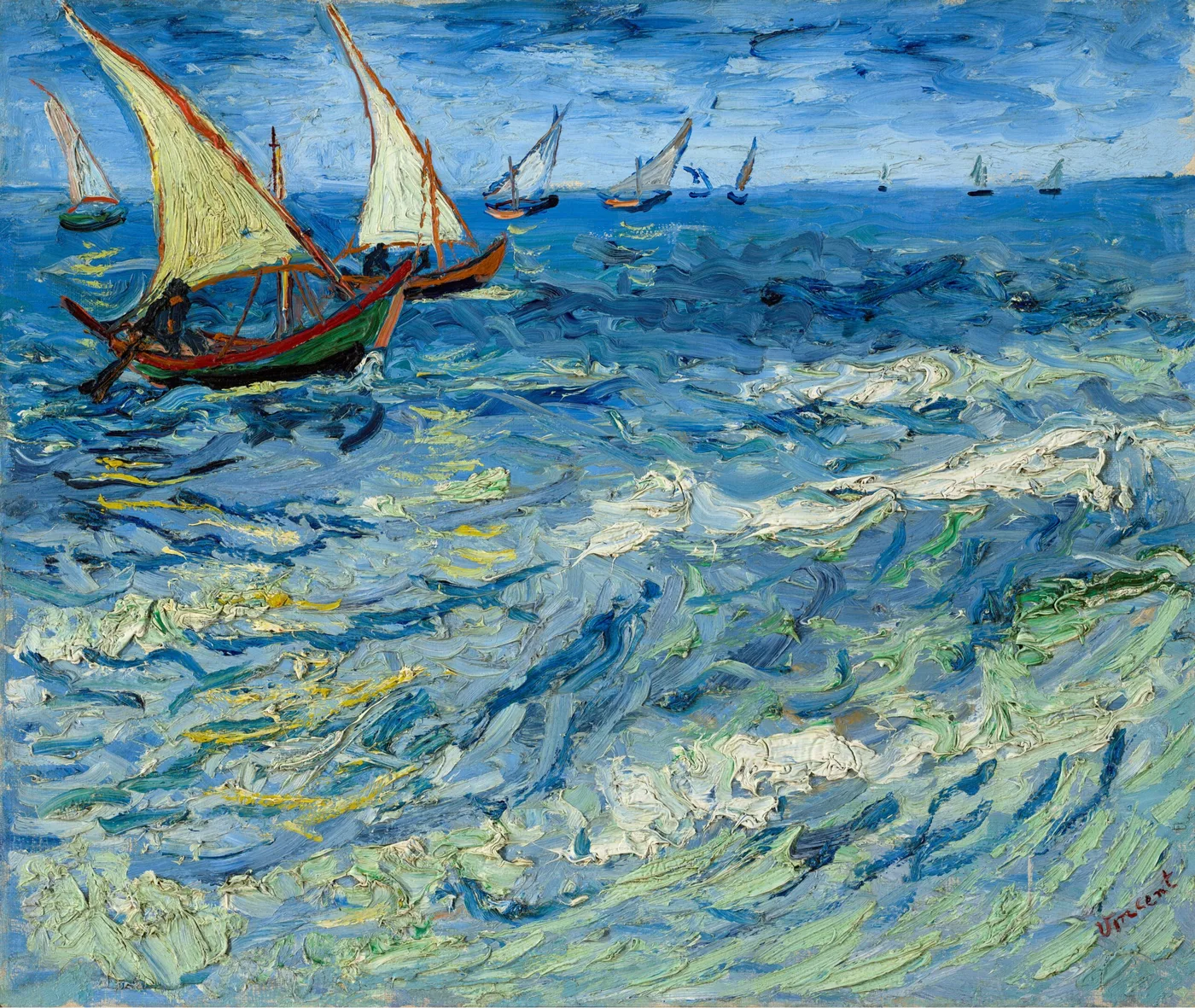
Seascape at Saintes-Maries, painted in 1888, is one of them. It is a small picture, only 53 by 44 centimetres, but it carries more incident than its size suggests.
Water That Would Not Sit Still
The canvas is almost entirely sea. A narrow strip of pale sky sits along the top edge, streaked with cloud, and everything below it is heaving water rendered in blue, green, violet and white.
At upper left, a fishing boat cuts across the waves under two raked sails, its hull painted in red and dark green, a figure just visible at the stern. Behind it, smaller craft scatter toward the horizon, their sails no more than a few flicks of white paint.
Van Gogh had noticed how quickly the sea’s colour shifted, and in his letters he compared it to the shot, shifting colour of a fish’s scales. That description matches what is on the canvas: no single blue, but dozens, laid one against another so the water seems to move as the eye crosses it.
The foreground waves rise closest to the viewer, their crests broken into ropes of white and pale green. There is no beach, no shoreline to rest on. The water simply fills the frame and pushes the boats toward its edge.
Paint Laid on Like Rope
The brushwork is thick and directional, following the line of each wave rather than blending across it. Van Gogh built the swell in short, loaded strokes, letting ridges of paint stand up from the surface where the crest catches light.
Yellow appears in narrow threads through the blue and green, a note of sun on moving water rather than a colour borrowed from the sky. It is a small addition, but it keeps the sea from settling into a single cool tone.
He signed the canvas simply “Vincent” in red at the lower right, the way he signed most of his mature work, choosing a single given name over the full weight of a surname.
A Small Canvas With a Big Horizon
There is very little sky in this composition and almost no land, which puts the weight of the picture entirely on the sea’s surface. That choice makes the water read as a subject in its own right, not a backdrop to the boats.
The painting has stayed in Russia for most of its later history and is now held by the Pushkin Museum of Fine Arts in Moscow, part of a collection that includes several other major Van Gogh canvases from his final years.
On a wall, its effect depends on where the light comes from. Under a low afternoon sun the greens and violets in the shadowed troughs deepen, while by a window with cooler, flatter daylight the white crests and the streaks of yellow pull forward and the whole surface reads brighter and more agitated.
Hung at eye level in a hallway or a study, it rewards a second look more than a first: the boats catch the eye immediately, but it is the water around them, built stroke by stroke, that holds it.
Sizes and materials for Seascape at Saintes-Maries are listed on its product page.
More from this collection
Bring this painting home
Choose a hand-painted oil reproduction for real brushwork, or an archival canvas print for a crisp museum-image edition. Every size preserves the original proportions.
View this work & options
Further reading
Verify the original in the Pushkin Museum of Fine Arts collection record and continue through related works in the catalogue.