
Harvest at La Crau (Blue Cart): Story & Meaning
A Plain Van Gogh Wanted to Paint Whole
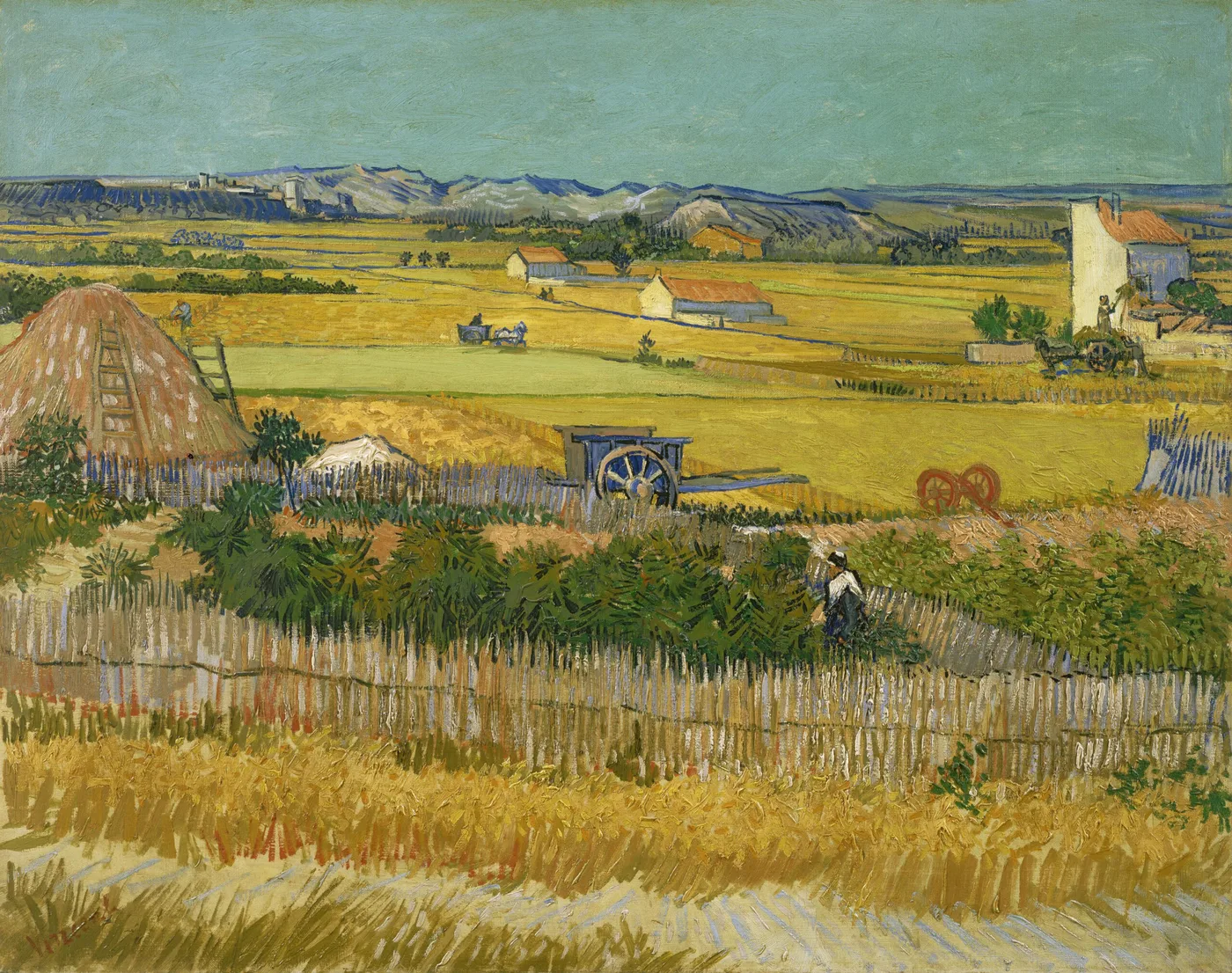
In June 1888, Vincent van Gogh climbed the high ground near the ruined abbey of Montmajour, a short walk from Arles, to look out over the plain of the Crau spread below. From that rise he could take in the whole harvest at once, from the nearest furrows to the hills on the horizon, a view that flatter ground nearby could not have given him.
Arles had given him what Paris had not: strong, steady light, a horizon that did not close in, and subjects that stayed still long enough to study closely. That June the Crau, a stony plain to the south and east of the town, stood under ripening and newly cut wheat. Van Gogh made more than one picture from this same high ground that summer, but this canvas, its full original title Harvest at La Crau, with Montmajour in the Background, is the most complete view he took from it.
He rated it among the strongest paintings he had made so far. That is worth noting on its own terms, since he was rarely satisfied with his own work, and this one held up against his own scrutiny at a point when he was working at real speed and producing canvases faster than he could always send them on to Paris.
Fields, Carts and a Ruin on the Horizon
The canvas moves in bands, from a foreground of vegetable plots and picket fencing, up through the cut wheat, to a line of farm buildings, and finally to pale hills under a high, thin sky. A haystack with a ladder propped against it anchors the left side, its thatch built up in short diagonal strokes. Beyond it, harvested fields lie in yellow and pale green, worked in patches that read as separate plots rather than one continuous field.
A two wheeled cart with a blue frame and red wheels stands empty in the middle distance, left where the last load was taken from it. Further back, a second cart drawn by a horse moves along a farm track between low buildings with orange tiled roofs. On the right a taller white house catches the sun directly, its wall the brightest passage in the whole picture.
Toward the horizon, low hills rise blue grey against the sky, and the ruins of Montmajour sit among them, easy to miss unless you already know where to look. A single figure in dark clothing walks a path through the foreground plots, small against the scale of the plain. The sky above is pale, closer to green than blue, and takes up nearly a third of the canvas.
How the Paint Sits on the Canvas
Van Gogh built this picture from short, directional strokes rather than blended colour. In the wheat they run diagonally, following the lie of the cut stalks; in the sky they lie flatter and thinner, letting the pale ground show through in places. The picket fences in the foreground are drawn almost like handwriting, quick vertical marks that give the fencing its rhythm without describing every post.
He worked with yellow and blue set against each other through the whole composition: gold wheat against a blue grey horizon, a blue cart against yellow stubble. Orange roof tiles sit against green shutters and grey walls further back. The effect is a picture that reads as bright and orderly from a distance, and as a dense record of individual decisions up close.
There is very little black or grey mixed into the palette. Shadows are built from cooler versions of the surrounding colour rather than from added dark pigment, which keeps the whole surface high in key even in the parts furthest from the sun.
What Holds the Eye First
Most eyes land on the blue cart before anything else, partly because it sits at the point where the foreground plots give way to open field, and partly because its blue is the coolest note in an otherwise warm canvas. From there the eye tends to follow the fence line back into the picture, past the walking figure, toward the white house on the right.
The haystack does the opposite work on the left, pulling attention down and close rather than out toward the horizon. Between these two anchors the middle distance is busy with incident, a second cart, a horse, low farm buildings, without ever feeling crowded, because Van Gogh kept the brushwork consistent across the whole surface rather than sharpening detail in any one area.
In a Room
Hung where daylight reaches it, this painting changes through the day in a way flat reproductions of open landscape rarely manage, because so much of the surface is built from directional strokes that catch raking light differently depending on where the light comes from. Morning light picks out the ridges in the wheat; evening light flattens them and lets the colour carry more of the weight.
It is a picture that rewards standing close as much as standing back. From across a room it reads as a wide, calm view of open country under a pale sky. Close up, it resolves into hundreds of individual marks, the record of a single sustained stretch of looking.
The original, painted in Arles in June 1888 and measuring 92 by 73 centimetres, is held by the Van Gogh Museum in Amsterdam.
Sizes and materials for Harvest at La Crau, with Montmajour in the Background are listed on its product page.
More from this collection
Bring this painting home
Choose a hand-painted oil reproduction for real brushwork, or an archival canvas print for a crisp museum-image edition. Every size preserves the original proportions.
View this work & options
Further reading
Verify the original in the Van Gogh Museum collection record and continue through related works in the catalogue.