
Pink Roses: Story, Meaning & Brushwork
A last week before leaving Provence
In May 1890 Vincent van Gogh was preparing to leave the asylum at Saint-Paul-de-Mausole, near Saint-Rémy-de-Provence, after a year that had brought both his finest paintings and his worst attacks of illness. He was waiting for his brother Theo to arrange the next move, north to Auvers-sur-Oise, where he hoped to work under the watch of Dr Paul Gachet.
In that final week he set aside the swirling skies and cypress trees that had absorbed him for months and turned instead to what was close at hand: cut flowers, arranged in a bowl and painted before they wilted. He worked on two bunches of roses and two of irises, calmer subjects for an unsettled stretch of time.
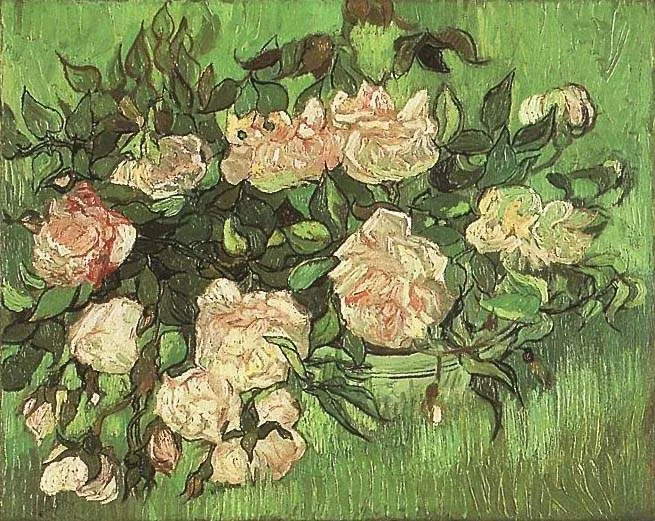
Pink Roses, painted in 1890 and now in the collection of the Ny Carlsberg Glyptotek, belongs to that short run of canvases. It carries none of the agitation that marks his skies from the same year; instead it is deliberately, almost stubbornly, quiet.
A bowl of roses spilling into green
The canvas, at 40.5 by 32 centimetres, holds a single subject close: a full, loose bunch of roses set low in a shallow vase, its rim barely visible beneath the foliage. The flowers spread wide rather than standing upright, some blooms leaning almost horizontal, as though the bunch had slipped rather than been arranged.
The roses themselves run from near-white through pale pink to a warmer rose at the centre of a few open blooms, the colours worked wet into wet so they bleed softly into one another. Several buds stay tight and green-tinged at the edges, holding the pink back until they open.
Behind and around the flowers, the whole field is green: a bright, slightly acid green that fills the background and the ground beneath the vase alike, broken only by darker strokes marking stems and leaf shadow. There is no table, no wall, no window in view; the roses simply sit in colour.
Light in the painting comes from everywhere and nowhere in particular. Van Gogh gives no single source, no cast shadow to fix a time of day; the pale blooms hold the brightest passages of paint, and the eye goes to them first before following the dark stem lines out toward the leaves.
Quick strokes, drawn edges
Van Gogh worked the petals in short, loaded strokes of white, pink and cream, set side by side rather than blended, so the paint keeps its own texture even where colours sit close together. Up close the roses read as separate touches of the brush; at a normal viewing distance they close into full, soft blooms.
The leaves and stems are built differently again, drawn as much as painted. Dark green and near-black lines trace the outline of each leaf and the wandering path of every stem, a habit that owes something to the Japanese prints Van Gogh had studied since his Paris years and kept returning to.
That contrast, thick colour held inside a drawn contour, gives the whole canvas its structure. Without the dark outlines the roses would dissolve into the green ground; with them, a loose and slightly chaotic bunch of flowers reads clearly as a bunch of flowers, held together by line as much as by paint.
Flowers as a way of steadying himself
Van Gogh had painted flowers to concentrate his mind before, most famously the sunflowers in Arles, but the roses of this last Saint-Rémy week feel different in temper. There is less bravado in the colour and more attention paid to simply looking, to getting a bunch of cut flowers down on canvas before they faded.
He was, by his own account in letters from this period, trying to work steadily and calmly ahead of a difficult journey. A bowl of roses asks little of a painter beyond close observation, and that may have been exactly what he needed after a year of harder subjects.
The result is a painting with very little incident and a great deal of care. Nothing in Pink Roses argues for attention the way his stormier landscapes do; it simply holds still and asks to be looked at closely, bloom by bloom.
On a wall, through the day
Hung where daylight reaches it, Pink Roses changes more than its small scale suggests. Morning light picks out the near-white highlights on the open blooms; by evening, under lamplight, the green ground deepens and the pinks warm, so the painting reads less as a bunch of flowers and more as a field of colour with roses caught inside it.
It is a close, quiet painting, and it rewards the kind of room where someone actually stops in front of it often: a bedroom, a landing, a reading corner, somewhere the eye returns to enough times to keep finding new strokes in the green.
Sizes and materials for Pink Roses are listed on its product page.
More from this collection
Bring this painting home
Choose a hand-painted oil reproduction for real brushwork, or an archival canvas print for a crisp museum-image edition. Every size preserves the original proportions.
View this work & options
Further reading
Verify the original in the Ny Carlsberg Glyptotek collection record and continue through related works in the catalogue.