
Les Peiroulets Ravine: Story, Meaning & Brushwork
A Confined Life, An Open Landscape
By the spring of 1889 Vincent van Gogh had admitted himself to the asylum of Saint-Paul-de-Mausole, just outside Saint-Rémy-de-Provence. He had asked to go there himself, after the crisis in Arles, and the decision gave him a strange kind of stability: a locked door at night, and by day, when his condition allowed it, permission to walk and paint in the countryside beyond the walls.
The hills around Saint-Rémy are the Alpilles, a small limestone range cut through by dry gorges and sudden ravines. An orderly from the asylum sometimes went with him on these excursions, since he was not trusted to wander alone, and it was on one of these accompanied walks that he found the gorge he called Les Peiroulets.
He painted it in 1889, in the same burst of activity that produced his cypresses, his wheatfields and his olive groves that year. Working outdoors, close to the motif, seems to have steadied him in a way that little else did during this period, and the ravine paintings carry none of the caution of a convalescent. They are among his most physically ambitious landscapes.
Into the Ravine
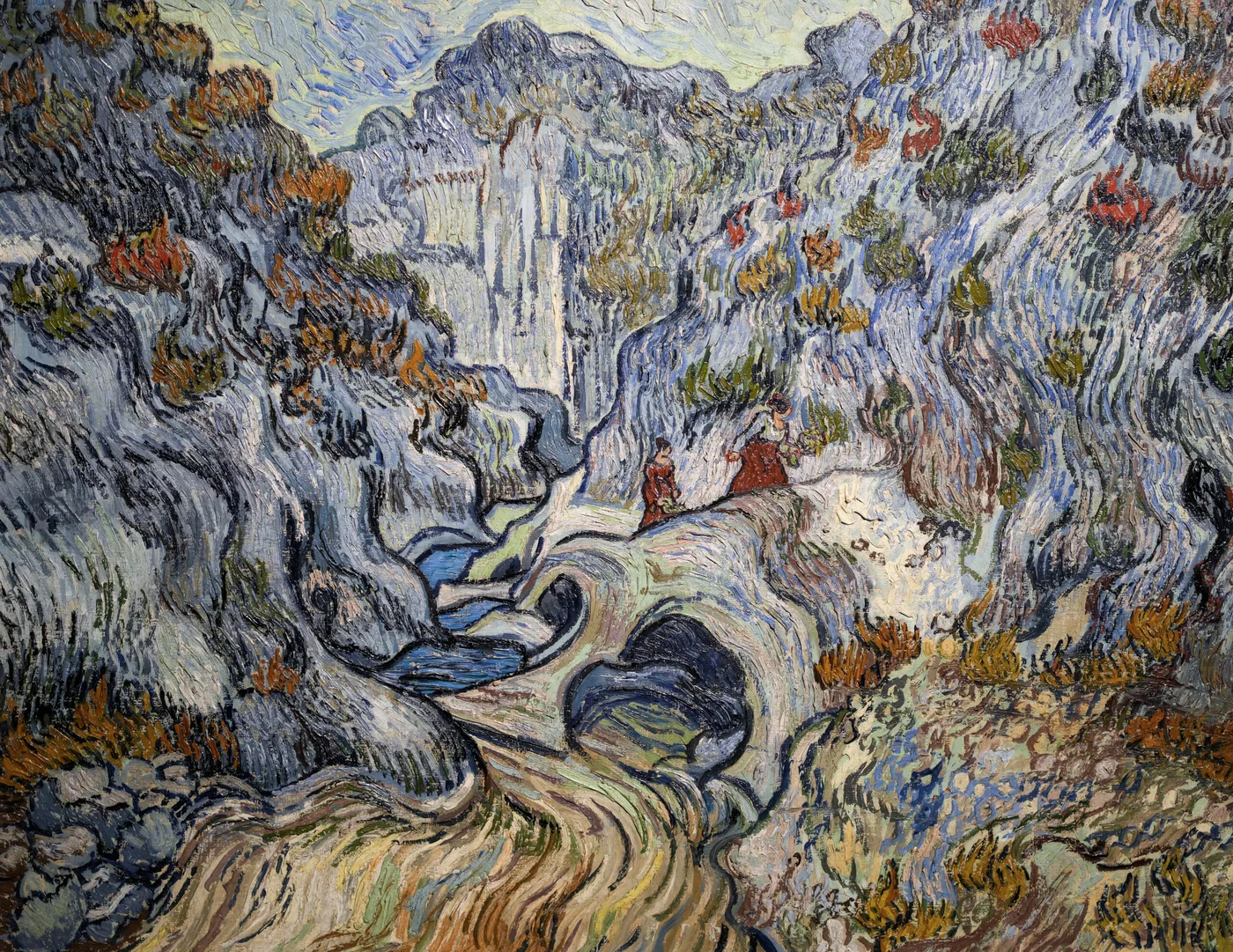
The canvas, at 92 by 72 centimetres, is built almost entirely around a single plunging view. Two rock walls close in from left and right, rising in tall, broken masses of blue, grey and violet, and between them the eye is pulled down and back into the gorge until it meets a pale limestone outcrop lit up in the distance.
A stream and a worn footpath twist along the ravine floor in loose, pale curves of cream, ochre and soft green, doubling back on themselves the way water does when it has cut its own channel over a long time. Van Gogh gives that floor almost the same energy as the cliffs above it, so the whole gorge feels like it is still moving.
The sky survives only as a narrow strip along the top edge, pale yellow-green shading into blue, hemmed in by rock on both sides. Against the cool blues and violets of the stone, patches of rust orange and ochre break out along the ledges, scrubby growth clinging to the rock in short diagonal touches of colour.
Rock Made of Paint
Van Gogh does not paint the ravine walls as smooth surfaces. He builds them from long, directional strokes that follow the tilt and fracture of the rock, so the paint itself seems to register the geology, tipping one way on one ledge and another way a few feet along.
Where the rock catches light, near the pale tower-like formation at the centre of the gorge, the strokes thin and lighten, almost scraped rather than laid down. Where it falls into shadow, the paint thickens into dense ridges of blue and violet, laid on with enough pressure that the brush marks stand proud of the canvas.
The streambed is handled differently again, in looser, rounder strokes that curl and eddy rather than march in one direction. That change in handling, from the raking diagonals of the cliffs to the swirl of the valley floor, does most of the work of telling a viewer which parts of the scene are hard and which are fluid.
Two Figures, One Immense Wall
Near the centre of the composition, on a pale outcrop above the stream, Van Gogh places two small figures, painted in quick strokes of red and dark blue. They stand close together on what reads as a natural rock bridge or ledge, dwarfed by the walls rising around them.
They are barely more than a few marks of the brush, yet they anchor the whole scene. Without them the ravine could be read as pure pattern, an abstraction of colour and stroke; with them, the scale of the place becomes physical, and the viewer understands just how far down, and how enclosed, this gorge really is.
It is a device Van Gogh used elsewhere in his Saint-Rémy landscapes, setting a human figure or two against a landscape too large and too old to notice them. Here the effect is sharper than usual, because the rock presses in from both sides at once.
On a Wall, In Shifting Light
The original hangs today at the Kröller-Müller Museum, its violets and blues calibrated for gallery light. In a home the same painting behaves differently through the course of a day, the cool stone colours pulling back in dim conditions and the rust and ochre accents warming up as lamplight or late sun catches them.
Hung where morning light reaches it, the ravine can look almost cold, all blue-grey rock and shadow. By evening, under warmer artificial light, the orange lichen and the pale gold of the streambed come forward, and the same canvas reads as a much warmer, more intimate space.
That range is part of what makes the painting worth living with rather than glancing at once. It rewards a second and third look, at different hours, in a way a flatter, more evenly lit landscape rarely does.
Sizes and materials for Les Peiroulets Ravine are listed on its product page.
More from this collection
Bring this painting home
Choose a hand-painted oil reproduction for real brushwork, or an archival canvas print for a crisp museum-image edition. Every size preserves the original proportions.
View this work & options
Further reading
Verify the original in the Kröller-Müller Museum collection record and continue through related works in the catalogue.