
Poppy Flowers: Story, Meaning & Brushwork
Paris, Not Arles
Vincent van Gogh reached Paris in the early spring of 1886 and moved in with his brother Theo, an art dealer who kept him fed, housed, and in touch with everything new in the city’s studios. By 1887 he was deep in the company of painters working through Impressionist colour and the stricter, dot-built method of Georges Seurat and Paul Signac. His own palette, dull and earthbound in the Dutch years, was changing fast.
He did not wait for a landscape or a willing model to test what he was learning. He bought or picked flowers, set them in whatever vase was on hand, and painted them in a single sitting, over and over, through that year in Paris.
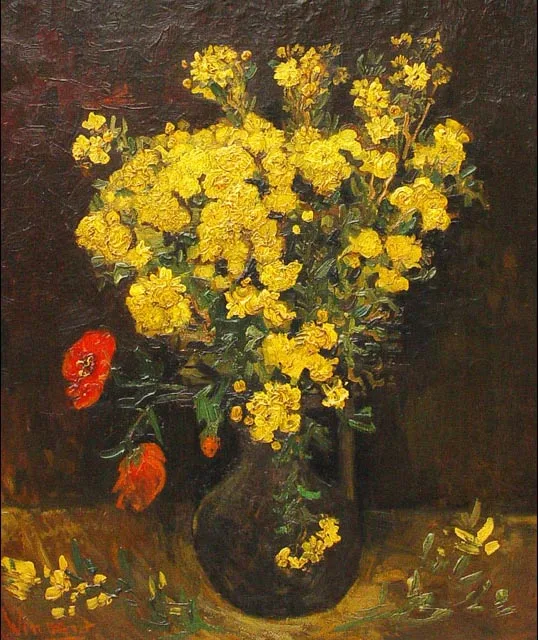
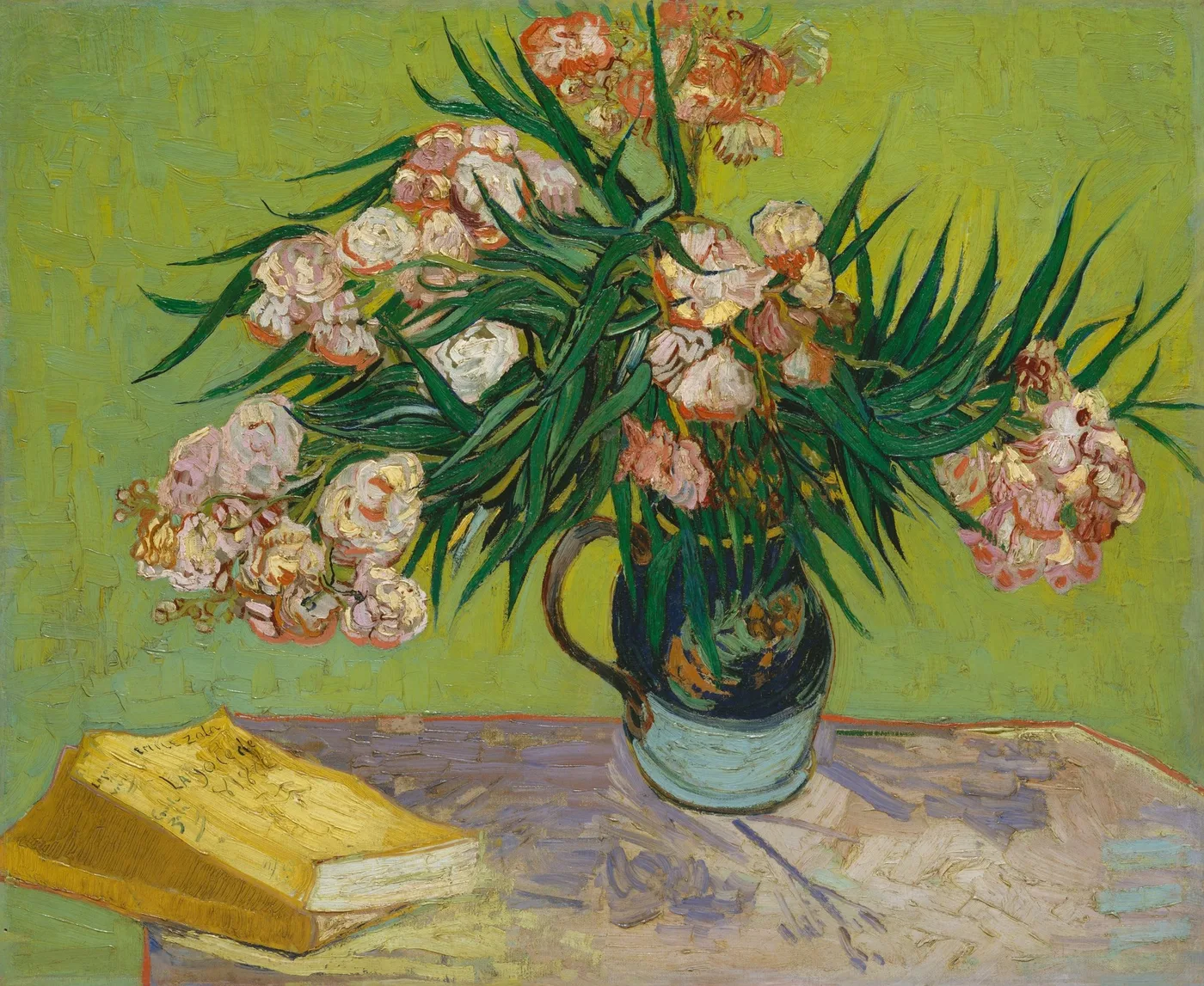
Poppy Flowers, its original and correct title, is one result of that habit. Painted in 1887 and measuring 54 by 65 centimetres, it is a small, quick, concentrated piece of work rather than a finished set piece, the kind of canvas an artist makes to find out what a colour does before he trusts it in something larger.
What Fills the Vase
A dark earthenware jug, squat and round-bellied, stands just off centre on a bare tabletop. Out of it rises a dense, almost overgrown mass of small yellow flowers, packed so tightly that the individual blooms blur into a single glowing cluster against the surrounding dark.
Two red poppies break that yellow field. They hang low on the left side of the bouquet, one nearly upright, one bent so far its head droops below the rim of the vase, and their flat, saturated red is the only warm note that is not yellow anywhere in the painting.
The background gives the flowers nothing to compete with. It is painted in near-black browns and deep maroons, flat and undetailed, so that all the incident in the picture, every fleck of colour and every ridge of paint, has to happen inside the bouquet itself.
The tabletop below is a warm, dry ochre, scattered with a few loose yellow petals that have fallen away from the arrangement. It is a small, plain detail, but it grounds the vase and gives the eye somewhere to rest before it climbs back up into the flowers.
Where Van Gogh Left the Brush Visible
Look closely at the yellow heads and the paint stands proud of the canvas. Van Gogh built each cluster of petals from short, loaded strokes, laid one against another without much blending, so that the surface itself has a texture close to the texture of the flowers it shows.
The stems and leaves are done more quickly, in a darker, thinner green that reads as shorthand rather than description. He was not trying to record every leaf; he was trying to hold the shape of the whole bouquet together while the yellow did the real work.
The two poppies are handled differently again, in looser, more fluid strokes that let the red sit thin and slightly translucent over the ground beneath. That difference in touch, tight and thick for the yellow, loose and thin for the red, is easy to miss in reproduction and is one of the things worth seeing in the original brushwork.
In the lower left corner, half lost against the dark, is his signature, Vincent, the single name he used on his pictures from this period onward.
Yellow Before Arles
By the following year Van Gogh would leave Paris for Arles and paint the sunflowers that made yellow his signature colour in the public mind. Poppy Flowers shows him arriving at that colour a year earlier, in a Paris flower piece rather than a southern field, working out how far yellow could carry a picture on its own.
The drooping poppies keep the painting from being only a study in one colour. Set against so much upright, tightly packed yellow, their bent stems and heavier red read as a small note of weight and decline inside a picture that otherwise pushes upward and outward.
The painting is now in the collection of the Mohamed Mahmoud Khalil Museum, whose holdings bring together French Impressionist and Post-Impressionist works gathered in Cairo. It is one of the relatively few Van Gogh paintings held outside Europe and North America.
On a Wall at Home
The near-black ground around the flowers is what makes this painting work at close range, in a room rather than across a gallery hall. In low or evening light, the dark recedes almost to nothing and the yellow bouquet seems to hold its own light, glowing rather than simply being lit.
Under daylight, the same canvas reads differently: the ochre tabletop and the maroon undertones in the background come forward, and the red poppies stop being a small accent and start pulling the eye first.
At 54 by 65 centimetres, it is a picture built for a room you actually spend time in and look at closely, a bedroom or a quiet corner rather than a hall meant to be seen in passing. It rewards being looked at more than once, in different light, at different hours, the way Van Gogh himself must have looked at it while he was still working out what yellow could do.
Sizes and materials for Poppy Flowers are listed on its product page.
More from this collection
Bring this painting home
Choose a hand-painted oil reproduction for real brushwork, or an archival canvas print for a crisp museum-image edition. Every size preserves the original proportions.
View this work & options
Further reading
Verify the original in the Mohamed Mahmoud Khalil Museum collection record and continue through related works in the catalogue.