
Grass and Butterflies: Story, Meaning & Brushwork
A Painter Confined to a Garden
In May 1889 Van Gogh admitted himself to the asylum of Saint-Paul-de-Mausole near Saint-Rémy-de-Provence, seeking some structure after the breakdown that had ended his time in Arles. The institution gave him a second room to use as a studio and, once the doctors judged it safe, allowed him out to paint under supervision within the walled grounds and the fields nearby.
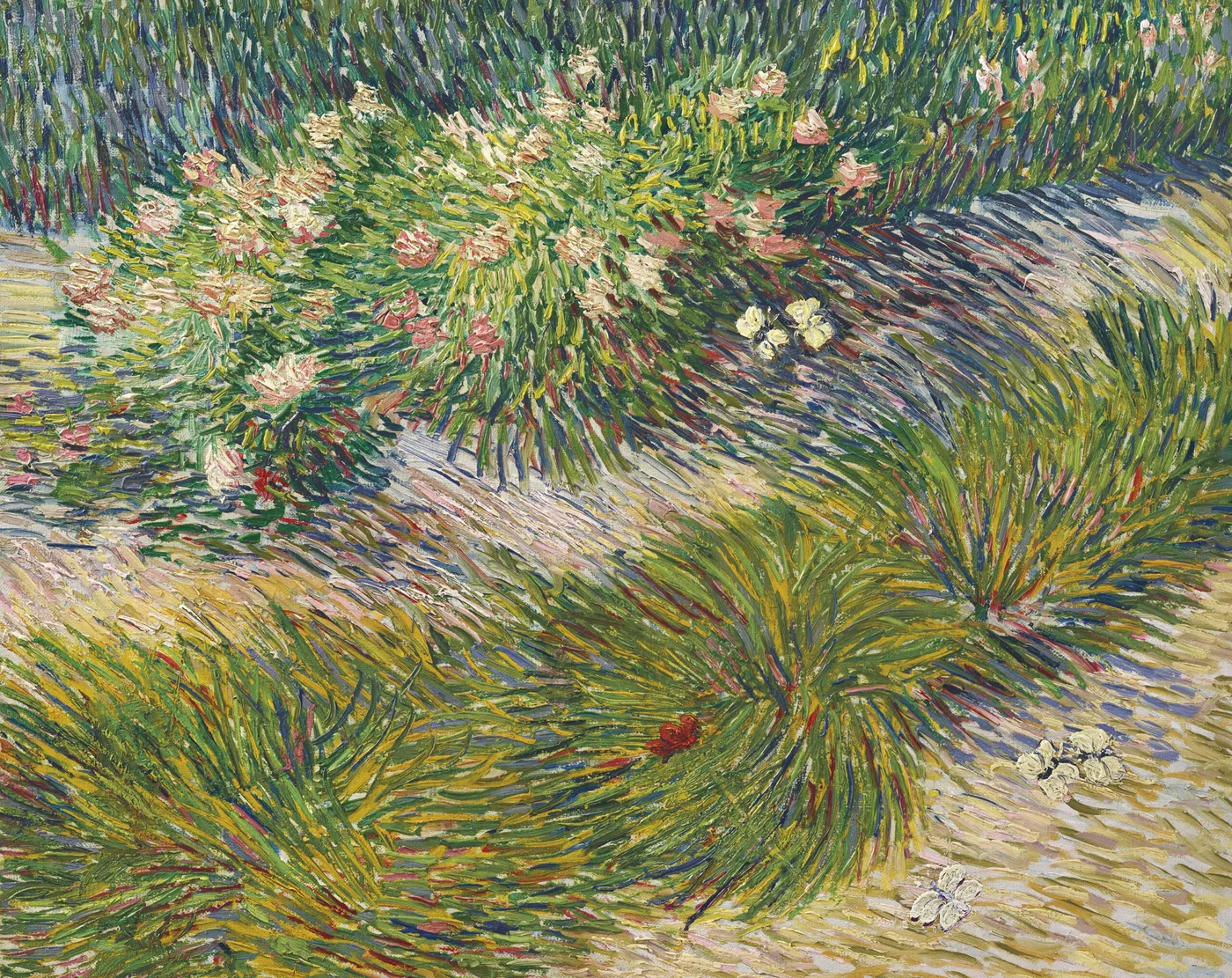
For much of that first summer his subjects were whatever lay close at hand: irises and lilac by the clinic wall, cypresses seen over the fence, and the ordinary, untended grass at his feet. Grass and Butterflies, painted in 1889, belongs to this narrower way of looking that the enclosure had more or less forced on him.
Rather than the open wheat fields he had painted further north, he began setting his easel low, close to the ground, and staying with a single patch of meadow until he had said everything he could about it. This canvas, at 61 by 51 cm, is built entirely from that kind of sustained, close attention.
A Meadow Seen from the Ground
There is no horizon here and no sky. The picture is cropped so tightly that grass and low blossom fill the entire surface, as though the viewer were kneeling in the meadow rather than standing over it.
In the upper left a loose spray of pale pink and cream blossom rises out of the grass, the flowers of a low shrub caught mid-bloom among the green blades. Its petals are laid in with soft, rounded touches that stand apart from the sharper strokes used for the grass around them.
Small pale butterflies are scattered through the composition rather than gathered in one place, one hovering just right of centre, another folded low near the bottom edge, a third settled among blossoms at the lower right. They are painted with a handful of quick, precise strokes, wings caught mid-flutter rather than posed.
Toward the lower right, patches of bare, sun-warmed soil interrupt the grass in streaks of ochre and lilac-grey. These gaps let the eye rest before returning to the denser tangle above, and they show that this is worn ground, walked or grazed, not an idealised lawn.
Colour Built in Small Decisions
The palette stays close to what the subject offered: greens that shift from cool blue-green in shadow to a hot yellow-green where sunlight strikes the tips of the grass. Against this, the ochre soil and the pink and cream blossom read as warm interruptions rather than a separate colour scheme.
Van Gogh laces the green with threads of violet and slate-blue laid into the shadowed roots of the grass, a device he used often in this period to keep green from turning flat or heavy. A few strokes of red, barely more than flicks, sit low in the composition and pull the eye down into the depth of the meadow.
There is no single light source dramatising the scene, no long shadow falling across the grass. Instead the light seems to come from everywhere at once, the even, slightly bleaching daylight of a Provençal midday, so that colour and texture carry the picture rather than illumination.
The Grass as a Field of Marks
Every blade in this painting is a separate decision. Van Gogh built the grass from short, directional strokes of thick paint, each one following the lean of a real stem, so that the brushwork itself behaves like growth.
In places the strokes gather into small radiating whorls, tufts that spin outward from a low point like eddies in water. It is a pattern he returned to in several of his Saint-Rémy studies of undergrowth and meadow, where the ground itself becomes as much the subject as anything standing on it.
The paint is laid on thickly enough to hold ridges and furrows that catch real light across the canvas surface, so the texture of the brushwork echoes the texture of the grass it depicts. Up close the picture reads as almost abstract, a field of coloured marks; only at a small distance does it resolve into meadow, blossom and butterfly.
Living with the Painting
Hung where daylight reaches it through the day, a reproduction of this kind keeps changing in ways a flatter image would not. Morning light picks out the cooler blues and violets threaded through the shadows; by afternoon the ochre ground and the warmer greens come forward.
Because the composition has no horizon and no fixed vantage point, it does not organise a room the way a landscape with sky and distance tends to. It behaves more like a close, absorbing detail, something to be read slowly rather than taken in at a glance, in keeping with the patient, ground-level attention Van Gogh gave it in 1889.
Sizes and materials for Grass and Butterflies are listed on its product page.
More from this collection
Bring this painting home
Choose a hand-painted oil reproduction for real brushwork, or an archival canvas print for a crisp museum-image edition. Every size preserves the original proportions.
View this work & options
Further reading
Verify the original in the collection record and continue through related works in the catalogue.