
The Plain of Auvers: Story, Meaning & Brushwork
A Final Season at Auvers-sur-Oise
In May 1890, Vincent van Gogh arrived at Auvers-sur-Oise, a village on the Oise river north of Paris, having just discharged himself from the asylum at Saint-Rémy-de-Provence. He took a room at the Auberge Ravoux and placed himself under the loose supervision of Dr Paul Gachet, a physician and amateur painter recommended by his brother Theo.
What followed was one of the most productive stretches of his career. In roughly ten weeks he completed dozens of canvases, working outdoors through the wheat, the orchards, the thatched cottages and the church, chasing the light before it changed.
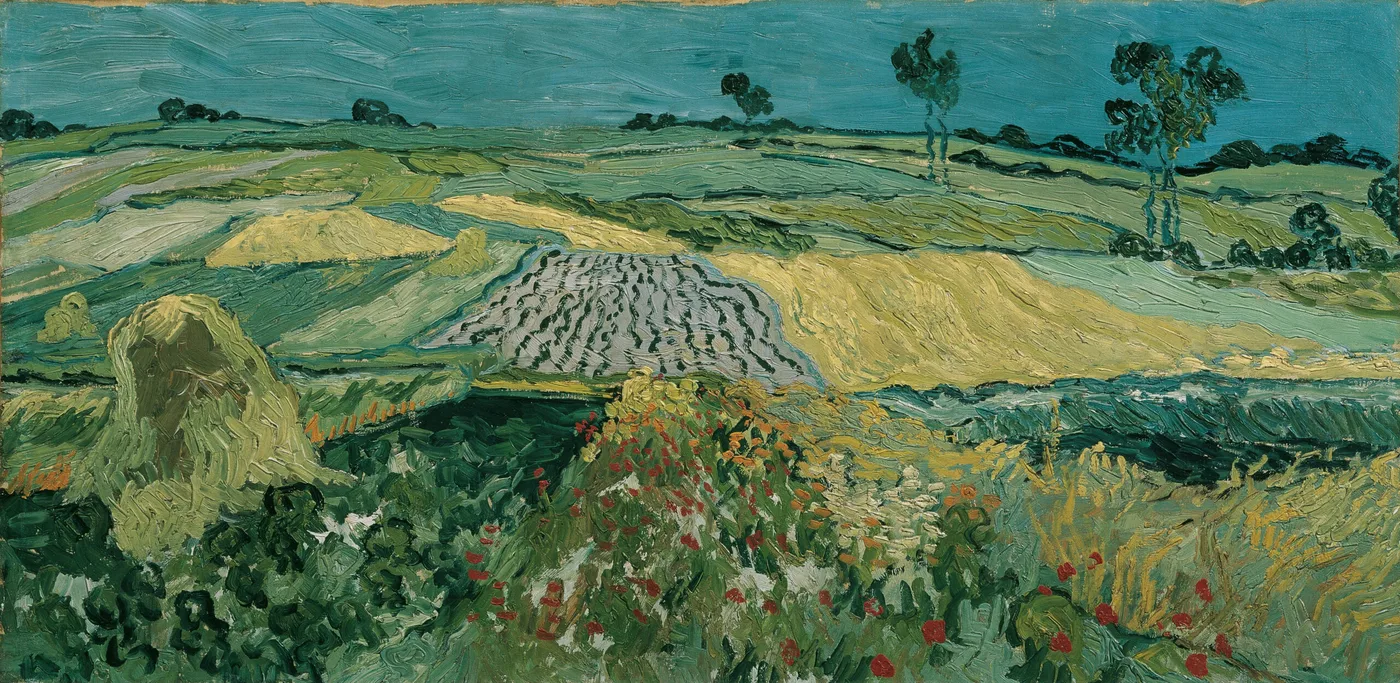
The Plain of Auvers, painted in 1890, belongs to a short group of panoramic views he made of the open farmland surrounding the village. For these he turned to an elongated double-square canvas, roughly twice as wide as it is tall, a format he had only begun using in his last weeks. At 101 by 50 cm, this canvas holds the plain as a continuous sweep rather than cropping it into a conventional rectangle.
Reading the Panorama
The foreground is a dense tangle of wildflowers and grasses, poppies burning red among white blossoms and green stems, occupying the lower third of the canvas. To the left a rounded haystack rises out of the growth, low and solid against the looser brushwork around it.
Beyond the flowers the land opens out. A field of freshly turned earth sits at the centre, its ridges combed into grey furrows that cut a firm horizontal band across the warmer gold and green strips of cultivated ground on either side.
The plain recedes in patches of ochre, olive and pale green, each field a different stroke direction, each a slightly different note of colour. There is no single path or road to lead the eye in; instead the fields themselves, laid side by side like a quilt, carry the view towards the horizon.
On the right, a cluster of trees breaks the flat line of the land, their trunks trailing thin and dark against the sky, foliage clumped in heavy touches of green and near-black. The sky itself fills the upper half of the canvas, a deep teal-blue laid in long, level strokes, without cloud or incident, pressing down on the plain below.
Colour and the Weight of the Brush
The painting works from a small set of contrasts. Cool blue-green in the sky sits against warm gold and green in the fields, and both are pulled taut by the small, sharp reds and whites of the foreground flowers, the only true accents in the whole composition.
Van Gogh handled each part of the canvas differently. The fields are built from short, choppy strokes laid on at speed, describing furrows and field edges almost like a diagram of the land’s structure. The sky, by contrast, is brushed in longer, calmer horizontal sweeps that give it a stillness the ground does not have.
The foreground is the most heavily worked area, thick knots of paint standing up from the surface where he dabbed in each poppy and blossom individually. This is paint applied wet, fast and without correction, the record of a man working directly in front of his subject rather than composing at leisure indoors.
Nowhere in the canvas is there a smooth, blended passage. Every field, every cloud-free stretch of sky, every stem in the foreground keeps the mark of the brush that made it, which is much of why the painting still reads as alive rather than settled.
On a Wall, in Changing Light
The long, low format of The Plain of Auvers suits a horizontal stretch of wall, above a sideboard or a low sofa, where the eye can travel across it the way it travels across an actual horizon. It does not ask to be looked at from a single fixed point the way a portrait does.
Because the surface is built from distinct, textured strokes rather than flat colour, the painting changes through the day. Morning light picks out the ridges of paint in the ploughed field and the raised petals of the poppies; evening light softens the same passages and lets the teal sky dominate the room instead.
Held today by the Belvedere, the painting remains one of the clearest records of how Van Gogh saw the countryside around Auvers-sur-Oise in the final months of his life: worked fast, in full colour, and without a single quiet corner.
Sizes and materials for The Plain of Auvers are listed on its product page.
More from this collection
Bring this painting home
Choose a hand-painted oil reproduction for real brushwork, or an archival canvas print for a crisp museum-image edition. Every size preserves the original proportions.
View this work & options
Further reading
Verify the original in the Belvedere collection record and continue through related works in the catalogue.