
Saint-Paul Asylum, Saint-Remy: Story, Meaning & Brushwork
In May 1889, Vincent van Gogh committed himself to the Saint-Paul-de-Mausole asylum outside Saint-Rémy-de-Provence, a former monastery run as a private clinic by Dr Théophile Peyron. He had asked to go there himself, after the collapse that ended his time in Arles, seeking a controlled routine rather than isolation.
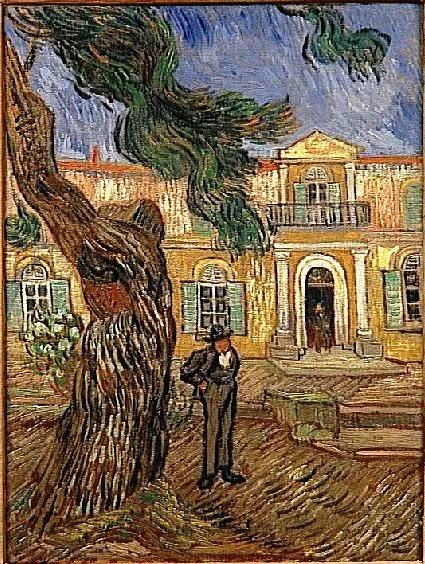
The doctors gave him a second cell to use as a studio and, before long, permission to paint within the walled grounds. Hôpital Saint-Paul à Saint-Rémy-de-Provence, painted in 1889, is one of several views he made of the building from just outside its door, close enough that leaving the grounds was barely necessary.
The year gave him an odd kind of freedom. Cut off from the taverns and arguments of Arles, watched but not pressed, he painted with unusual concentration, and the asylum itself, its trees, its corridors, its walled garden, became the only subject he needed.
A trunk between the eye and the building
The painting is built around an obstruction. A single pine, its bark rendered in tight curling strokes of brown and ochre, rises through the whole left side of the canvas and throws a tangle of green branches across the upper third of the sky.
Nothing about this placement is accidental. Van Gogh set his easel close enough to the trunk that it forces itself between the viewer and the asylum, so the pale building behind has to be read past the tree rather than handed over directly.
Beyond the branches, the facade of Saint-Paul stands in soft ochre and cream, its shuttered windows a pale green-grey, a wrought-iron balcony over the entrance and a low tiled roof catching a warmer orange. It reads as a substantial, almost genteel house, more than an institution.
The man in the forecourt
A single figure stands in the bare earth of the forecourt, dressed in a dark coat and hat, his head bent toward the ground. He is painted small and still, dwarfed by both the trunk beside him and the building behind, with nothing in the scene to explain what he is doing there.
That isolation seems deliberate. Whether the figure is a fellow patient, an attendant, or Van Gogh’s own stand-in on the gravel he crossed each day, the painting gives him no companion and no destination, only the patch of ground between the tree and the door.
Colour and the rhythm of the brush
The palette turns on a contrast between warm and cool. Ochres and terracotta carry the building and the beaten earth, set against a sky of clear cobalt blue and the deep, almost black-green of the pine.
Van Gogh’s brush moves differently across each surface. The trunk is built from short, twisting strokes that follow the grain of the bark.
The branches are laid in long looping sweeps, and the ground is worked in choppy diagonal strokes that catch the light unevenly, leaving the lower half of the canvas restless and uneven. Even the sky is not left calm, worked in short curved strokes that push against the branches.
At 45 by 58 centimetres, the canvas is modest, closer to a study than a set piece, and that scale suits the intimacy of the view. This is not a grand institutional portrait but something closer to what could be seen from a doorway on an ordinary afternoon.
On the wall
Reproduced at scale, the picture holds its own from across a room chiefly through that trunk. Its dense, curling brushwork reads as a dark mass under electric light and only breaks into individual strokes on approach, rewarding a second and third look rather than giving everything up at once.
Morning light draws out the cobalt of the sky and the cooler grey-green of the shutters. By evening, the ochres of the facade and the earth take over, and the picture warms considerably, so a room that shifts with daylight sees two different balances of colour across a single day.
The original hangs in the Musée d’Orsay in Paris, among the works from Van Gogh’s year at Saint-Rémy that the museum holds. Seen at home, this version keeps the thing worth pausing on: a man alone in a garden, held there by a tree that refuses to get out of the way.
Sizes and materials for Hôpital Saint-Paul à Saint-Rémy-de-Provence are listed on its product page.
More from this collection
Bring this painting home
Choose a hand-painted oil reproduction for real brushwork, or an archival canvas print for a crisp museum-image edition. Every size preserves the original proportions.
View this work & options
Further reading
Verify the original in the Musée d'Orsay collection record and continue through related works in the catalogue.