
Apricot Trees in Blossom: Story, Meaning & Brushwork
Arles, and a spring that would not wait
Vincent van Gogh reached Arles in February 1888, in the middle of a cold snap that broke within weeks into an explosion of blossom across the surrounding orchards. He had come south chasing light and colour he could not find in Paris, and the region delivered faster than he expected. Almond, plum, peach and apricot trees came into flower in quick succession, and he understood at once that the bloom would not last.
Over a few weeks that spring he painted through a rapid sequence of orchard scenes, working small canvases he could carry out and finish before the petals dropped. Apricot blossom is especially brief, often gone within days of opening, so speed was not a stylistic choice here but a practical necessity. He wrote to his brother Theo around this time about wanting to capture the orchards “before the blossom is over.”
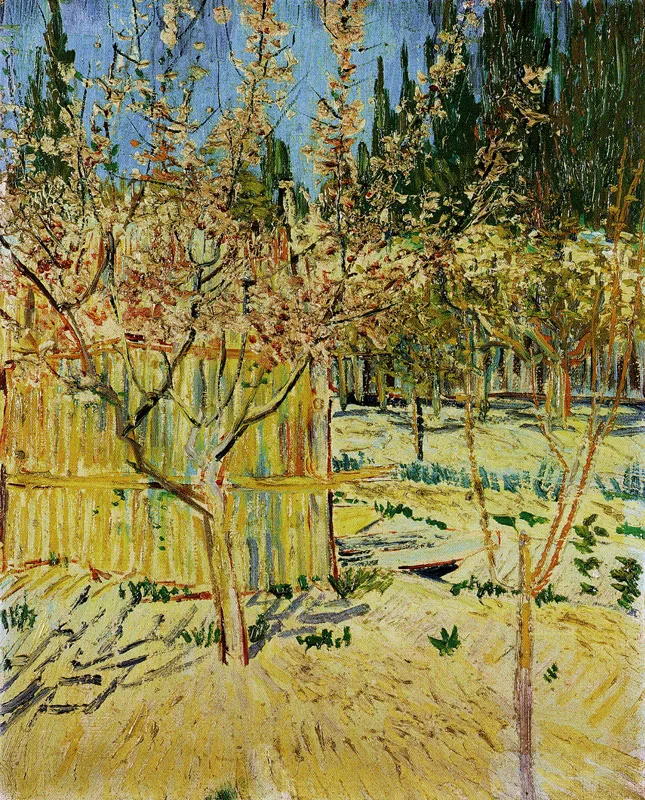
This canvas, painted in 1888 and measuring 33 by 41 centimetres, belongs to that burst of work. Its modest size suits the task: a picture that could be started and largely settled in a single sitting, while the light and the flowers were still there to see.
A yellow fence, a young tree, and the sky behind it
The painting is built around one young apricot tree standing just off centre, its pale trunk forking into thin branches crowded with white and pink-tinged blossom. The tree fills most of the upper half of the canvas, its flowering crown pressed close to the picture plane so that the eye meets it before anything else registers.
Behind the tree runs a fence of rough yellow planking, set at a diagonal that cuts across the middle of the composition and anchors the loose tangle of branches above it. The fence is one of the few hard, straight-edged forms in the picture, a piece of built structure holding its own against the organic sprawl of the orchard.
Further back, a row of tall, dark cypress-like trees closes the view, and beyond the fence a second stand of blossoming trees continues the orchard into the distance. A slender young sapling with a pale trunk stands to the right of the main tree, echoing its shape and repeating the theme in miniature.
Patches of clear blue sky show through the gaps in the branches at the top of the canvas, cool and flat against the warmth of the blossom and the ochre ground below. The earth itself is dry and pale gold, scored with long shadows and small tufts of green grass pushing up between the furrows.
Brushwork built for speed
The blossom is laid on in short, loaded touches of white, cream and pale pink, dabbed rather than blended, so that each cluster of flowers reads as a scatter of individual marks rather than a smooth mass. Seen up close, the branches themselves are little more than dark, wiry lines dragged quickly across the paint beneath them.
The fence is handled differently, in longer, more deliberate strokes of yellow and ochre that follow the direction of the planking. This is one of the few passages where van Gogh slows down, and the contrast with the flicked, urgent marks of the blossom above it is easy to feel even in reproduction.
Across the ground, strokes of ochre, ash grey and pale blue cross and overlap to suggest packed earth and raking shadow, applied wet into wet in places so that colours mix slightly on the surface rather than on the palette. The paint is thin in some areas, letting the weave of the canvas show through, and thicker where the blossom catches the strongest light.
Nothing in the picture looks laboured. The whole surface carries the pace at which it was painted, a record of a hand moving quickly to fix a moment that everyone involved, painter and trees alike, knew would not hold.
What it does on a wall through the day
Hung where morning light can reach it, the picture leans warm, the ochre fence and ground pulling forward while the blossom seems to catch actual sunlight rather than painted white. Later in the day, as the room cools, the blue gaps in the branches read more strongly and the whole composition tips toward the sky rather than the earth.
It is a small picture, close in scale to a window, and it rewards being looked at from near enough to see the individual strokes separate into blossom, fence and shadow. That closeness is part of the point: this was painted at the speed of a season that would not slow down for anyone, and it still asks to be looked at quickly, before the light changes again.
Sizes and materials for Apricot Trees in Blossom are listed on its product page.
More from this collection
Bring this painting home
Choose a hand-painted oil reproduction for real brushwork, or an archival canvas print for a crisp museum-image edition. Every size preserves the original proportions.
View this work & options
Further reading
Verify the original in the collection record and continue through related works in the catalogue.