
Cypresses with Two Figures: Story, Meaning & Brushwork
In May 1889 Vincent van Gogh admitted himself to the asylum of Saint-Paul-de-Mausole, on the edge of Saint-Rémy-de-Provence. Within its walled garden, and in the fields and lanes beyond it, one shape kept drawing his eye back: the cypress, dark and upright against the Provençal sky.
He had already painted cypresses that June and felt he had not got them right. Writing to his brother Theo, he called the tree ‘as beautiful of line and proportion as an Egyptian obelisk’, and set out to master it as he once had the sunflower, until the subject belonged to him.
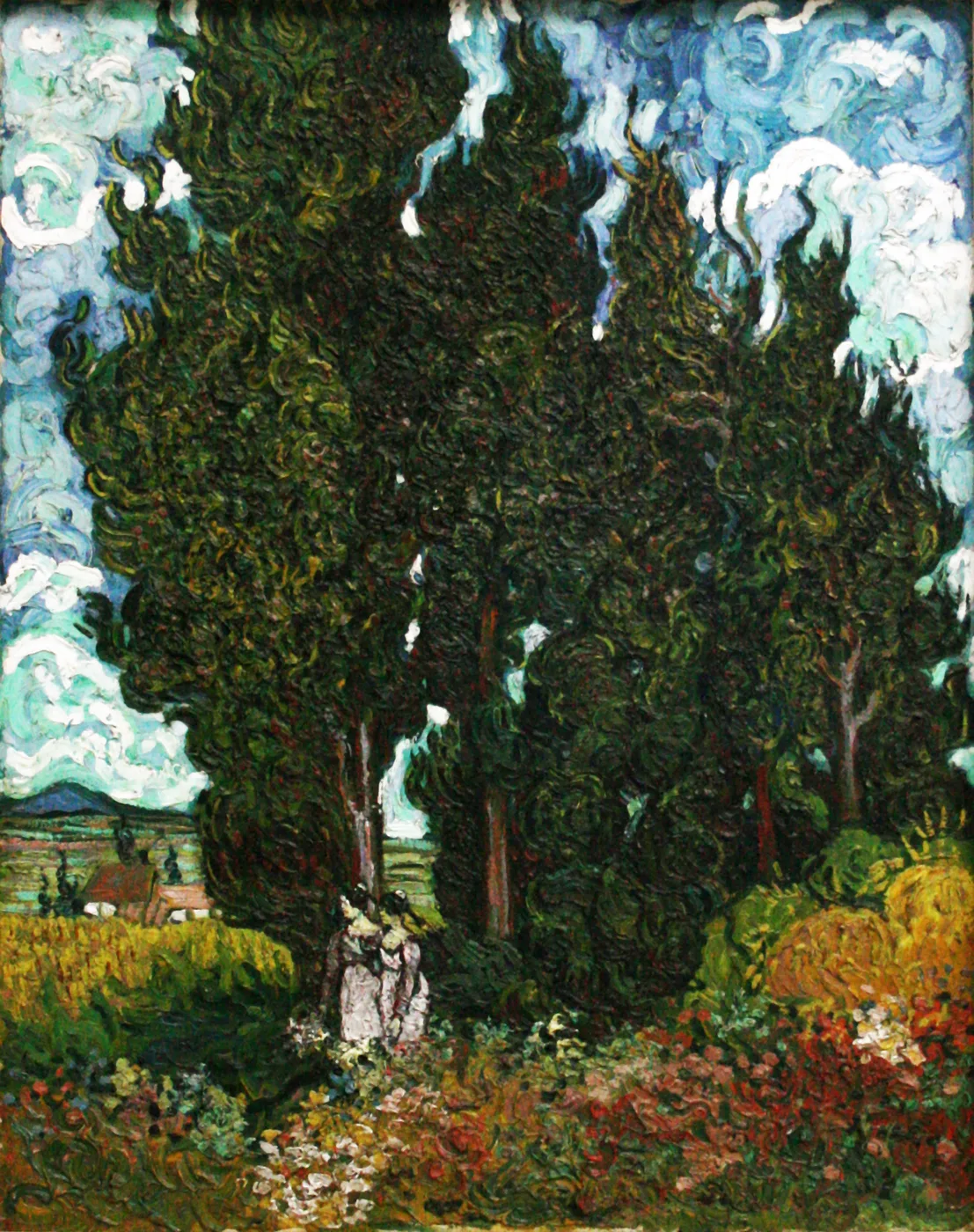
Cypresses with Two Figures, painted in 1889, was a second, more deliberate try at the same motif. Where his earlier cypress views were painted directly from nature, this one is generally understood as a studio reworking, built up from an existing study rather than made on the spot. It is now held by the Kröller-Müller Museum, one of the largest repositories of his work anywhere in the world.
A Second Attempt at the Cypress
By the time he returned to the subject, Van Gogh had spent months inside the asylum walls, painting the same limited stretch of garden, wheat field and hillside over and over. The cypress offered him something the wards could not: a form tall enough to fill a canvas from edge to edge, and wild enough in its outline to absorb whatever energy he had left to give it.
He wanted the tree to carry the same weight in his work that the sunflower had. That ambition shows in how much space it is given here: the trees are not a backdrop to a landscape but the landscape’s entire subject, with everything else, sky, field, figures, arranged around them.
Two Walkers Beneath a Green Flame
Two cypresses climb the full height of the canvas, measured at 73 by 92 centimetres, their dark, twisting bulk set against a sky broken into curling ribbons of white and pale turquoise. Van Gogh gave the trees no single clean outline; each is built from short strokes pushing upward and sideways at once, so the mass reads as something still moving rather than foliage fixed in place.
At the foot of the trees, small against their scale, two women in pale dresses walk together, seen from behind and already half swallowed by the undergrowth. They do not look up at the cypresses or at each other. The picture makes no claim about who they are; it simply lets them pass through.
To the left, a stretch of yellow wheat runs toward a low farmhouse and a line of blue hills. To the right, golden stooks and a mass of yellow foliage close the composition. Underfoot, a bed of red, pink and white flowers is laid down in short dabs of colour, echoing the same restless rhythm as the clouds above.
Paint Handled Like Weather
Van Gogh worked the paint quickly and wet, dragging the brush in short arcs that change direction stroke by stroke. The same curling movement he used for the clouds reappears in the cypress needles and in the flowers underfoot, so the whole canvas pulses to one rhythm rather than several.
The green of the trees is not a single colour. It shifts through near-black, olive and a bright acid tone wherever a branch catches light, built in overlapping passes rather than mixed smooth on the palette. Against that density, the sky is handled more loosely, in longer sweeping strokes of white and blue-green that read as wind moving through cloud.
Colour, more than line, carries the picture’s charge. The cool blues and whites of the sky are set against the warm reds and yellows of the flowerbed and the wheat field, so the eye keeps travelling between the two temperatures instead of settling on either.
In a Room, as the Light Turns
Hung somewhere that gets any daylight, the painting changes through the day. Morning light picks out the pale dresses of the two walkers and the white curls in the sky; by evening the greens deepen and the trees read almost as one dark silhouette against a fading blue.
Seen from across a room, the cypresses hold the eye first, tall enough to dominate a wall much as they were painted to dominate a field. Only on a closer look do the two figures and the flowers at their feet emerge, a slower discovery that keeps the image from being used up in one glance.
It suits a spot where someone actually pauses: a hallway that catches changing light, a study wall opposite a window, a bedroom seen last thing before dark. The painting does not offer itself all at once. It asks to be looked at again the next time the light is different.
Sizes and materials for Cypresses with two figures are listed on its product page.
More from this collection
Bring this painting home
Choose a hand-painted oil reproduction for real brushwork, or an archival canvas print for a crisp museum-image edition. Every size preserves the original proportions.
View this work & options
Further reading
Verify the original in the Kröller-Müller Museum collection record and continue through related works in the catalogue.