
Irises: Story, Meaning & Brushwork
In May 1889, Vincent van Gogh entered the asylum of Saint-Paul-de-Mausole at Saint-Rémy-de-Provence, seeking shelter after the crises of the previous winter in Arles. He had asked to be admitted himself. Painting was one of the few activities the doctors allowed him, and the walled grounds of the asylum, overgrown and untended in places, gave him a garden to work from almost as soon as he arrived.
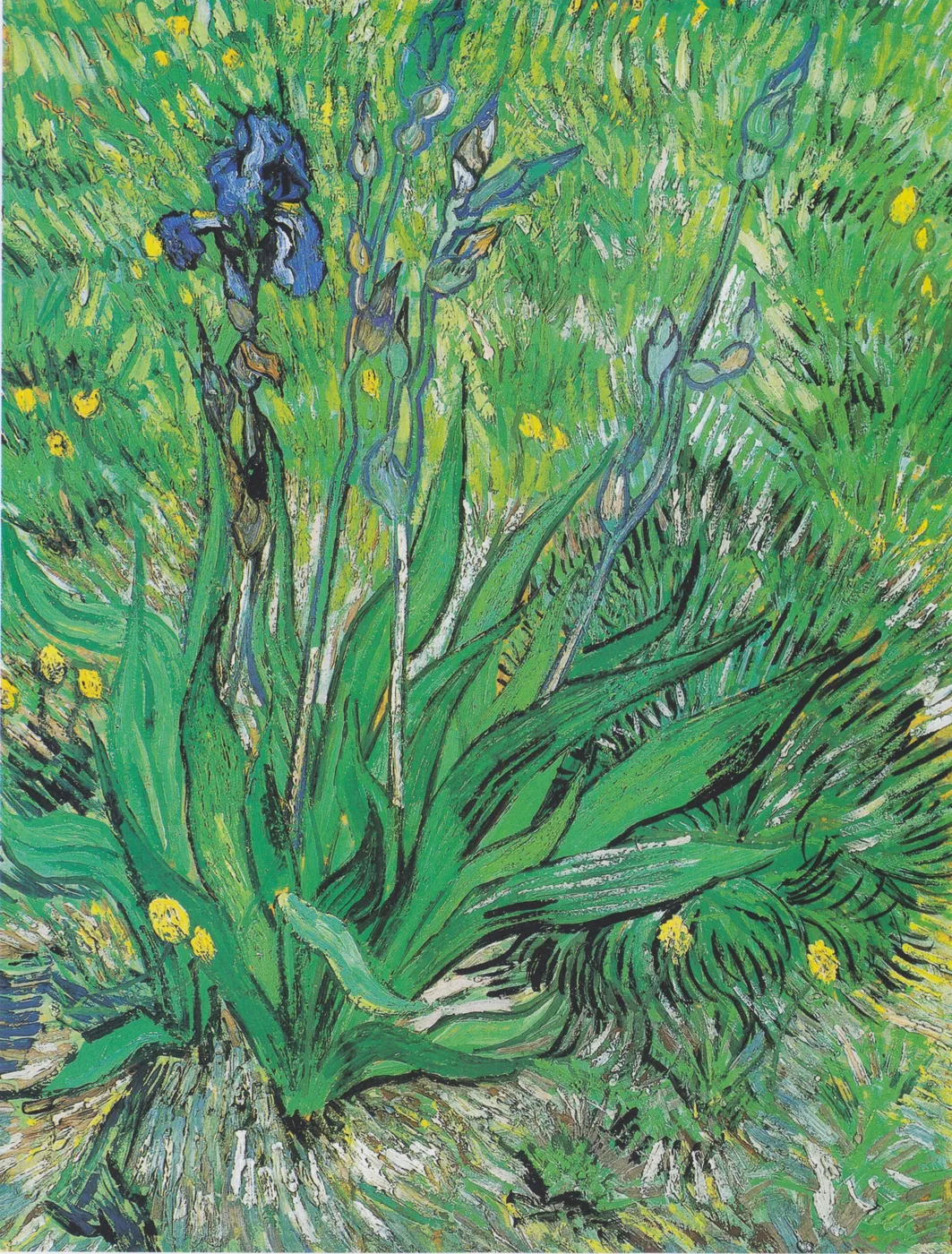
Among the first things he painted there was a single iris plant, close to the ground, caught mid bloom. He titled it simply Iris. It has none of the grand sweep of a border in flower; it is one plant, studied the way a portrait painter studies a face.
One Plant Singled Out from the Grass
The canvas holds a single iris rising from a low clump of blade-shaped leaves, its stem lifting one open flower toward the upper left of the picture. The bloom is a deep blue-violet, its falls turned down and its ruffled petals catching what light there is. Around it, still closed, are a handful of slender buds in grey-green sheaths, waiting their turn.
Van Gogh gives the plant room to be itself. The leaves curve and cross in loose fans, some pale and silvered where the light hits the surface, others a deep, almost black-green in shadow. There is no vase, no cut stem, no interior room; the iris is left growing exactly where he found it.
Small yellow flowers, likely dandelions, dot the grass around the base of the plant, no bigger than a flick of the brush. They keep the eye moving through the lower half of the canvas before it settles again on the single violet bloom at the top.
A Field of Green with One Note of Colour
There is no sky in this picture and no horizon. The whole ground is grass, rendered in short, dashed strokes of green in a dozen different values, from acid yellow-green in the light to a near-black green in the shade beneath the leaves.
Against that field, the blue-violet of the iris is the only cool, saturated colour in the painting, and it carries the whole composition. The eye finds it first, however dense the greenery, because nothing else on the canvas holds that weight of colour.
The dimensions, 48.3 by 62.2 centimetres, keep the plant close to life size. Standing in front of it is less like looking at a landscape and more like kneeling down at the edge of a flowerbed.
Drawing First, Paint Second
Van Gogh had been studying Japanese woodblock prints for several years by 1889, and their mark is plain in how this iris is built. Each leaf is drawn with a firm, continuous line before colour is laid inside it, the outline doing as much work as the paint.
The grass behind has no such outline. It is built instead from short, repeated strokes that read as texture rather than drawing, so that the iris, with its clean contours, sits forward from the field behind it almost like a shape cut out and laid over a woven ground.
This contrast between drawn plant and dashed grass gives the painting its structure. Without it, the picture could dissolve into a single mass of green; with it, the eye always knows which lines belong to the flower and which belong to the meadow around it.
Made in a Difficult Year
1889 was one of the hardest years of Van Gogh’s life and also one of his most productive. Admission to Saint-Rémy followed the breakdown that had ended his time in Arles, and for much of the year he worked between spells of illness, painting whenever he was well enough to be given materials.
The garden gave him a subject he could return to day after day without leaving the grounds. A single iris, studied closely and repeatedly, suited those conditions: contained, close at hand, and demanding the sort of concentration that left little room for anything else.
The painting now held by the National Gallery of Canada is one result of that close attention, made within his first weeks at Saint-Rémy, when the asylum garden was still new to him and everything growing in it was worth setting down.
On a Wall, as the Light Changes
Hung in a room with shifting daylight, the painting behaves differently through the day. Early or late, when the light is warm, the greens pull toward yellow and the iris reads darker and more inward. In flatter, cooler light the blue-violet of the flower comes forward and the grass settles into a calmer, more even field.
It rewards being looked at up close, the way Van Gogh looked at the plant itself: leaf by leaf, stroke by stroke, one bloom picked out from everything growing up around it.
Sizes and materials for Iris are listed on its product page.
More from this collection
Bring this painting home
Choose a hand-painted oil reproduction for real brushwork, or an archival canvas print for a crisp museum-image edition. Every size preserves the original proportions.
View this work & options
Further reading
Verify the original in the National Gallery of Canada collection record and continue through related works in the catalogue.