
Orchards in Blossom, View of Arles: Story
By the spring of 1889, Vincent van Gogh had lived in Arles for barely a year, and the year had very nearly finished him. The town had given him the harsh southern light he had come south chasing, but it had also brought the breakdown of December 1888, weeks in the Arles hospital, and a return home that a group of his neighbours petitioned against that March. When the orchards on the edge of town came into blossom regardless, he went out and painted them, working fast in the weeks before he left Arles for the asylum at Saint-Rémy-de-Provence.
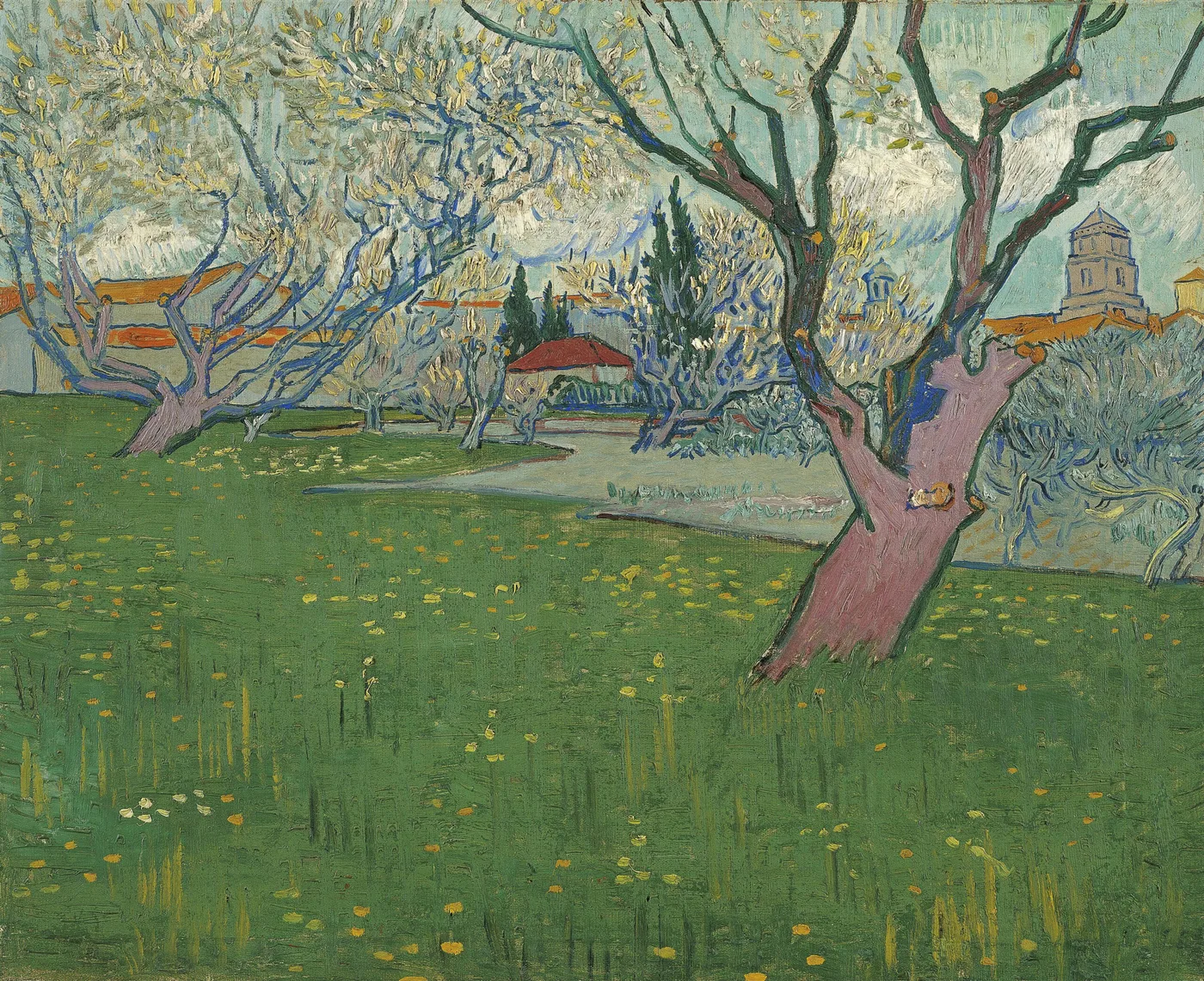
Orchards in Blossom, View of Arles is one result of those weeks: a meadow at the town’s edge, two blossoming trees planted close to the eye, and the rooftops of Arles held at a careful distance behind them.
A Fragile Spring
Van Gogh had painted orchards once already, in the spring of 1888, when blossom season became something close to a private ritual: a dozen or more canvases in a few weeks, worked fast because the flowers would not wait. By 1889 the same subject carried a different weight. His hold on the life he had built in Arles was slipping, and the fields beyond the town were among the few places still open to him.
He worked outdoors, directly in front of the motif, in the manner he had defended for years against the convention of finishing pictures in the studio. The result is not a calm rehearsal of a familiar view. It is an orchard seen quickly, under a changeable sky, by a man who had good reason to look hard at whatever was still in front of him.
Trees Set Close, a Town Held Back
The painting is built in three bands. Nearest the viewer, a meadow of coarse green strokes runs the full width of the canvas, scattered with small dabs of yellow dandelion and a few flecks of white. Two blossoming trees rise directly out of this grass, their trunks a startling grey-mauve, thick and gnarled, set just off-centre so that one is cropped by the top edge of the canvas.
Above the trunks, the branches fork into a fine dark web, and it is this web, not the trunk, that carries the blossom: clusters of white and pale cream, dabbed on rather than drawn, catching what light there is in the sky behind them. A second, older tree stands further back and to the left, its blossom thinner, its shape more bent by wind.
Between the trees and the town, a pale road curves through the middle distance, past low buildings with orange-red tiled roofs and a dark run of cypress. Arles itself sits at the far edge of the canvas, a cluster of rooftops and, to the right, a square church tower, all painted smaller and flatter than the trees so the eye reads them as background rather than destination.
Nothing in the picture asks to be looked at first. The eye lands on the near trunk, follows the branches up into the blossom, drops to the meadow, and only then travels back toward the town, roughly the order in which a person standing in that field would actually see it.
Paint Handled Two Ways
Van Gogh painted the blossom and the town in two distinct hands. The blossom is quick: short, loaded dabs of white, cream and pale blue, laid close together so the individual strokes read as flicker rather than settled form. Close up, the canvas is almost entirely texture at this point, ridges of paint standing proud enough to catch real light across their surface.
The trunks and branches are built differently, in longer, twisting strokes of violet, brown and grey that follow the actual turn of the wood. This is where the paint sits thickest, laid on in ropes close to full strength from the tube. The contrast between the loose blossom above and the heavy, muscular trunk below carries most of the picture’s structure.
Further back, toward the rooftops and the tower, the brush settles down. Strokes shorten, colour flattens into pale terracotta, grey-blue and green, and the paint layer thins considerably. Distance here is a matter of touch as much as of size or tone, the town painted the way something looks when a person’s attention has already moved on from it.
In a Room, Through the Day
Hung where morning light can reach it, the meadow and the blossom take the eye first, the small yellow dandelions picking up warmth from a low sun. As the light flattens later in the day, the mauve and grey trunks come forward and hold their own even in a duller room, while the distant town recedes further still.
The original, painted in 1889 and measuring 65 by 50 centimetres, is held by the Van Gogh Museum in Amsterdam. A reproduction close to that scale keeps the trunks near life size, which is what lets the picture work at close range: stand near it, the way Van Gogh stood near his easel in that field, and the blossom breaks apart into paint before it settles back into flowers as you step away.
Sizes and materials for Orchards in blossom, view of Arles are listed on its product page.
More from this collection
Bring this painting home
Choose a hand-painted oil reproduction for real brushwork, or an archival canvas print for a crisp museum-image edition. Every size preserves the original proportions.
View this work & options
Further reading
Verify the original in the Van Gogh Museum collection record and continue through related works in the catalogue.