
Portrait of Adeline Ravoux: Story, Meaning & Brushwork
By May 1890 Vincent van Gogh had left the asylum at Saint-Remy and travelled north to Auvers-sur-Oise, a village on the Oise river within easy reach of his brother Theo in Paris. He took a room at the inn run by Arthur-Gustave Ravoux, on the town square, and worked at a pace that still startles anyone who counts the canvases against the calendar. In the roughly ten weeks he had left, he painted the wheatfields above the village, the church, the doctor who was treating him, and the people of the inn where he ate and slept.
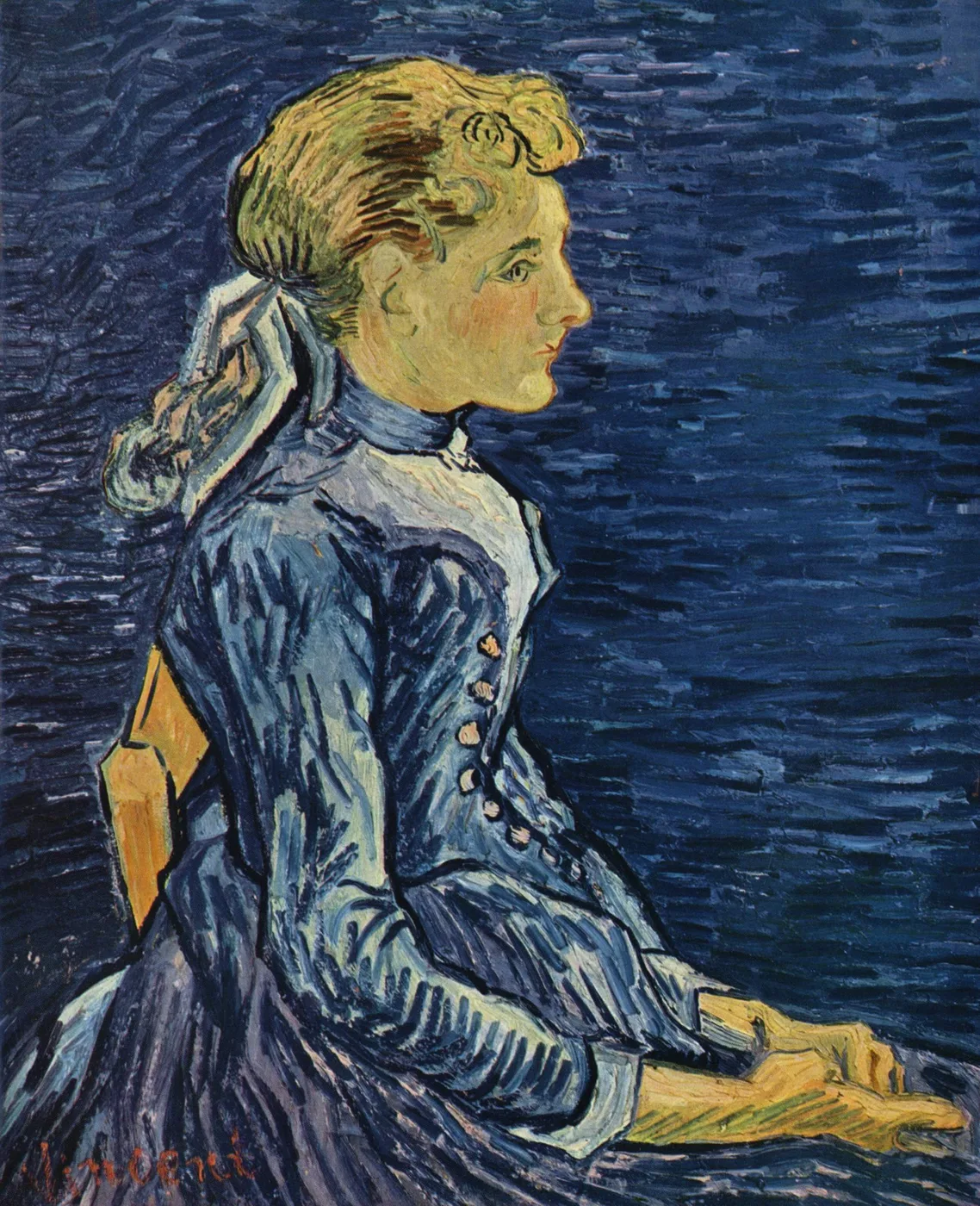
Adeline Ravoux was the innkeeper’s thirteen-year-old daughter, and she sat for Van Gogh in his last weeks of work. He painted her more than once that summer, but this is the version in profile, and it is the one that keeps her at a distance even as it studies her closely. The picture is dated 1890 and measures 55 by 67 centimetres, a modest scale that suits a portrait made at close quarters in a rented room.
A Sitting Held in Profile
Adeline is turned fully to her right, so that the painting gives us her forehead, nose and chin in a single unbroken line and nothing of her other eye. It is a pose that asks nothing of the sitter beyond stillness, and it gives the artist a face reduced to its essential planes.
She wears a dark blue jacket buttoned to the throat over a pale collar, her fair hair drawn back and tied with a ribbon that falls in a loose knot at the nape of her neck. One arm bends behind her back, the elbow just visible at the left edge of the canvas; the other rests on a surface at the lower right, the hand loosely open as if she has just set something down.
There is no furniture to speak of, no window, no clue to the room itself. Van Gogh has stripped the setting down to the girl and the wall behind her, so that the whole painting reads as an encounter between one face and one field of colour.
Cobalt Ground, Ochre Face
The background is blue from edge to edge, but it is not one blue. Van Gogh worked it in long diagonal strokes, some near navy, some closer to slate, so that the wall seems to ripple rather than sit flat behind the sitter, closer to moving water than to plaster.
Against that ground, the girl’s jacket is painted in a second, cooler register of blue, violet-tinged where it falls into shadow along her back. The two blues sit close enough in tone that the figure could almost dissolve into the wall, and it is the collar and the skin that pull her back out of it.
Her face and neck are built from warm ochre and rose, a heat that has no other source in the picture. It is the one passage of warmth in a painting otherwise given over to cold colour, and the eye goes there first, then to the small orange flourish of the artist’s signature at the lower left, the only other warm note on the canvas.
The Marks Left by the Brush
Look closely and the picture is not blended in any conventional sense. Van Gogh laid the blue ground in directional strokes that all run the same way, a technique that turns a flat wall into something with visible current and weight.
The jacket is built the same way, in strokes that follow the fall of the fabric down her back, thick enough in places that the paint still holds its ridge. Only the face is handled more gently, with shorter, more careful touches around the eye and the line of the nose, as though the sitter’s stillness earned a different kind of attention than the wall did.
Nothing here is smoothed for effect. The buttons on the jacket are a few dabs of pale paint, the hand at the lower right barely more than a shape in ochre, and the picture depends on the viewer standing back to let those quick marks settle into a coherent figure.
The Painting in a Room
Hung on a wall, this portrait behaves differently from a picture with a horizon or a window, because it has no other light source to answer to. Its blues shift with whatever daylight or lamp falls across the room, sometimes reading as near-black, sometimes lifting to a clear, cold marine colour.
What stays constant is the girl’s profile and the warmth of her face against all that cold, a single held note in a painting built almost entirely from one colour worked in a dozen different ways. It rewards a second look more than a first, which is exactly the kind of picture worth living with.
Sizes and materials for Portrait of Adeline Ravoux are listed on its product page.
More from this collection
Bring this painting home
Choose a hand-painted oil reproduction for real brushwork, or an archival canvas print for a crisp museum-image edition. Every size preserves the original proportions.
View this work & options
Further reading
Verify the original in the collection record and continue through related works in the catalogue.