
Street in Auvers-sur-Oise: Story, Meaning & Brushwork
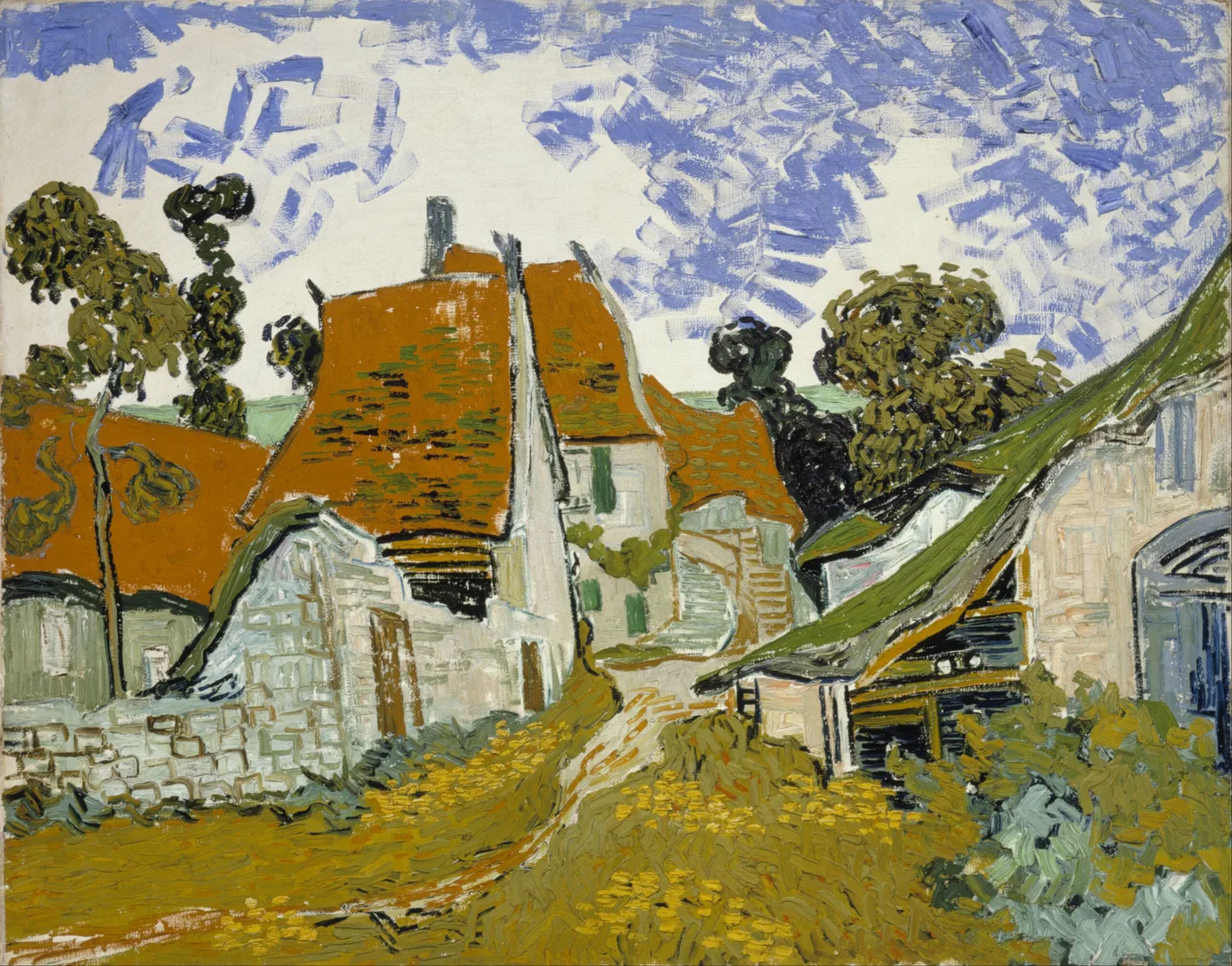
Vincent van Gogh reached Auvers-sur-Oise on 20 May 1890, stepping off the train from Paris after a year shut inside the asylum at Saint-Rémy. He took a room above the Ravoux inn, arranged to be seen weekly by Dr Paul Gachet, and within days was out painting again, often twice a day. Street in Auvers-sur-Oise belongs to that burst of work, one of the village views he made in his last ten weeks of life.
A Village Reopened to Him
After the confinement of Saint-Rémy, Auvers gave Van Gogh streets he could walk, gardens he could stand in front of, and rooflines he could study from a dozen angles without asking anyone’s leave. He painted the town almost daily that summer, moving from thatched farmhouses to the church to the wheatfields on the plateau above.
This canvas measures 92.5 by 73.5 centimetres, a substantial size for work produced at this pace. It shows a street he clearly returned to look at hard, not a scene dashed off in passing.
The picture carries none of the turmoil later readings sometimes project onto his final weeks. It is a record of close, steady attention to an ordinary corner of the village.
Down the Lane
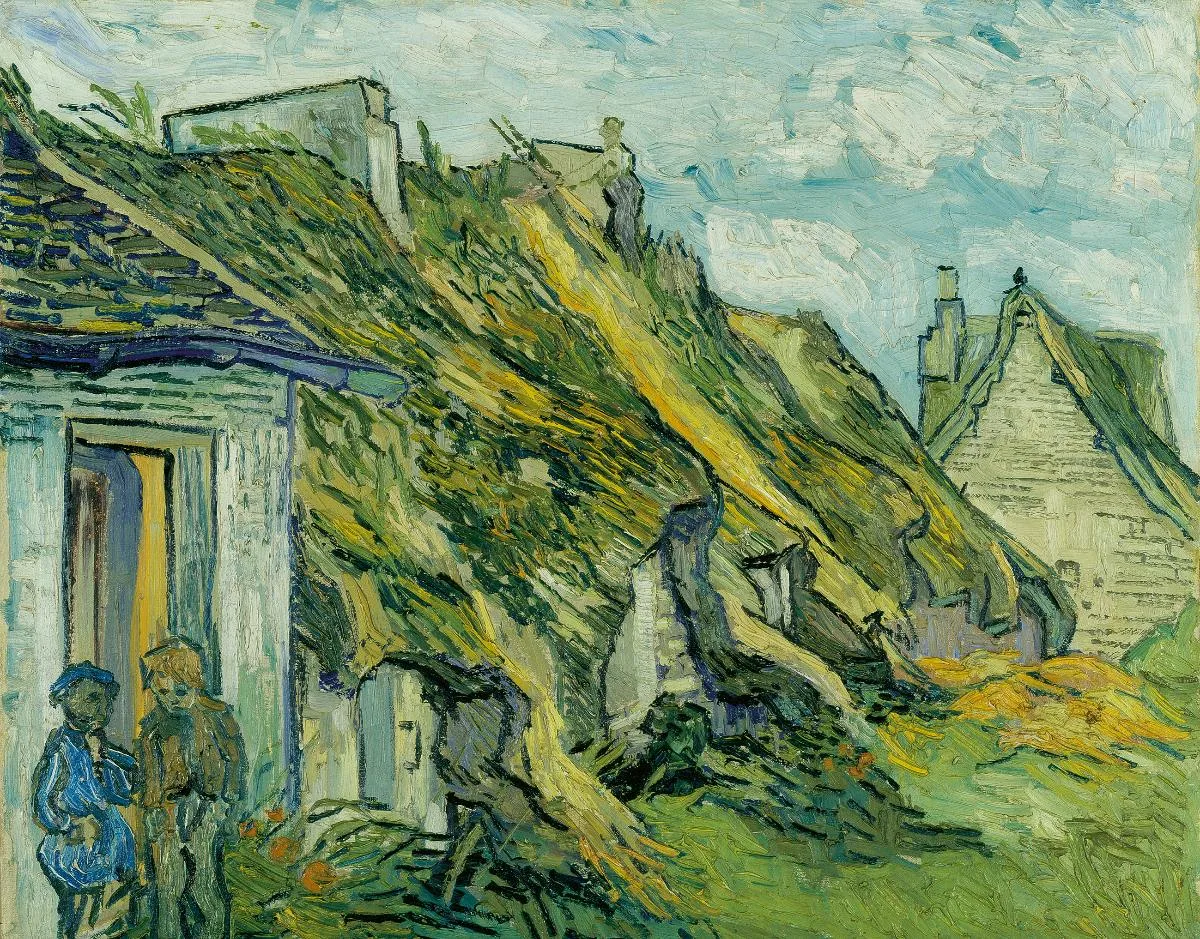
A dirt lane drops on a steep diagonal from the lower right of the canvas toward a cluster of houses at its centre, then vanishes behind them. The eye follows that slope automatically, drawn by the run of yellow and ochre strokes marking the track underfoot.
A tall house with a steep, dark-orange tiled roof and a narrow chimney stands almost at the centre of the composition, flanked by lower whitewashed buildings with grey stone footings and small green-shuttered windows. To its right, a wide roof of weathered green tilts down toward the viewer, its ridge catching the last of the structure’s geometry before the eye reaches the open gateway beneath it.
Trees stand sentinel on both sides, their foliage built from dense, looping strokes of dark olive and black-green, heavier and more shadowed than anything else in the scene. Beyond the rooftops, a thin strip of pale green hillside is just visible, the only hint of the wider Auvers countryside beyond this one street.
The foreground bank is given over to grass and low scrub, worked in short, flicking touches of yellow, ochre and sage that read, from a step back, as sunlit growth rather than individual blades. A low stone wall built of rough grey blocks anchors the bottom left corner, one of the few passages in the painting where the brush slows down.
Sky in Motion, Ground at Rest
The upper third of the canvas is sky, and it is the most restless part of the whole picture. Van Gogh laid in broad, angled strokes of violet-blue and near-white, all pulling in roughly the same diagonal direction, so that the sky seems to be moving even though nothing in it is a cloud in any conventional sense.
Against that current, the orange and rust-red roofs sit as a deliberate counterweight. Orange and blue are near-opposites on the colour wheel, and Van Gogh knew exactly what placing them side by side would do: each pushes the other to look more intense than it would alone.
The walls of the houses are kept comparatively quiet, pale greys, creams and dull whites applied in flatter patches, so that the roofs and sky can carry the picture’s energy without the whole surface competing for attention. Green appears throughout, in the shutters, in the tree canopies, in the long roof on the right, tying the upper and lower halves of the composition together.
Up close, almost nothing in this painting is a flat area of colour. Even the stone wall and the pale house fronts carry visible ridges of paint, laid on quickly and left to hold their own edges rather than being smoothed flat.
Where the Painting Lives Now
Street in Auvers-sur-Oise is held today by the Finnish National Gallery, one of the relatively few paintings from Van Gogh’s final weeks to have found a permanent home outside France or the Netherlands. Its presence there means visitors encounter this particular village lane far from the town where it was painted.
Seen in the flesh, the canvas rewards the kind of close looking Van Gogh himself was doing on that street in 1890, roof tile by roof tile, stroke by stroke.
On a Wall, Through a Day
Hung where daylight reaches it, the painting shifts more than most. Morning light tends to sharpen the diagonal pull of the sky strokes, while a dimmer room in the evening lets the orange roofs settle into the composition’s quieter centre of gravity.
What stays constant is the pull of that lane, a street the painter walked and looked at hard enough to leave, in the space of one canvas, a record of exactly where the light fell and where his hand moved fastest.
Sizes and materials for Street in Auvers-sur-Oise are listed on its product page.
More from this collection
Bring this painting home
Choose a hand-painted oil reproduction for real brushwork, or an archival canvas print for a crisp museum-image edition. Every size preserves the original proportions.
View this work & options
Further reading
Verify the original in the Finnish National Gallery collection record and continue through related works in the catalogue.