
Sunflowers (Munich Version): Story, Meaning & Brushwork
Arles, August 1888
By the summer of 1888 Vincent van Gogh had been living in the Yellow House in Arles for several months, working towards an idea that mattered to him more than almost anything else: a house of artists, a shared studio in the south, built around the promise that Paul Gauguin would soon come to join him.
Sunflowers were in season along the roads outside the town, and van Gogh began buying them by the armful, carrying them back to paint before they wilted. He worked at a pace he described that summer as the enthusiasm of a man from Marseille eating bouillabaisse, and by August he had several sunflower canvases underway at once.
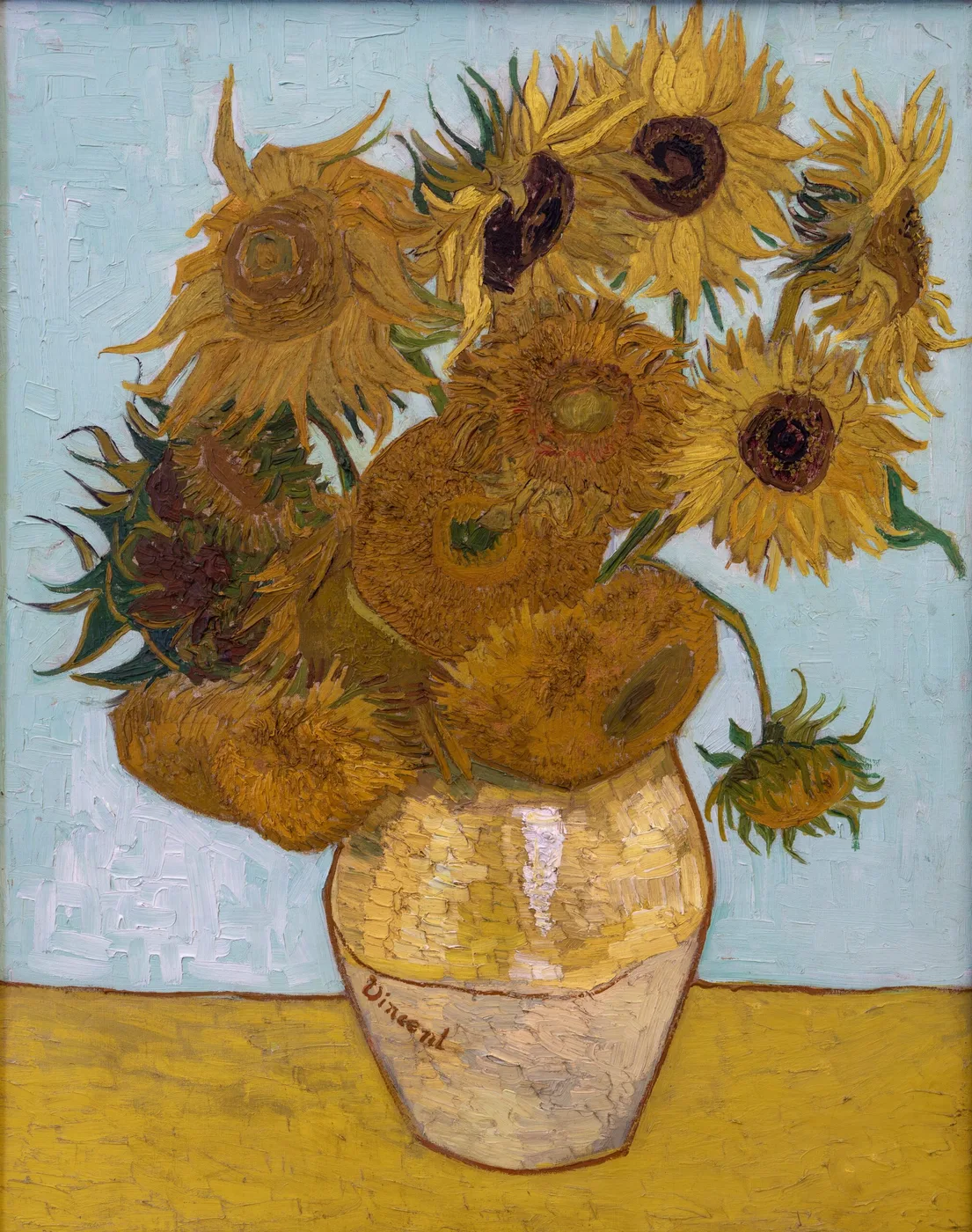
He meant them as decoration in the plainest sense, pictures for the walls of the room he was preparing for Gauguin, bright enough to hold their own in strong light and cheerful enough to say something about the welcome he intended. This canvas, known today as the Munich version, is one of that August group, painted in 1888 and measuring 73 by 92 centimetres.
Twelve Flowers, Every Stage of a Life
The bouquet fills almost the whole canvas, a dozen sunflower heads crowded into a plain earthenware vase with barely any room left around them. Van Gogh was not painting a single, tidy arrangement so much as a whole life cycle laid out at once.
Some heads face the viewer directly, their petals fully open and their centres a deep, almost black brown ringed with rust and gold. Others turn in profile or hang forward on curved stems, heavy and past their best, the petals thinned and the seed heads gone dark and dense.
A few flowers near the top still carry the loose, ragged energy of new bloom, petals splayed at odd angles as though caught moving. The variation is the point: in one vase, van Gogh set out youth, fullness and decay side by side, and painted each with equal attention.
A Narrow Band of Blue, a Field of Yellow
The setting is reduced to almost nothing. Behind the flowers, van Gogh laid a pale, chalky blue-green, brushed on in short crossing strokes that leave the wall looking scumbled and slightly unsettled, never a flat, dead colour.
Below, a band of ochre yellow stands in for a table or ledge, close in tone to the flowers themselves, so the boundary between bouquet and surface reads more as a change in brushwork than a change in colour. The vase sits at the meeting point of the two, a pale cream ochre catching the most direct light in the whole picture.
Van Gogh signed the vase itself, in red lettering along its widest point, simply Vincent, the way he signed most of his mature work. It sits low in the composition, almost part of the pot’s own decoration rather than a label added afterwards.
Paint Thick Enough to Cast Its Own Shadow
Up close, the flowers are built from paint laid on thickly, in short, loaded strokes that stand proud of the canvas. Petals are single strokes of pure colour, yellow against yellow against ochre, with barely any blending between one and the next.
Around each flower head van Gogh drew a firm, dark contour, a line rather than a shadow, which is what lets the crowded bouquet stay legible from across a room even though the colour range is so narrow. Without those outlines the heads would run together into a single mass of gold.
The vase and table are handled more calmly, with longer, flatter strokes, so the eye has somewhere to rest before returning to the turbulence of the flowers above. It is a picture built almost entirely from variations on one colour, yet it never reads as monotonous, because the paint itself keeps changing direction, thickness and pace.
On a Wall, Through the Day
The original hangs today in the collection of the Bavarian State Painting Collections in Munich, but the qualities that make it work were suited from the start to exactly the kind of domestic wall van Gogh had in mind when he painted it: a room with changing daylight, not a fixed gallery spot.
In direct light the impasto throws its own small shadows across the petals, and the yellows sharpen. Later in the day, in softer light, the blue-green ground comes forward and the flowers settle into a warmer, quieter register.
That is part of why the picture has stayed so recognisable for well over a century: it was never painted to be looked at once. It was painted to be lived with, on a wall a person passes every day, changing very slightly each time the light does.
Sizes and materials for Sunflowers (Munich version) are listed on its product page.
More from this collection
Bring this painting home
Choose a hand-painted oil reproduction for real brushwork, or an archival canvas print for a crisp museum-image edition. Every size preserves the original proportions.
View this work & options
Further reading
Verify the original in the Bavarian State Painting Collections collection record and continue through related works in the catalogue.