
The Sower (Version III): Story, Meaning & Brushwork
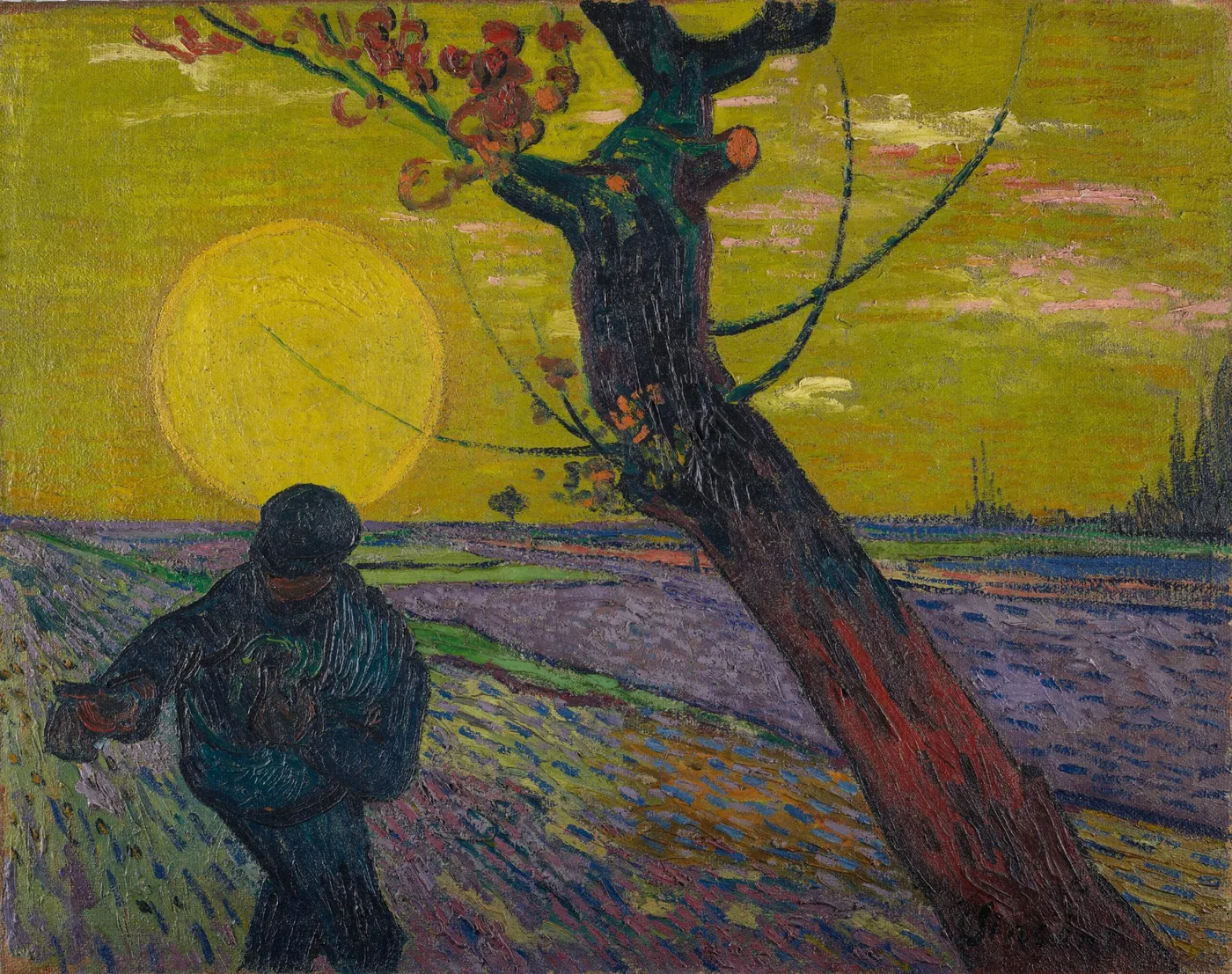
Vincent van Gogh painted the sower more than once in 1888, and this is the version that refuses to let the subject sit quietly in the middle of the canvas. A huge, dark tree trunk cuts diagonally through the whole scene, crossing the horizon and slicing straight through the disc of the sun, so that the man scattering seed has to be found rather than simply looked at. The painting is catalogued as The Sower III, and it now hangs at the Kunsthaus Zürich, measuring 93 by 73.5 centimetres.
By 1888 Van Gogh had left Paris for Arles, drawn south by a light he felt the city had been starving out of his work. He rented rooms, painted at a pace that alarmed people who knew him, and found in the flat wheat country of the Rhône valley a landscape that matched subjects he had carried with him since his earliest years as an artist. Sowing was one of them, and it was not a new interest picked up for effect.
A Subject He Would Not Set Down
Van Gogh had drawn and painted sowers since his time in the Dutch countryside, well before Arles, long before the colour of the south entered his work. He returned to the theme so often that art historians count several distinct versions from 1888 alone, of which this canvas is one.
The debt to Jean-Francois Millet is direct and Van Gogh never hid it. Millet had painted peasants at work as figures worth serious attention, and Van Gogh took that conviction and pushed it further, turning a working figure in a field into something closer to a symbol of endurance and renewal.
What kept him coming back was not technical curiosity but belief. A man throwing seed onto ground he may never see harvested carried, for Van Gogh, an almost devotional weight, labour performed on trust rather than certainty.
The Tree That Blocks the Sun
The sower himself is small and dark, planted in the lower left corner of the canvas, mid-stride, his arm swung out to release the next handful of seed. He is built from a few economical strokes, a silhouette against the field rather than a figure picked out in detail.
Behind him the ground is laid down in bands of violet, blue and ochre, worked with short diagonal strokes that follow the direction of ploughing rather than describing individual furrows. It reads as freshly turned earth seen at speed, not studied at leisure.
Above all this stands the tree. Its trunk rises from the bottom edge of the canvas at a steep angle, painted in near black with streaks of deep red showing through the bark, and one flowering branch reaches out across the upper half of the sky, hung with small red and orange blossom. It is an almond or fruit tree caught between seasons, blooming while a man sows below it.
The sun sits low, a flat disc of pale gold hanging just above the horizon, partly hidden behind the trunk. It gives the whole upper half of the painting its colour without acting as a conventional light source, closer to a second, quieter subject than to a backdrop.
Colour Doing the Work of Light
The sky is chrome yellow shading toward green, streaked with pink and white where clouds have been dragged across it in loaded strokes. Van Gogh set that yellow against the violet of the field, a pairing of complementary colours he used deliberately, so that neither passage sits still against the other.
The brushwork throughout is thick and visibly directional. Strokes in the sky curve and loop around the tree’s branches, strokes in the field run in short diagonal dashes, and the trunk itself is built from long vertical drags of near black paint that let red show through at the edges like exposed heartwood.
Nothing here is rendered for topographical accuracy. The colour is pitched higher than anything the eye would actually meet in a Provencal field at dusk, because Van Gogh was recording feeling and structure ahead of appearance, and by 1888 he trusted that instinct completely.
On a Wall, In Changing Light
Reproduced at scale, the painting keeps the disorientation that makes the original memorable, that first moment of hunting for the sower behind the trunk before the rest of the composition falls into place. It rewards a second and third look rather than giving everything away at once.
Under warm evening light the yellows in the sky pick up and seem to advance off the wall, while the violet field recedes, an effect that shifts through the day as the room’s own light changes. It is a painting that behaves differently in the morning than it does at dusk, which suits a subject built entirely around the passage of a sun across a field.
Sizes and materials for The Sower (Version III) are listed on its product page.
More from this collection
Bring this painting home
Choose a hand-painted oil reproduction for real brushwork, or an archival canvas print for a crisp museum-image edition. Every size preserves the original proportions.
View this work & options
Further reading
Verify the original in the Kunsthaus Zürich collection record and continue through related works in the catalogue.